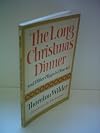
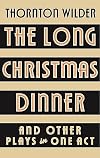
The Long Christmas Dinner and Other Plays in One Act
by Thornton Wilder
On This Page
Description
A collection of six short plays by one of the greatest American playwrights of the 20th century. Renowned for his masterful gift for revealing the miraculous in the seemingly mundane, these short plays showcase Thornton Wilder's ability to examine American life, death, and all the mysteries therein with warmth, humor, and grace. This collection includes The Long Christmas Dinner, Queens of France, Pullman Car Hiawatha, Love and How to Cure It, Such Things Only Happen in Books, and The Happy show more Journey to Trenton and Camden. show lessTags
Recommendations



















Member Reviews
12 Books of Christmas
#5 Time
Christmas stories proliferate. Christmas songs keep growing in number. Even Christmas movies – even ones you might list as all-time favorites without embarrassment – may be in the double digits by now (Scrooge, It’s a Wonderful Life, Miracle on 34th Street. The Christmas Gift, Winter Wonderland, Holiday Inn, and from tv, Charlie Brown’s Christmas, How the Grinch Stole Christmas, Rudolf the Red-Nosed Reindeer, and maybe The Nightmare Before Christmas and National Lampoon Christmas Vacation.
But what, please tell me, is the best Christmas play? Now that’s a tough question, isn’t it?
I can think of only one – a short one-act play, first published in 1931; but it is good enough to make up for all show more the rest that are missing. It is Thornton Wilder’s Long Christmas Dinner. It was first published in a little book of one-act plays, well before Wilder achieved a dramatist’s fame with Our Town and The Skin of Our Teeth, and shortly after his masterful novel, The Bridge of San Luis Rey had brought him to the attention of the reading public. I also have a little paperback edition (Avon, 1980), introduced by the theater historian, critic, and anthologist John Gassner.
“Time is telescoped in The Long Christmas Dinner,” he says, “so that ninety years of family life flow through the play without interruption in a sequence of merging scenes.”
The conversation at Christmas dinner goes on and on. “Have a little more white meat.” “Such a good sermon.” “. . . is suffering from his rheumatism.” “I never told her how wonderful she was.” Babies in perambulators are wheeled in through the flowery door at the extreme left; actors age before us and depart quietly through a black velvet portal to their right. In some twenty minutes we experience the lives of three generations of the Bayard family. The dialogue and the action are perfectly simple, perfectly natural, cheerful but sometimes sad.
“Sh, mother. . . . You mustn’t be depressed.”
“But sad things aren’t the same as depressing things. I must be getting old; I like them.”
“Uncle Brando, . . . . some cranberry sauce.”
As Gassner says in his introduction, “. . . the author’s imaginative management of time is simple and persuasive. We feel as though we be floating in the flux of life and time itself, in a broad and never-ending stream which is both ‘real’ and ‘unreal.’ We move ahead and are nevertheless becalmed by the sameness of the things that ultimately matter most to us, the quotidian realities that underlie the course of nations and even the ardors and endurances of men and women celebrated in history, saga, and high tragedy. And the marvel is that this effect of simplicity was achieved by the author with some of the most sophisticated strategies of dramaturgy within the competence of modern theatrical art.”
“Is she actually in pain dear?”
“Oh, she says it’ll be the same in a hundred years!”
“Yes, she’s a brave little stoic.”
“Come now, a little white meat, Mother? – Mary, pass my cousin’s plate.”
I first saw this play performed – and you must see it performed to truly appreciate it – by an amateur group at a Unitarian Universalist Church. It was as effective as if it had been done by professional actors on Broadway.
Wilder’s writing works that way.
“A play is what takes place,” Wilder explained. “A novel is what one person tells us took place. A play visibly represents pure existing.”
Plays are pretensions, he insisted, but the reality represented on the stage is “a series of signs which the spectator interpret[s] and remember[s] in his own mind.” That’s the way it was in the Greek theater; that’s the way it still is today.
There are five different – very different – plays in this little book. Long Christmas Dinner is the first one: The Happy Journey from Trenton to Camden is the last. Both illustrate Wilder’s remaking of American drama. Read them; see them; perform them. show less
#5 Time
Christmas stories proliferate. Christmas songs keep growing in number. Even Christmas movies – even ones you might list as all-time favorites without embarrassment – may be in the double digits by now (Scrooge, It’s a Wonderful Life, Miracle on 34th Street. The Christmas Gift, Winter Wonderland, Holiday Inn, and from tv, Charlie Brown’s Christmas, How the Grinch Stole Christmas, Rudolf the Red-Nosed Reindeer, and maybe The Nightmare Before Christmas and National Lampoon Christmas Vacation.
But what, please tell me, is the best Christmas play? Now that’s a tough question, isn’t it?
I can think of only one – a short one-act play, first published in 1931; but it is good enough to make up for all show more the rest that are missing. It is Thornton Wilder’s Long Christmas Dinner. It was first published in a little book of one-act plays, well before Wilder achieved a dramatist’s fame with Our Town and The Skin of Our Teeth, and shortly after his masterful novel, The Bridge of San Luis Rey had brought him to the attention of the reading public. I also have a little paperback edition (Avon, 1980), introduced by the theater historian, critic, and anthologist John Gassner.
“Time is telescoped in The Long Christmas Dinner,” he says, “so that ninety years of family life flow through the play without interruption in a sequence of merging scenes.”
The conversation at Christmas dinner goes on and on. “Have a little more white meat.” “Such a good sermon.” “. . . is suffering from his rheumatism.” “I never told her how wonderful she was.” Babies in perambulators are wheeled in through the flowery door at the extreme left; actors age before us and depart quietly through a black velvet portal to their right. In some twenty minutes we experience the lives of three generations of the Bayard family. The dialogue and the action are perfectly simple, perfectly natural, cheerful but sometimes sad.
“Sh, mother. . . . You mustn’t be depressed.”
“But sad things aren’t the same as depressing things. I must be getting old; I like them.”
“Uncle Brando, . . . . some cranberry sauce.”
As Gassner says in his introduction, “. . . the author’s imaginative management of time is simple and persuasive. We feel as though we be floating in the flux of life and time itself, in a broad and never-ending stream which is both ‘real’ and ‘unreal.’ We move ahead and are nevertheless becalmed by the sameness of the things that ultimately matter most to us, the quotidian realities that underlie the course of nations and even the ardors and endurances of men and women celebrated in history, saga, and high tragedy. And the marvel is that this effect of simplicity was achieved by the author with some of the most sophisticated strategies of dramaturgy within the competence of modern theatrical art.”
“Is she actually in pain dear?”
“Oh, she says it’ll be the same in a hundred years!”
“Yes, she’s a brave little stoic.”
“Come now, a little white meat, Mother? – Mary, pass my cousin’s plate.”
I first saw this play performed – and you must see it performed to truly appreciate it – by an amateur group at a Unitarian Universalist Church. It was as effective as if it had been done by professional actors on Broadway.
Wilder’s writing works that way.
“A play is what takes place,” Wilder explained. “A novel is what one person tells us took place. A play visibly represents pure existing.”
Plays are pretensions, he insisted, but the reality represented on the stage is “a series of signs which the spectator interpret[s] and remember[s] in his own mind.” That’s the way it was in the Greek theater; that’s the way it still is today.
There are five different – very different – plays in this little book. Long Christmas Dinner is the first one: The Happy Journey from Trenton to Camden is the last. Both illustrate Wilder’s remaking of American drama. Read them; see them; perform them. show less
Ratings
Members
- Recently Added By
Author Information

One of the most honored and versatile of modern writers, Thornton Wilder combined a career as a successful novelist with work for the theater that made him one of this century's outstanding dramatists. It was an early short novel, however, that first brought him fame. The Bridge of San Luis Rey (1927), a bestseller that won the Pulitzer Prize in show more 1927, is the story of a group of assorted people who happen to be on a bridge in Peru when it collapses. Ingeniously constructed and rich in its philosophical implications about fate and synchronicity, Wilder's book would seem to be the first well-known example of a formula that has become a cliche in popular literature. His attraction to classical themes is manifested in The Woman of Andros (1930), a tragedy about young love in pre-Christian Greece, and The Ides of March (1948), set in the time of Julius Caesar and told in letters and documents covering a long span of years. Heaven's My Destination (1934), is a seriocomic and picaresque story about a young book salesman traveling through the Midwest during the early years of the Great Depression.Theophilus North (1973), Wilder's last novel, disappointed many reviewers, but it provided its author with opportunities to offer some wry observations on the life of the idle rich in Newport during the summer of 1926 and to ponder in the story of his alter ego what might have happened if Wilder had stayed home, so to speak, instead of becoming Thornton Wilder. As a serious writer of fiction, Wilder's main claim rests on The Eighth Day (1967), an intellectual thriller, which the N.Y. Times called "the most substantial fiction of his career." It won the National Book Award for fiction in 1968. (Bowker Author Biography) show less
Some Editions
Series
Belongs to Publisher Series
Penguin Plays (PL92)
Work Relationships
Is contained in
Common Knowledge
- Canonical title
- The Long Christmas Dinner and Other Plays in One Act
- Original publication date
- 1931
- First words*
- The dining-room of the Bayard home.
I reckon we're ready now, Gertrude. - Last words*
- (Click to show. Warning: May contain spoilers.)Now I'll read a little.
(Click to show. Warning: May contain spoilers.)She finds a cane beside her, and soon totters into the dark portal, murmuring "Dear little Roderick and little Lucia." - Original language*
- English
*Some information comes from Common Knowledge in other languages. Click "Edit" for more information.
Classifications
Statistics
- Members
- 76
- Popularity
- 407,062
- Reviews
- 1
- Rating
- (4.36)
- Languages
- Chinese, English
- Media
- Paper, Ebook
- ISBNs
- 6
- ASINs
- 9