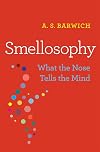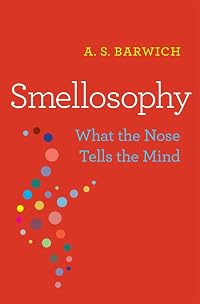
Smellosophy: What the Nose Tells the Mind
by A. S. Barwich
On This Page
Description
"A pioneering exploration of olfaction that upsets settled notions of how the brain translates sensory information. Decades of cognition research have shown that external stimuli "spark" neural patterns in particular regions of the brain. This has fostered a view of the brain as a space that we can map: here the brain responds to faces, there it perceives a sensation in your left hand. But it turns out that the sense of smell-only recently attracting broader attention in neuroscience-doesn't show more work this way. A. S. Barwich asks a deceptively simple question: What does the nose tell the brain, and how does the brain understand it? Barwich interviews experts in neuroscience, psychology, chemistry, and perfumery in an effort to understand the biological mechanics and myriad meanings of odors. She argues that it is time to stop recycling ideas based on the paradigm of vision for the olfactory system. Scents are often fickle and boundless in comparison with visual images, and they do not line up with well-defined neural regions. Although olfaction remains a puzzle, Barwich proposes that what we know suggests the brain acts not only like a map but also as a measuring device, one that senses and processes simple and complex odors. Accounting for the sense of smell upsets theories of perception philosophers have developed. In their place, Smellosophy articulates a new model for understanding how the brain represents sensory information"-- show lessTags
Recommendations












Member Reviews
This book, while primarily targeted at academic (or very curious, or people for whom smell is a part of work) audiences, has a lot to offer:
- a complete description of what we know about smell and how we came to learn about it, including a history of how smell has been theorized since Antiquity;
- a study of how research is made, how the incorporation of new tools from adjacent fields can introduce new framings, and even if these are not successful, discard unhelpful hypothesis;
- an explanation of how experts (sommelier etc) develop their abilities;
- and let's say a 'thought-experiment' to neuroscientists and philosophers.
It is easy to read, although it would have benefited from explanatory figures in the first chapters.
- a complete description of what we know about smell and how we came to learn about it, including a history of how smell has been theorized since Antiquity;
- a study of how research is made, how the incorporation of new tools from adjacent fields can introduce new framings, and even if these are not successful, discard unhelpful hypothesis;
- an explanation of how experts (sommelier etc) develop their abilities;
- and let's say a 'thought-experiment' to neuroscientists and philosophers.
It is easy to read, although it would have benefited from explanatory figures in the first chapters.
Ratings
Members
- Recently Added By
Author Information
1 Work 49 Members
Awards and Honors
Classifications
Statistics
- Members
- 49
- Popularity
- 614,155
- Reviews
- 1
- Rating
- (3.75)
- Languages
- English
- Media
- Paper, Audiobook, Ebook
- ISBNs
- 5
- ASINs
- 2