On This Page
Description
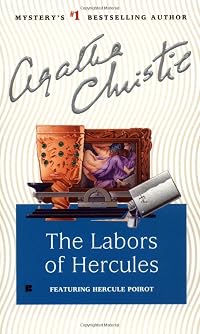
In appearance Hercule Poirot hardly resembled an ancient Greek hero. Yet-reasoned the detective-like Hercules he had been responsible for ridding society of some of its most unpleasant monsters. So, in the period leading up to his retirement, Poirot makes up his mind to accept just twelve more cases: his self-imposed "Labors." Each would go down in the annals of crime as a heroic feat of deduction.Tags
Recommendations













Member Reviews
Dame Christie was getting especially bored with Monsieur Poirot circa 1947. Thirty years of writing about a character who she intended to be rather odious, but many of her readers found charming...that can wearing. So, why not (a) retire him for good to grow those vegetable marrows she first brought up in [b:The Murder of Roger Ackroyd|16328|The Murder of Roger Ackroyd (Hercule Poirot, #3)|Agatha Christie|https://i.gr-assets.com/images/S/compressed.photo.goodreads.com/books/1389734015l/16328._SY75_.jpg|1073110] and (b) poke a little fun at his rather ironic moniker (ironiker?) and his overly inflated sense of self-worth?
Poirot decides to take on twelve final cases, all with nods to the Labors of Hercules (some requiring serious show more imaginative stretching):
1) Slay the Nemean lion (or bust a dog-napping ring)
2) Slay the nine-headed Lernaean Hydra (or put gossiping tongues to rest)
3) Capture the Arcadian Deer (or track down an vanished sweetheart)
4) Capture the Erymanthian Boar (otherwise known as a dangerous criminal)
5) Clean the Augean stables in a single day (no more difficult than cleaning up a political scandal)
6) Slay the Stymphalian birds (birds? lady con artists? same diff.)
7) Capture the Cretan Bull (or find out if a woman's fiancé is really becoming a homicidal maniac)
8) Steal the Mares of Diomedes (or tame the wild daughters of a retired general)
9) Obtain the girdle of Hippolyta, queen of the Amazon (or find the connection between a stolen painting and a schoolgirl who temporarily went missing)
10) Obtain the cattle of the three-bodied giant Geryon (or save wealthy ladies from a murderous cult leader)
11) Steal three of the golden apples of the Hesperides (or track down a priceless Borgia goblet)
12) Capture and bring back Cerberus (or bust a drug ring being run out of Poirot's old friend Countess Vera Rosakoff's new nightclub Hell)
Short stories usually aren't my favorites and this collection is no exception. I prefer a slow striptease of a reveal to a fast & dirty one. Dame Christie also seems a little obsessed with drugs throughout the collection: so many young people losing their minds on the dope!
The standouts of the collection for me are "The Cretan Bull" (wherein Poirot provesthat Hugh Chandler isn't actually going mad and that he's not actually Admiral Chandler's son! The admiral knew that all along and was trying to drive Hugh to kill himself as punishment for his old friend Colonel Frobisher having an affair with Hugh's mother. and "The Flock of Geryon," because I always love a good cult, especially one with people injecting hashish! show less
Poirot decides to take on twelve final cases, all with nods to the Labors of Hercules (some requiring serious show more imaginative stretching):
1) Slay the Nemean lion (or bust a dog-napping ring)
2) Slay the nine-headed Lernaean Hydra (or put gossiping tongues to rest)
3) Capture the Arcadian Deer (or track down an vanished sweetheart)
4) Capture the Erymanthian Boar (otherwise known as a dangerous criminal)
5) Clean the Augean stables in a single day (no more difficult than cleaning up a political scandal)
6) Slay the Stymphalian birds (birds? lady con artists? same diff.)
7) Capture the Cretan Bull (or find out if a woman's fiancé is really becoming a homicidal maniac)
8) Steal the Mares of Diomedes (or tame the wild daughters of a retired general)
9) Obtain the girdle of Hippolyta, queen of the Amazon (or find the connection between a stolen painting and a schoolgirl who temporarily went missing)
10) Obtain the cattle of the three-bodied giant Geryon (or save wealthy ladies from a murderous cult leader)
11) Steal three of the golden apples of the Hesperides (or track down a priceless Borgia goblet)
12) Capture and bring back Cerberus (or bust a drug ring being run out of Poirot's old friend Countess Vera Rosakoff's new nightclub Hell)
Short stories usually aren't my favorites and this collection is no exception. I prefer a slow striptease of a reveal to a fast & dirty one. Dame Christie also seems a little obsessed with drugs throughout the collection: so many young people losing their minds on the dope!
The standouts of the collection for me are "The Cretan Bull" (wherein Poirot proves
The central conceit of this book is that the redoubtable Hercule Poirot will accept no more than twelve cases before he retires (to go off and grow vegetable marrows -- allegedly!); these twelve cases will correspond, in certain ways, to the Labours of Hercules, his namesake. Thus, we get twelve short stories of detection. The quality of the stories varies a little bit, at least in the category of raw detection. Christie was a bit addicted to coincidences and improbabilities (quick change artists in trains, for example). What does more than save this collection, though, is the sheer cast of supporting characters (one of whom shows up in two stories), providing a great deal of amusing colour to the stories. And the title character show more himself amuses -- one can very much hear David Suchet's voice reading the dialogue! Likely not to fall out of print any time soon. show less
Before retiring to grow superior vegetable marrows, Hercule Poirot decides to take on twelve more cases, based on the labours of Hercules of the Greek myths.
This is an interesting little collection of short stories and, while there are – naturally – stories that deal with murder or attempted murder, there a few other crimes here that Hercule Poirot must solve. I won't go into any details here as part of the fun is to discover what a particular story will be about. The quality varies, of course; my favourites were 'The Lernean Hydra' and 'The Horses of Diomedes', where the symbolic association is quite superb, while the story I liked least – by some distance – was 'The Stymphalean Birds': not enough that the solution was terribly show more obvious from the start, but Hercule Poirot features in it on only four and a half pages. show less
This is an interesting little collection of short stories and, while there are – naturally – stories that deal with murder or attempted murder, there a few other crimes here that Hercule Poirot must solve. I won't go into any details here as part of the fun is to discover what a particular story will be about. The quality varies, of course; my favourites were 'The Lernean Hydra' and 'The Horses of Diomedes', where the symbolic association is quite superb, while the story I liked least – by some distance – was 'The Stymphalean Birds': not enough that the solution was terribly show more obvious from the start, but Hercule Poirot features in it on only four and a half pages. show less
One of my favorites so far. Mimicing his namesake, he completes the same number of labours as the classic mythological character. I think that Christie is an even stronger short story writer than a novelist as she is willing to be more inventive in the shorter form. My favorite story involves a smitten Poirot helping the charming Countess Roscovich, who begiled him in an earlier work and still does, escape a trap. I also enjoy the fact that once again, he swears these will be his last cases, and of course, we have a few more books to go.
Hercule Poirot is thinking of retirement. Before he ends his career as a private detective, he challenges himself to solve twelve more cases. But not just any twelve cases. They will be carefully picked to correspond with the mythical labors of Hercules.
I'm not a big fan of short stories in the mystery genre. The format imposes too many constraints on plot and character development. This collection is less successful than most in my estimation. The connection with the labors of Hercules is forced. Few of the cases have anything to do with murder, the usual subject of Poirot's investigations. Poirot prevented a murder or two, but many of the other cases involved drug dealing and/or smuggling. Poor Poirot has been trying to retire ever show more since The Murder of Roger Ackroyd. He won't manage it this time, either, since Christie wrote about a dozen more Poirot novels or short story collections after this one. show less
I'm not a big fan of short stories in the mystery genre. The format imposes too many constraints on plot and character development. This collection is less successful than most in my estimation. The connection with the labors of Hercules is forced. Few of the cases have anything to do with murder, the usual subject of Poirot's investigations. Poirot prevented a murder or two, but many of the other cases involved drug dealing and/or smuggling. Poor Poirot has been trying to retire ever show more since The Murder of Roger Ackroyd. He won't manage it this time, either, since Christie wrote about a dozen more Poirot novels or short story collections after this one. show less
Agatha Christie shines better in novel length, because her ability to mislead, plant red herrings and hide the actual clues works best when she has the room. As her short story collections go, this is a fine one. The conceit that connects the story is Hercule Poirot wanting to close his career solving twelve cases analogous to the mythological Hercules' twelve tasks or labours. The connection between Poirot's cases and Hercules labours is sometimes farfetched, although sometimes it fits well, like malicious rumors being analogous to the Hydra. It's entertaining, but it's not Agatha Christie's (or Poirot's best showcase), so I wouldn't advice starting here.
The Labors of Hercules – A. Christie
Audio performance by Hugh Fraser
4 stars
Hercule Poirot is about to retire. Leaving his detecting career behind, he plans to take his little grey cells to the country where he will cultivate gourmet vegetable marrows. Before he departs, he determines to undertake 12 more cases; cases of special and particular interest, which will mirror the labors of the classical Hercules. Twelve cases that also give Agatha Christie an opportunity to write 12 wonderful short stories for the little detective.
I thought this was an exceptionally good collection. There was a bit more comedy than in many of her stories. Christie seemed to be poking fun at her little Belgian detective, gently and with affection. show more Hastings does not appear in any of the stories, but this is the first time I’ve read anything of the resourceful butler, George. (Mildly reminiscent of Peter Whimsy’s Bunter.) Miss Lemon remains ever resourceful and Inspector Japp appears briefly in a story that includes Poirot’s version of ‘THE woman’. I especially liked the spinster, Miss Carnady, who appears in two of the stories. She reminded me a bit of Sayers’ Miss Climpson. (I always wonder about the parallels between these great dames of mystery writing.)
Some of the stories worked better than others. A few were dated in bias and attitude. Hugh Fraser’s performance made all of them enjoyable. show less
Audio performance by Hugh Fraser
4 stars
Hercule Poirot is about to retire. Leaving his detecting career behind, he plans to take his little grey cells to the country where he will cultivate gourmet vegetable marrows. Before he departs, he determines to undertake 12 more cases; cases of special and particular interest, which will mirror the labors of the classical Hercules. Twelve cases that also give Agatha Christie an opportunity to write 12 wonderful short stories for the little detective.
I thought this was an exceptionally good collection. There was a bit more comedy than in many of her stories. Christie seemed to be poking fun at her little Belgian detective, gently and with affection. show more Hastings does not appear in any of the stories, but this is the first time I’ve read anything of the resourceful butler, George. (Mildly reminiscent of Peter Whimsy’s Bunter.) Miss Lemon remains ever resourceful and Inspector Japp appears briefly in a story that includes Poirot’s version of ‘THE woman’. I especially liked the spinster, Miss Carnady, who appears in two of the stories. She reminded me a bit of Sayers’ Miss Climpson. (I always wonder about the parallels between these great dames of mystery writing.)
Some of the stories worked better than others. A few were dated in bias and attitude. Hugh Fraser’s performance made all of them enjoyable. show less
Members
- Recently Added By
Lists

Crime and Mysteries to Read
746 works; 31 members

British Mystery
469 works; 14 members

Agatha Christie story collections
19 works; 1 member

Agatha Christie Poirot
43 works; 2 members

Books About Murder
313 works; 7 members

Favorite Books from the 1940s
38 works; 3 members

Detective Stories
343 works; 5 members

Hercule Poirot Short Stories
51 works; 1 member

Books Read in 2023
5,547 works; 145 members
Must Read Detective Stories (Nick Fuller)
278 works; 2 members

Agatha Christie Chronology
93 works; 1 member
Author Information

2,150+ Works 439,856 Members
One of the most successful and beloved writer of mystery stories, Agatha Mary Clarissa Christie was born in 1890 in Torquay, County Devon, England. She wrote her first novel, The Mysterious Affair at Styles, in 1920, launching a literary career that spanned decades. In her lifetime, she authored 79 crime novels and a short story collection, 19 show more plays, and six novels written under the name of Mary Westmacott. Her books have sold over a billion copies in the English language with another billion in 44 foreign languages. Some of her most famous titles include Murder on the Orient Express, Mystery of the Blue Train, And Then There Were None, 13 at Dinner and The Sittaford Mystery. Noted for clever and surprising twists of plot, many of Christie's mysteries feature two unconventional fictional detectives named Hercule Poirot and Miss Jane Marple. Poirot, in particular, plays the hero of many of her works, including the classic, The Murder of Roger Ackroyd (1926), and Curtain (1975), one of her last works in which the famed detective dies. Over the years, her travels took her to the Middle East where she met noted English archaeologist Sir Max Mallowan. They married in 1930. Christie accompanied Mallowan on annual expeditions to Iraq and Syria, which served as material for Murder in Mesopotamia (1930), Death on the Nile (1937), and Appointment with Death (1938). Christie's credits also include the plays, The Mousetrap and Witness for the Prosecution (1953; film 1957). Christie received the New York Drama Critics' Circle Award for 1954-1955 for Witness. She was also named Dame Commander of the Order of the British Empire in 1971. Christie died in 1976. (Bowker Author Biography) show less
Some Editions
Series

Belongs to Publisher Series
Work Relationships
Common Knowledge
- Canonical title
- The Labors of Hercules; The Labours of Hercules
- Original title
- The Labours of Hercules
- Alternate titles
- The Labors of Hercules
- Original publication date
- 1947-09-01
- People/Characters
- Hercule Poirot; Felicity Lemon; Vera Rossakoff (Countess)
- Important places
- London, England, UK; France; Ireland; Switzerland
- Dedication
- To Edmund Cork
of whose labours on behalf
of Hercule Poirot I am
deeply appreciative
this book is affectionately
dedicated - First words
- Hercule Poirot's flat was essentially modern in its furnishings.
- Last words
- (Click to show. Warning: May contain spoilers.)"I wonder....Really--at his age!...Surely not..."
- Original language*
- englanti
*Some information comes from Common Knowledge in other languages. Click "Edit" for more information.
Classifications
Statistics
- Members
- 3,460
- Popularity
- 4,808
- Reviews
- 65
- Rating
- (3.64)
- Languages
- 25 — Catalan, Czech, Danish, Dutch, English, Estonian, Finnish, French, German, Greek, Hungarian, Indonesian, Italian, Japanese, Norwegian (Bokmål), Polish, Romanian, Serbian, Sinhalese, Slovenian, Spanish, Swedish, Turkish, Portuguese (Portugal), English (UK)
- Media
- Paper, Audiobook, Ebook
- ISBNs
- 118
- UPCs
- 3
- ASINs
- 84