
On This Page
Description
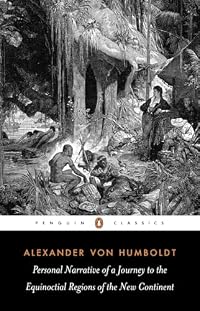
A great, innovative and restless thinker, the young Humboldt (1769-1859) went on his epochal journey to the New World during a time of revolutionary ferment across Europe. This part of his matchless narrative of adventure and scientific research focuses on his time in Venezuela - in the Llanos and on the Orinoco River - riding and paddling, restlessly and happily noting the extraordinary things on every hand. Great Journeys allows readers to travel both around the planet and back through the show more centuries - but also back into ideas and worlds frightening, ruthless and cruel in different ways from our own. Few reading experiences can begin to match that of engaging with writers who saw astounding things- Great civilisations, walls of ice, violent and implacable jungles, deserts and mountains, multitudes of birds and flowers new to science. show lessTags
Recommendations




























Member Reviews
Alexander von Humboldt details his adventures and explorations in Venezuela in 1800 in a beautifully written little travelogue. His intellectual curiosity knows no bounds and his skills at recording his observations are wonderfully lyrical. The flora, fauna, land, rivers, mountains, weather -- nothing escapes his observation. Not even the people who he objectively studies and records with clarity. He is open minded enough to recognize European pretensions and set them aside while living along side those who would be considered from the most primitive of cultures. His observations foreshadow the disastrous man-made changes to the land and environment as natural resources were even then being ripped from the land without thought for the show more future. This is a delightful adventure in the dense green jungle of a primeval land. show less
I’ve come to love nonfiction works from authors who’ve trekked the world thanks. So I couldn’t miss this book written about the author’s journey through Venezuela from 1798-1804. He was a naturalist so he includes many in-depth descriptions of plants and animals, landscapes and people. He was obviously extremely knowledgeable and tough to be able to deal with the harsh terrains of all sorts. He was sensitive to the plight of slaves, but less sensitive to some tribes he labeled lazy. But he was fair, too, identifying the good, the bad, the ugly, and the lovely (and sometimes the crazy) about all the people he encountered. One obviously native man insisted he was white and held himself out as so pretentious it was quite comical. show more Sometimes a bit boring, but overall this was a fascinating peak at a world far distant from our own. show less
A great, innovative and restless thinker, the young Humboldt (1769-1859) went on his epochal journey to the New World during a time of revolutionary ferment across Europe. This part of his matchless narrative of adventure and scientific research focuses on his time in Venezuela - in the Llanos and on the Orinoco River - riding and paddling, restlessly and happily noting the extraordinary things on every hand.
Naturalist-explorer von Humboldt makes his way through often uncharted territory in Venezuela of 1800. He muses on the different plant species- so similar, and yet not identical- to those on other side of the world; encounters piranhas, capybaras, jaguars... (I was mystified by an account of a near-miss with a 'tiger' , given the author's expertise on animals, that he had already referred to jaguars, and that I can find no record of tigers in Venezuela...)and sees stunning scenery.
The locals are Indians of various tribe;, blacks- slaves and freed- and European settlers.
Interesting account.
The locals are Indians of various tribe;, blacks- slaves and freed- and European settlers.
Interesting account.
Although the author wrote of his travels in the early 1800's,he nevertheless speaks to us in these pages with a very modern voice. In the short extracts we are given here,Alexander von Humboldt travels into the Venezuelan jungle and encounters in addition to the jaguars and electric eels of the title,crocodiles,snakes apes and worst of all,the dreaded The way he writes about the various plants that he collects and the way he tells of the natives and the missionaries that he meets are wonderfully described.In short,he is a man who anyone at all interested in exploration,travel or botany would be proud to meet.
The series of' Penguin Great Journeys' of which this is one,is a splendid set of 20 books.In the 100 pages of this particular show more book, we have the essence of a great explorer and by reading this short account,one is drawn to discover more about him and indeed to attempt to discover a fuller account of his travels. show less
The series of' Penguin Great Journeys' of which this is one,is a splendid set of 20 books.In the 100 pages of this particular show more book, we have the essence of a great explorer and by reading this short account,one is drawn to discover more about him and indeed to attempt to discover a fuller account of his travels. show less
Ratings
Members
- Recently Added By
Author Information

215+ Works 1,666 Members
Baron Alexander von Humboldt was born in Berlin, Germany. During his early school years, he studied such subjects as geology, biology, metallurgy, and mining, and his main interest was in nature and other lands. In 1796 Humboldt traveled to the German Alps, where he measured the atmospheric pressure, humidity, and oxygen content of the air. show more Shortly after, in 1799, he was granted permission by the Spanish king to explore Spain's mysterious holdings in the Americas. For the next five years, he and his companion, Aime Bonplaud, explored the region that is now Venezuela, Cuba, Colombia, Peru, Ecuador, and Mexico. While in the Andes, he fell prey to mountain sickness, which led him to become the first person to explain that the sickness was caused by a lack of oxygen. During these travels, he and Bonplaud collected 60,000 plant specimens; mapped the area; and studied its climates, bodies of water, wildlife, and minerals. The findings of this exhaustive adventure were published in a 23-volume series, Voyage de Humboldt et Bonplaud (1805--34). In 1829, at the invitation of the Russian government, Humboldt made an expedition to Russia and Siberia, categorizing, observing, and recording as he went. One of the results of this expedition was a 5-volume work, Kosmos (1845-62), in which he tried to combine the vague ideals of the eighteenth century with the exact scientific requirements of his own. Considered one of the founders of modern geography, Humboldt showed geographers that there was more to the study of geography than the shape of Earth and its regions. He gave them a system of geographic inquiry, he was the first to draw an isothermal map, studied tropical storms and volcanoes, and pioneered the field of terrestrial magnetism. Equally important, he was responsible for one of the first examples of international scientific cooperation, which led to the formation of a system of meteorological stations throughout Russia and Great Britain. During one of his many expeditions, he measured the temperature of the current with which his ship sailed from Lima, Peru, to Acapulco, Mexico. Later this current was named the Humboldt Current in his honor. (Bowker Author Biography) show less
Series

Belongs to Publisher Series
Great Journeys (9)
Common Knowledge
- Canonical title
- Jaguars and Electric Eels
- People/Characters
- Alexander von Humboldt; Bonpland
- Important places
- Venezuela, South America
- First words
- Crossing from Cumana to La Guaira by sea our plan was to stay in Caracas until the end of the rainy season; from there we would go to the great plains, the llanos, and the Orinoco missions; then we would travel upstream on th... (show all)e great river from south of the cataracts to the Rio Negro and the Brazilian frontier, and return to Cumana through the capital of Spanish Guiana, called Angostura (now Ciudad Bolivar) or Straits.
- Last words
- (Click to show. Warning: May contain spoilers.)Here, in a fertile land, in an eternal greenness, you search in vain for traces of man; you feelyou are carried into a different world from the one you were born into.
Classifications
- Genres
- Travel, Nonfiction, Science & Nature, General Nonfiction, Biography & Memoir
- DDC/MDS
- 918.0413 — History & geography Geography & travel Geography of and travel in South America Travel Early history to 1806 1498–1806
- LCC
- F1409.3 .H86 — Local History of the United States, Canada and Latin America Latin America. Spanish America Latin America (General)
- BISAC
Statistics
- Members
- 189
- Popularity
- 172,611
- Reviews
- 5
- Rating
- (3.42)
- Languages
- English
- Media
- Paper, Ebook
- ISBNs
- 3
- ASINs
- 1