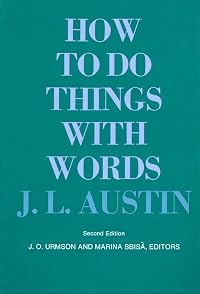
How to Do Things with Words
by J. L. Austin
On This Page
Description
This work sets out Austin's conclusions in the field to which he directed his main efforts for at least the last ten years of his life. Starting from an exhaustive examination of his already well-known distinction between performative utterances and statements, Austin here finally abandons that distinction, replacing it with a more general theory of 'illocutionary forces' of utterances which has important bearings on a wide variety of philosophical problems.Tags
Recommendations








Member Recommendations
The Message in the Bottle: How Queer Man Is, How Queer Language Is, and What One Has to Do with the Other by Walker Percy
elenchus Austin analyses possible speech acts, and discusses how every statement is usually a mix of these. Percy focuses on one type of speech act, the denotative (naming) act, and argues it is perhaps the most important of all. Different styles of argument, but they supplement one another quite well.
Member Reviews
Com um pouquinho de acabamento pelo autor esse livro seria uma obra prima, pois que com a reconstrução de notas de palestra já é bastante impressionante e traça um itinerário que me parece necessário para pensarmos a linguagem e o significado (o que é um significado, "a questão do significado"). São 12 palestrinhas, que começam com recapitulações fofas, chamando a atenção para o caráter performativo de certas frases, em contraste com sentenças descritivas, entendidas como constatações. A ênfase é então não na verdade, mas se a ação envolvendo a linguagem é feliz (adequada, apropriada, tem as consequências esperadas). Mas ao avaliar melhor os tipos de infelicidade quanto às ações linguageiras, ao introduzir show more as diferenças entre locução, ilocução e perlocução, e pensar a força de um ato de fala, Austin acaba por desvelar o caráter inerentemente normativo da prática linguística. Pois mesmo fazer asserções é se comprometer com certos valores, consequências, visões. E isso leva a ideia do significado como uso para além de uma lista de frases em que um conceito é utilizado, mas para os contextos de uso e o que eles acarretam. show less
Ο Ώστιν (J. L. Austin, 1911-1962) ανέλυσε πρώτος, στο How to Do Things With Words, ένα κλασικό βιβλίο της φιλοσοφίας του εικοστού αιώνα, την πρακτική διάσταση του ίδιου του λόγου - τους λόγους που οι ίδιοι είναι έργα. Όταν υποσχόμαστε, όταν ορκιζόμαστε, όταν διατάσσουμε, προειδοποιούμε, στοιχηματίζουμε... . δεν περιγράφουμε αλλά πράττουμε, δεν αποτυπώνουμε ένα πράγμα, αληθώς ή ψευδώς, αλλά κάνουμε, παράγουμε ένα πράγμα, εύστοχα ή show more άστοχα. Η παρούσα σχολιασμένη μετάφραση αποτελεί ένα είδος άθλου όσον αφορά τη μεταφορά στα ελληνικά αναλύσεων της αγγλικής καθομιλουμένης - δεδομένου μάλιστα ότι την ανάλυση της καθημερινής γλώσσας θεωρούσε ο Ώστιν απαραίτητο έργο της φιλοσοφίας - αλλά και όσον αφορά την απόδοση μιας σειράς νεότευκτων όρων. Όπως δείχνει και το εκτενές επίμετρο του Χάρη Χρόνη, αυτό το βιβλίο καταγράφει ταυτόχρονα μια υποδειγματική μεθοδική διαδικασία. Εφόσον η επιτελεστική διάσταση δεν μπορεί εν τέλει να απομονωθεί από την διαπιστωτική, ο Ώστιν προσφεύγει στην τριχοτόμηση λεκτικό-ενδολεκτικό-περιλεκτικό, προχωρώντας έτσι σε μια καλά θεμελιωμένη «αλλαγή παραδείγματος», η οποία δεν καταργεί το αρχικό πλαίσιο, αλλά το εντάσσει σε ένα άλλο ευρύτερο, κάτι που θα μπορούσε να ιδωθεί ως πρότυπο για την ορθολογική αλλαγή εννοιολογικών πλαισίων γενικά. show less
It's worth noting the title is a pun.
Austin examines when a speech act is performative and not merely constative: when the 'saying' evokes or conjures rather than (merely) states or describes, and is itself an activity (not merely in the trivial sense of flexing vocal cords, etc). Examples such as "I bet", in which case the bet is realised in the saying, rather than the speech act serving merely to report what is happening. Similarly, "I do" (in a wedding ceremony), "I christen this ship", or any number of verdicts such as by a judge or umpire.
In short: magick, though of course Austin declines to use any such vocabulary, assuming even that he was familiar with it.
Begins by drawing a sharp distinction between constative utterances and show more performative utterances, for the sake of pursuing his argument. Ends by arguing that all speech acts are always both, preferring then to describe three functions of all speech acts rather than to sort them into discrete categories: locutionary, illocutionary, perlocutionary (introduced in Lecture VIII).
Locutionary has a meaning (and is comprised of phonetic, phatic, rhetic acts). "The bull is going to charge."
Illocutionary has a certain force in saying something. Warning someone by stating "The bull is going to charge".
Perlocutionary achieves a certain effect in saying something. Persuading someone to cease making noise and waving a red handkerchief by stating "The bull is going to charge".
Lecture IV touches on the notion / possibility that all persuasion is essentially coercive; but does not explore this so much as evoke it.
Lecture IX links the above to cybernetic causation (signals and responses) as distinct from Newtonian causation (billiard balls).
Lecture XI touches on the relevance of truth / falsity of performatives, and in general. "[W]hat we have to study is not the sentence but the issuance of an utterance in a speech situation." (139) And issuances are not themselves true / false so much as successful or not, on various criteria. "The truth or falsity of a statement depends not merely on the meaning of words but on what act you were performing in what circumstances." (145)
Overall, the approach is analytical in the manner of Robert Dahl in his examination of democratic political theory.
"But the real conclusion must surely be that we need (a) to distinguish between locutionary and illocutionary acts, and (b) specially and critically to establish with respect to each kind of illocutionary act -- warnings, estimates, verdicts, statements, and descriptions -- what if any is the specific way in which they are intended, first to be in order or not in order, and second, to be 'right' or 'wrong'; what terms of appraisal and disappraisal are used for each and what they mean. This is a wide field and certainly will not lead to a conclusion of 'true' and 'false'; nor will it lead to a distinction of statements from the rest, for stating is only one among very numerous speech acts of the illocutionary class.
"Furthermore, in general the locutionary act as well as the illocutionary is an abstraction only: every genuine speech act is both." (147) show less
Austin examines when a speech act is performative and not merely constative: when the 'saying' evokes or conjures rather than (merely) states or describes, and is itself an activity (not merely in the trivial sense of flexing vocal cords, etc). Examples such as "I bet", in which case the bet is realised in the saying, rather than the speech act serving merely to report what is happening. Similarly, "I do" (in a wedding ceremony), "I christen this ship", or any number of verdicts such as by a judge or umpire.
In short: magick, though of course Austin declines to use any such vocabulary, assuming even that he was familiar with it.
Begins by drawing a sharp distinction between constative utterances and show more performative utterances, for the sake of pursuing his argument. Ends by arguing that all speech acts are always both, preferring then to describe three functions of all speech acts rather than to sort them into discrete categories: locutionary, illocutionary, perlocutionary (introduced in Lecture VIII).
Locutionary has a meaning (and is comprised of phonetic, phatic, rhetic acts). "The bull is going to charge."
Illocutionary has a certain force in saying something. Warning someone by stating "The bull is going to charge".
Perlocutionary achieves a certain effect in saying something. Persuading someone to cease making noise and waving a red handkerchief by stating "The bull is going to charge".
Lecture IV touches on the notion / possibility that all persuasion is essentially coercive; but does not explore this so much as evoke it.
Lecture IX links the above to cybernetic causation (signals and responses) as distinct from Newtonian causation (billiard balls).
Lecture XI touches on the relevance of truth / falsity of performatives, and in general. "[W]hat we have to study is not the sentence but the issuance of an utterance in a speech situation." (139) And issuances are not themselves true / false so much as successful or not, on various criteria. "The truth or falsity of a statement depends not merely on the meaning of words but on what act you were performing in what circumstances." (145)
Overall, the approach is analytical in the manner of Robert Dahl in his examination of democratic political theory.
"But the real conclusion must surely be that we need (a) to distinguish between locutionary and illocutionary acts, and (b) specially and critically to establish with respect to each kind of illocutionary act -- warnings, estimates, verdicts, statements, and descriptions -- what if any is the specific way in which they are intended, first to be in order or not in order, and second, to be 'right' or 'wrong'; what terms of appraisal and disappraisal are used for each and what they mean. This is a wide field and certainly will not lead to a conclusion of 'true' and 'false'; nor will it lead to a distinction of statements from the rest, for stating is only one among very numerous speech acts of the illocutionary class.
"Furthermore, in general the locutionary act as well as the illocutionary is an abstraction only: every genuine speech act is both." (147) show less
I cannot recall a more boring book. As short as it was, I still struggled to get through it. It is about the philosophy of language. Austin develops a construct around "performatives." I get that this work was a step in the development of language, helping to cut off an inane trend toward impracticality (all sentences are statements). I didn't really need to read this though.
Austin was apparently bothered by the lack of attention given by philosophers (or philologists) to whether a "statement" describes truly or falsely, while grammarians point out that there are also questions, exclamations and even commands. Austin also distinguishes whether ANY sentence is a 'statement', since, rather, it is a 'logical construction' used in MAKING a statement. (!) [1] You see right where he is going -- and goes on for 12 lectures. It does not help that he advises, "Yet we, that is, even philosophers, set some limits to the amount of nonsense that we are prepared to admit we talk: so that it was natural to go on to ask, as a second stage, whether many apparent pseudo-statements really set out to be 'statements' at all." show more [2] He initially contrasts the 'performative' and the 'constative' utterance, and proceeds to compare it to other classes of utterance for which he further provides a Latin candle of "more-or-less rebarbative names" [150]: (1) Verdictives [giving verdict 42], (2) Exercitives [exercising powers 58], (3) Commissives [promising 81], (4) Behabitives [social attitudes 83 --condoling, cursing, apologizing], and (5) Expositives [fitting the utterance in - 85].
Austin tries to set out how the construction of word-speaking is an Act--he calls it a "performative" sentence or utterance [6], although he also likes what the lawyers refer to as "operative" parts, distinct from the recitative parts [7 crediting Prof HLA Hart].
After establishing his approach, with his new use for an old word, Austin addresses the question of whether SAYING something can make it so. For example, we do not Get Married by saying a few words. We do not make bets by saying something. Well, we do, but that is never how we 'say' it! [7]
In the American (distinct from English) law of Evidence, a report of what someone else said may be admitted as evidence if it is an utterance of a 'performative' kind. In other words, where the words are the actions. {Or to use our example, try using eyewitness testimony to prove A married B, without permitting what is obviously Hearsay. "I do" is not relevant UNLESS it is the prohibited probandum.} As Austin explains this -- "So far then we have merely felt the firm ground of prejudice slide away beneath our feet." [13]
By the VIIth of XII lectures, Austin introduces "the possibility of 'etiolation' as it occurs when we use speech in acting, fiction and poetry, quotation and recitation". Now ordinarily I think the introduction of botanical terms is a fair and even useful way to describe things and processes. Austin uses this "picture" of how plants respond to inadequate lighting conditions to convey in one word the "refinement" of circumstances of 'issuing an utterance'. He breaks the Act down to the (a) Phone - phonetic, (b) Pheme - phatic {phemic}, and (c) rheme - rhetic.
Austin is unable to take the time to explain why this is "interesting". And he notes that Philosophers have long been interested in the word 'good', which they have just begun taking the "line" [must be "time" -- this kind of substitution plague the reprint of the lectures from student notes] to consider [163]. He expresses the position that "we shall not get really clear about this word ' good' and what we use it to do until, ideally, we have a complete list of [its] illocutionary acts..." [162]. Well, he seems to think lecturing at Harvard was good. show less
Austin tries to set out how the construction of word-speaking is an Act--he calls it a "performative" sentence or utterance [6], although he also likes what the lawyers refer to as "operative" parts, distinct from the recitative parts [7 crediting Prof HLA Hart].
After establishing his approach, with his new use for an old word, Austin addresses the question of whether SAYING something can make it so. For example, we do not Get Married by saying a few words. We do not make bets by saying something. Well, we do, but that is never how we 'say' it! [7]
In the American (distinct from English) law of Evidence, a report of what someone else said may be admitted as evidence if it is an utterance of a 'performative' kind. In other words, where the words are the actions. {Or to use our example, try using eyewitness testimony to prove A married B, without permitting what is obviously Hearsay. "I do" is not relevant UNLESS it is the prohibited probandum.} As Austin explains this -- "So far then we have merely felt the firm ground of prejudice slide away beneath our feet." [13]
By the VIIth of XII lectures, Austin introduces "the possibility of 'etiolation' as it occurs when we use speech in acting, fiction and poetry, quotation and recitation". Now ordinarily I think the introduction of botanical terms is a fair and even useful way to describe things and processes. Austin uses this "picture" of how plants respond to inadequate lighting conditions to convey in one word the "refinement" of circumstances of 'issuing an utterance'. He breaks the Act down to the (a) Phone - phonetic, (b) Pheme - phatic {phemic}, and (c) rheme - rhetic.
Austin is unable to take the time to explain why this is "interesting". And he notes that Philosophers have long been interested in the word 'good', which they have just begun taking the "line" [must be "time" -- this kind of substitution plague the reprint of the lectures from student notes] to consider [163]. He expresses the position that "we shall not get really clear about this word ' good' and what we use it to do until, ideally, we have a complete list of [its] illocutionary acts..." [162]. Well, he seems to think lecturing at Harvard was good. show less
1) The distinctions Austin makes are useful.
2) The distinctions don't hold up.
3) The collapse of the distinctions is useful.
2) The distinctions don't hold up.
3) The collapse of the distinctions is useful.
an easy-reading classic
Members
- Recently Added By
Lists

Filosofía - Clásicos
217 works; 1 member

In Our Time books
4,934 works; 2 members
Author Information

Some Editions
Series
Belongs to Publisher Series
Work Relationships
Is contained in
Common Knowledge
- Canonical title
- How to Do Things with Words
- Original publication date
- 1955
Classifications
Statistics
- Members
- 1,440
- Popularity
- 16,336
- Reviews
- 8
- Rating
- (3.90)
- Languages
- 13 — Chinese, Danish, English, Estonian, Finnish, French, German, Greek, Hungarian, Italian, Romanian, Spanish, Turkish
- Media
- Paper, Ebook
- ISBNs
- 36
- ASINs
- 19