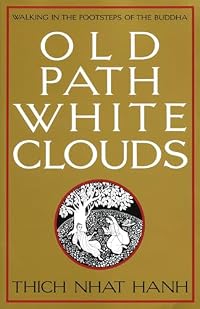
Old Path White Clouds: Walking in the Footsteps of the Buddha
by Thich Nhat Hanh
On This Page
Description
Old Path White Clouds presents the life and teachings of Gautama Buddha. Drawn directly from twenty-four Pali, Sanskrit, and Chinese sources, and retold by Thich Nhat Hanh in his inimitably beautiful style, this book traces the Buddha's life slowly and gently over the course of eighty years, partly through the eyes of Svasti, the buffalo boy, and partly through the eyes of the Buddha himself. Old Path White Clouds is destined to become a classic of religious literature.Tags
Recommendations




Member Recommendations

Member Reviews
Thich Nhat Hanh retells the story of the Buddha Shakyamuni. This is truly a wonderful book. It starts off a bit like a fairy tale or a children's story, very simple. It might seem too simple to be worth reading. A little patience is appropriate! Very gradually, one is drawn into the story, and then as the story evolves it slowly shifts into Dharma teaching of ever greater depth. In the later chapters there are some wonderful reprises, wonderful summaries that lead from the most elementary to the most profound teachings in just a couple pages - I am thinking in particular of chapter seventy-six, "The Fruits of Practice".
This book is a summary of many teachings of the Pali canon. It doesn't bring up any of the more cosmic dimensions of show more the Mahayana or Vajrayana. So this is hardly the full range of Buddhist teaching. But this book covers the foundations very accessibly. These are the roots that the wider reaches of the Dharma grow from.
I suppose the danger here is that the teachings are presented so simply that a reader might completely miss their profundity. After all, that is the nature of the Buddha's teaching - it doesn't get entangled in metaphysical elaboration! Of course, there is metaphysical elaboration aplenty, but the project is always liberation from entanglement. The intricacy of the cure is just a reflection of the intricacy of the disease!
I think again of chapter seventy-six. King Ajatasattu has dug himself into such a deep pit of misdeed, he despairs of any possibility of escape. Yet the Buddha opens the door of liberation for him. This is not so unlike our modern industrial society. We are so far from the simple direct encounter with the elements of life - and yet, all our elaborate conceptualization are truly insubstantial and reality is as close as the palm of our hand. For me, the simplicity and profundity of this book were almost frightening. If liberation is like that, what am I doing with my crazy life?
Yes, pause, be mindful of breathing, of the sensations and feelings and emotions that are present, that come and go, that flow. Just look deeply at the present moment.
This is truly an inspiring book! show less
This book is a summary of many teachings of the Pali canon. It doesn't bring up any of the more cosmic dimensions of show more the Mahayana or Vajrayana. So this is hardly the full range of Buddhist teaching. But this book covers the foundations very accessibly. These are the roots that the wider reaches of the Dharma grow from.
I suppose the danger here is that the teachings are presented so simply that a reader might completely miss their profundity. After all, that is the nature of the Buddha's teaching - it doesn't get entangled in metaphysical elaboration! Of course, there is metaphysical elaboration aplenty, but the project is always liberation from entanglement. The intricacy of the cure is just a reflection of the intricacy of the disease!
I think again of chapter seventy-six. King Ajatasattu has dug himself into such a deep pit of misdeed, he despairs of any possibility of escape. Yet the Buddha opens the door of liberation for him. This is not so unlike our modern industrial society. We are so far from the simple direct encounter with the elements of life - and yet, all our elaborate conceptualization are truly insubstantial and reality is as close as the palm of our hand. For me, the simplicity and profundity of this book were almost frightening. If liberation is like that, what am I doing with my crazy life?
Yes, pause, be mindful of breathing, of the sensations and feelings and emotions that are present, that come and go, that flow. Just look deeply at the present moment.
This is truly an inspiring book! show less
This seminal text by Vietnamese monk, poet, and peace activist, revered around the world for his teachings on mindfulness, ethics, and peace, is recommended by many lamas, teachers, and students and is appropriate for adults and children alike. It’s long, but broken up into 2 books with a total of 81 chapters. There are summaries of each chapter in the appendix at the end as well as a map of the area where Buddha roamed, and an excellent appendix of Pali and Sanskrit terms.
An interesting aspect of this book is that the chapters are not in sequential order of the story of the Buddha’s life and there is no description of his enlightenment. He’s teaching sutras in chapter 2 and is born in chapter 6. Chapter 30 presents the Five show more Precepts. In this way the story flows more from the teachings and it can be read out of order.
One Buddhist mom said she read Old Path, White Clouds cover to cover as a bedtime story to her young daughter. “It was this special place that she and I went to every night. It wasn’t action-packed but it had so much atmosphere, at least for us. It was like we went on a journey every night. It was so gentle. I remember reading every night for about half an hour.” The daughter, now all grown up, recalls this as a very special time. “Even if I don’t remember all the details from the stories, they left a lasting impression. It was the first time I was connected with the Buddha, and through the telling, I developed an affection for him as a main character. This later turned into something more. But at the time, that seed of just really liking this guy Siddhartha was important. The book became a bridge for my mom to share Buddhism with me, which I know she was happy about. That joy of reading something that was so dear to her made it stand out from other bedtime stories and I could feel that.” show less
An interesting aspect of this book is that the chapters are not in sequential order of the story of the Buddha’s life and there is no description of his enlightenment. He’s teaching sutras in chapter 2 and is born in chapter 6. Chapter 30 presents the Five show more Precepts. In this way the story flows more from the teachings and it can be read out of order.
One Buddhist mom said she read Old Path, White Clouds cover to cover as a bedtime story to her young daughter. “It was this special place that she and I went to every night. It wasn’t action-packed but it had so much atmosphere, at least for us. It was like we went on a journey every night. It was so gentle. I remember reading every night for about half an hour.” The daughter, now all grown up, recalls this as a very special time. “Even if I don’t remember all the details from the stories, they left a lasting impression. It was the first time I was connected with the Buddha, and through the telling, I developed an affection for him as a main character. This later turned into something more. But at the time, that seed of just really liking this guy Siddhartha was important. The book became a bridge for my mom to share Buddhism with me, which I know she was happy about. That joy of reading something that was so dear to her made it stand out from other bedtime stories and I could feel that.” show less
I agree with some of the other reviewers, at no point do you forget this is a 600 page book. As a fictionalized account of Buddha's life, it feels lacking that at no point does he seem to face any real conflict. He leaves his wife, kid, and patents in the middle of the night with no problems and no later consequences. Whenever he meets someone who expresses any doubt he is able to convert them within a day. Much of the way he seems to handle other people's emotions appeared to me as just dismissing them by reminding them about the precepts. Not to mention the misogyny expressed regarding bhikkhunis that is never fully addressed except one throwaway line about if their rules were sexist, which is never brought up again.
However, this show more does seem like a good beginners introduction to some of the basic concepts of Buddhism. The concepts that were introduced were explained in a relatively simple way. I feel like anyone who was honestly interested in Buddhism could really use this book as a decent jumping off point to begin exploring the teachings of Buddha. show less
However, this show more does seem like a good beginners introduction to some of the basic concepts of Buddhism. The concepts that were introduced were explained in a relatively simple way. I feel like anyone who was honestly interested in Buddhism could really use this book as a decent jumping off point to begin exploring the teachings of Buddha. show less
Read this on and off for the past year. Some very beautiful writing at times. Got about 3/4 of the way through it and finally gave up, though. Wonderful of course, but this could seriously have been three hundred pages shorter without losing a single thing. Very repetitive. I think if Thay would have written this 20 years later, it would have been much shorter.
This is a wonderful book, beautifully written and illustrated. Thich Nhat Hanh's gentle prose tells the story of the Buddha and his teachings in an accessible manner. I have recommended this book to people wanting to learn about Buddhism, and they have enjoyed it a great deal.
Old Path White Clouds presents the life and teachings of Gautama Buddha. Drawn directly from 24 Pali, Sanskrit, and Chinese sources, and retold by Thich Nhat Hanh in his inimitably beautiful style, this book traces the Buddha's life slowly and gently over the course of 80 years, partly through the eyes of Svasti, the buffalo boy, and partly through the eyes of the Buddha himself. Old Path White Clouds is destined to become a classic of religious literature. ''I have not avoided including the various difficulties the Buddha encountered, both from his own disciples and in relation to the wider society. If the Buddha appears in this hook as a man close to us, it is partly due to recounting such difficulties.'
Old Path White Clouds, 1991 English language Dharma classic by Thich Nhat Hanh, a narrative of the life of Buddha Shakyamuni, constructed using mostly Theravada sources for historical events ... Adorned by skillful illustrations, this large book is very well written, radiating throughout a gentle feeling of simplicity and natural reverence, a sense of the teacher before us, of the sacred emerging in real life situations through the Buddha's presence and his teachings. Good for young and old, good to read to children.
Members
- Recently Added By
Author Information

Thich Nhat Hanh was born in central Vietnam on October 11, 1926. He entered Tu Hieu Temple as a novice monk at the age of sixteen. During the Vietnam War, he was part of a movement called "engaged Buddhism", which combines traditional practices with nonviolent civil disobedience. For this, he was exiled by both the Communist and non-Communist show more governments and was nominated by Martin Luther King, Jr. for the Nobel Peace Prize in 1967 for his efforts to reconcile North and South Vietnam. He is a teacher, author, poet, and peace activist. He has written over 100 titles on meditation, mindfulness and Engaged Buddhism, as well as poems, children's stories, and commentaries on ancient Buddhist texts. His books include The Heart of the Buddha's Teaching: An Introduction to Buddhism, Peace Is Every Step, The Miracle of Mindfulness, The Art of Power, True Love and Anger, Vietnam: Lotus in a Sea of Fire, and Living Buddha, Living Christ. He founded a retreat in France called Plum Village. (Bowker Author Biography) show less
Some Editions
Series
Belongs to Publisher Series
Common Knowledge
- Original title
- Đường xưa mây trắng - Theo gót chân Bụt; Old Path, White Clouds: Walking in the Footsteps of the Buddha
- Alternate titles
- Old Path, White Clouds: The Life Story of the Buddha
- Original publication date
- 1987
- People/Characters
- Buddha
- First words
- Im Schatten des grünen Bambus saß der junge Bhikkhu Svasti mit verschränkten Beinen, seine Aufmerksamkeit ganz auf den Atem gerichtet.
- Quotations*
- I sutra mahayana offrono un approccio più libero e ampio alla comprensione degli insegnamenti fondamentali del Buddhismo. Ciò ha l'effetto di prevenire quella reificazione degli insegnamenti dovuta a un approccio rigido o p... (show all)iù ristretto. I sutra mahayana ci aiutano infatti a scoprire il senso profondo dei Nikaya e degli Agama. Sono come la luce proiettata su un oggetto esaminato al microscopio, un oggetto che è stato in certo modo distorto da un tentativo di preservazione risultato artificiale. Certo i Nikaya e gli Agama sono più prossimi alla forma originale dell'insegnamento del Buddha, ma alterati e modificati dalla comprensione e dalla pratica peculiari alle tradizioni attraverso le quali sono stati trasmessi. Gli studiosi e i praticanti contemporanei dovrebbero recuperare l'insegnamento originario dai testi di entrambe le scuole, tanto la meridionale che la settentrionale. A questo fine occorre essere familiari con i testi di entrambe le tradizioni.
Ho omesso gli eventi miracolosi con cui spesso i sutra abbelliscono la vita del Buddha. Il Buddha stesso mise in guardia i discepoli contro lo sprecare tempo ed energia nell'acquisizione di poteri soprannaturali. Ho invece in... (show all)cluso molte difficoltà venutegli dalla società e dagli stessi discepoli. Se il libro riesce a farcelo sentire vicino, è grazie a queste difficoltà. - Last words*
- (Click to show. Warning: May contain spoilers.)Wo immer die Flüsse hinströmten - da war der Buddha.
- Original language
- Vietnamese
*Some information comes from Common Knowledge in other languages. Click "Edit" for more information.
Classifications
Statistics
- Members
- 870
- Popularity
- 31,027
- Reviews
- 21
- Rating
- (4.43)
- Languages
- 6 — Dutch, English, French, German, Italian, Spanish
- Media
- Paper, Audiobook, Ebook
- ISBNs
- 27
- ASINs
- 8