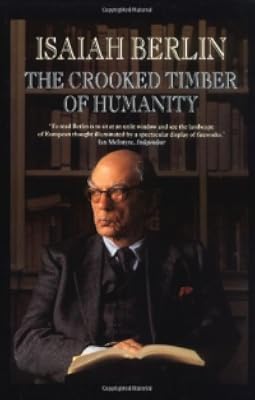
The Crooked Timber of Humanity: Chapters in the History of Ideas
by Isaiah Berlin
On This Page
Description
"Out of the crooked timber of humanity, no straight thing was ever made."--Immanuel Kant Isaiah Berlin was one of the most important philosophers of the twentieth century--an activist of the intellect who marshaled vast erudition and eloquence in defense of the endangered values of individual liberty and moral and political plurality. In The Crooked Timber of Humanity he exposes the links between the ideas of the past and the social and political cataclysms of our own time: between the show more Platonic belief in absolute truth and the lure of authoritarianism; between the eighteenth-century reactionary ideologue Joseph de Maistre and twentieth-century Fascism; between the romanticism of Schiller and Byron and the militant--and sometimes genocidal--nationalism that convulses the modern world. This new edition features a revised text that supplants all previous versions, a new foreword in which award-winning novelist John Banville discusses Berlin's life and ideas, particularly his defense of pluralism, and a substantial new appendix that provides rich context, including letters by Berlin and previously uncollected writings, most notably his virtuoso review of Bertrand Russell's A History of Western Philosophy. show lessTags
Recommendations










Member Reviews
Berlin ferrets out the roots of the prejudice, intolerance, fanaticism and lust for domination that blight the modern world. He is leery of disruptive nationalisms that presume a nation's unique mission and intrinsic superiority--and that often foster racial and ethnic hatreds. He persuasively interprets 18th-century French reactionary thinker Joseph de Maistre as a harbinger of fascism. The Romantic movement's dismissal of the very notion of objective truth, its glorification of defiance and martyrdom, are, to Berlin, a disturbing legacy. While nodding to cultural pluralism, he insists that "we inhabit one common moral world." In tracing the pedigree of such novel ideals as tolerance, liberty and social equality from the Enlightenment show more onward, these erudite, engaging essays throw our century of massive violence into sharp perspective. show less
I'm currently reading Alan Ryan's _On Politics_, a new survey of political theory from the Greeks to the present. In the introduction, Ryan states that Isaiah Berlin's essays provide one model or ideal for his project, in terms of their extraordinary vividness and an almost uncanny ability to engage with the temperament of the thinkers he wrote about. That's a better blurb than I could write, and it rings true.
During the fight against fascism and the Cold War, Berlin was an important thinker. I don't think that his essays are quite as relevant today, but they do provide extremely readable access to the history of ideas.
During the fight against fascism and the Cold War, Berlin was an important thinker. I don't think that his essays are quite as relevant today, but they do provide extremely readable access to the history of ideas.
Perry Anderson's review of Berlin's Crooked Timber of Humanity (1990) when it first appeared. Anderson's reasonably sympathetic comments dismissed the hypothesis out of hand with the thought that, amongst other evidence from the classical and medieval periods for which Berlin had not accounted, he had "mislaid Mount Olympus." Worth noting as well is Anderson's effort to state the hypothesis clearly in the claim that it told us that all traditions of the past had affirmed the existence of a single normative standard "however much they disagreed over what it was" (Perry Anderson, "England's Isaiah," London Review of Books 12/24, 20 December 1990, 6).
On another level Berlin often quoted Kant, 'Out of the crooked timber of humanity no show more straight thing was ever made'. Most attempts to create utopias lead to hellish suffering, through oppression and persecution. As Berlin said, 'To force people into the neat uniforms demanded by dogmatically believed-in schemes is almost always the road to inhumanity'. show less
On another level Berlin often quoted Kant, 'Out of the crooked timber of humanity no show more straight thing was ever made'. Most attempts to create utopias lead to hellish suffering, through oppression and persecution. As Berlin said, 'To force people into the neat uniforms demanded by dogmatically believed-in schemes is almost always the road to inhumanity'. show less
No one writes about the history of ideas like Isaiah Berlin. His prose is clear and his essays invite the reader to explore his subjects further. What more could you ask for?
No one writes about the history of ideas like Isaiah Berlin. His prose is clear and his essays invite the reader to explore his subjects further. What more could you ask for?
Not the easiest read but a great background on the history of philosophical thought in western Europe and the extremes to where it lead.I fast read through some parts but most was a review of a number of philosophers through history.
" European Unity and it's Vicissitudes " is simply amazing ( written in 1959 ! )
Members
- Recently Added By
Lists

Books Read in 2023
5,547 works; 145 members
Author Information

85+ Works 9,163 Members
Philosopher, political theorist, and essayist, Isaiah Berlin was born in 1909 to Russian-speaking Jewish parents in Latvia. Reared in Latvia and later in Russia, Berlin developed a strong Russian-Jewish identity, having witnessed both the Social-Democratic and the Bolshevik Revolutions. At the age of 12, Berlin moved with his family to England, show more where he attended prep school and then St. Paul's. In 1928, he went up as a scholar to Corpus Christi College in Oxford. After an unsuccessful attempt at the Manchester Guardian, Berlin was offered a position as lecturer in philosophy at New College. Almost immediately, he was elected to a fellowship at All Souls. During this time at All Souls, Berlin wrote his brilliant biographical study of Marx, titled Karl Marx: His Life and Environment (1939), for the Home University Library. Berlin continued to teach through early World War II, and was then sent to New York by the Ministry of Information, and subsequently to the Foreign Office in Washington, D.C. It was during these years that he drafted several fine works regarding the changing political mood of the United States, collected in Washington Despatches 1941-1945 (1981). By the end of the war, Berlin had shifted his focus from philosophy to the history of ideas, and in 1950 he returned to All Souls. In 1957, he was elected to the Chichele Chair of Social and Political Theory, delivering his influential and best-known inaugural lecture, Two Concepts of Liberty. Some of his works include Liberty, The Soviet Mind: Russian Culture under Communism, Flourishing: Selected Letters 1928 - 1946, Political Ideas in the Romantic Age: Their Rise and Influence on Modern Thought, and Unfinished Dialogue, Prometheus. Berlin died in Oxford on November 5, 1997. (Bowker Author Biography) show less
All Editions
Series
Belongs to Publisher Series
Saggi [Adelphi] (16)
Common Knowledge
- Canonical title
- The Crooked Timber of Humanity: Chapters in the History of Ideas
- Original title
- The Crooked Timber of Humanity: Chapters in the History of Ideas
- Original publication date
- 1990
- People/Characters
- Joseph de Maistre; Giambattista Vico
- Epigraph
- Out of the crooked timber of humanity no straight thing was ever made.
Immanuel Kant - Dedication
- For Jon Stallworthy
- First words
- There are, in my view, two factors that, above all others, have shaped human history in this century.
- Blurbers
- McIntyre, Ian; Carr, Raymond; Dunn, John; Kakutani, Michiko
- Original language
- English
Classifications
Statistics
- Members
- 759
- Popularity
- 36,947
- Reviews
- 13
- Rating
- (4.24)
- Languages
- 9 — Dutch, English, French, German, Italian, Polish, Portuguese, Romanian, Spanish
- Media
- Paper, Ebook
- ISBNs
- 23
- ASINs
- 4