The Man with a Shattered World: The History of a Brain Wound
by Aleksandr R. Luria
On This Page
Description
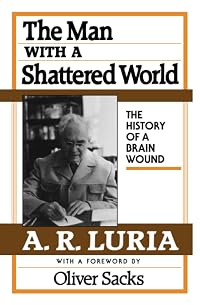
Russian psychologist A. R. Luria presents a compelling portrait of a man's heroic struggle to regain his mental faculties. A soldier named Zasetsky, wounded in the head at the battle of Smolensk in 1943, suddenly found himself in a frightening world: he could recall his childhood but not his recent past; half his field of vision had been destroyed; he had great difficulty speaking, reading, and writing. Much of the book consists of excerpts from Zasetsky's own diaries. Laboriously, he show more records his memories in order to reestablish his past and to affirm his existence as an intelligent being. Luria's comments and interpolations provide a valuable distillation of the theory and techniques that guided all of his research. His "digressions" are excellent brief introductions to the topic of brain structure and its relation to higher mental functions. show lessTags
Recommendations










Member Reviews
A very disturbing story about a Russian soldier who suffered a catastrophic brain injury after he was shot during the second world war war.
This book gives Neuroscientists and psychologist a insight into the machinations of the brain. However, only someone rather stocial would not be moved by this story. And it reminds me of man's inhumanity to his fellow man.
This book gives Neuroscientists and psychologist a insight into the machinations of the brain. However, only someone rather stocial would not be moved by this story. And it reminds me of man's inhumanity to his fellow man.
Although I read little non fiction in general, one exception has been the work of Oliver Sacks, whose writing I enjoy, and whose topics are almost always entertaining and engaging. I picked up "The Man with a Shattered World" largely because Sacks wrote the introduction, and because it sounded as though it would be a nice companion to "The Man Who Mistook His Wife for a Hat" and other works already in my library.
I was not disappointed. "The Man with a Shattered World" is one of two biographies published at the end of A. R. Luria's distinguished career as a neuropsychologist. The book tells the story of Zazetsky, a soldier in the Second World War whose brain injury instantly transformed him from a bright young man on the verge of show more finishing his engineering degree to an illiterate unable to perform any meaningful work or even hold a simple conversation.
Zazetsky discovered that he was still able to write by rote (although reading even his own writing was a tortuous process), and was able to chronicle his injury and its effects. Although he never recovered as fully as he hoped, Zazetsky struggled to improve himself in what ways he could and did make some small progress. Given that he initially could not even recognize the Cyrillic alphabet and at his best could barely read more than two words at a time, the fact that he was able to write over 3,000 pages of journal entries over the course of 30 years is as inspiring as the moon landing.
Between the numerous journal entries, Luria intersperses observations, brain science, and other narrative details. He provides the structure that Zazetsky himself could not, but with a light hand, so that the journal entries themselves shine through. This combination of subjective detail (from Zazetsky) and objective detail (from Luria) is what makes the book so enjoyable and comprehensible.
A very good read, both informative and inspiring. I look forward to picking up a copy of the other biography ("The Mnemonist") at some point in my travels. show less
I was not disappointed. "The Man with a Shattered World" is one of two biographies published at the end of A. R. Luria's distinguished career as a neuropsychologist. The book tells the story of Zazetsky, a soldier in the Second World War whose brain injury instantly transformed him from a bright young man on the verge of show more finishing his engineering degree to an illiterate unable to perform any meaningful work or even hold a simple conversation.
Zazetsky discovered that he was still able to write by rote (although reading even his own writing was a tortuous process), and was able to chronicle his injury and its effects. Although he never recovered as fully as he hoped, Zazetsky struggled to improve himself in what ways he could and did make some small progress. Given that he initially could not even recognize the Cyrillic alphabet and at his best could barely read more than two words at a time, the fact that he was able to write over 3,000 pages of journal entries over the course of 30 years is as inspiring as the moon landing.
Between the numerous journal entries, Luria intersperses observations, brain science, and other narrative details. He provides the structure that Zazetsky himself could not, but with a light hand, so that the journal entries themselves shine through. This combination of subjective detail (from Zazetsky) and objective detail (from Luria) is what makes the book so enjoyable and comprehensible.
A very good read, both informative and inspiring. I look forward to picking up a copy of the other biography ("The Mnemonist") at some point in my travels. show less
Ratings
Members
- Recently Added By
Author Information

All Editions
Some Editions
Awards and Honors
Notable Lists
Work Relationships
Is contained in
Common Knowledge
- Canonical title*
- De man met een kogel in zijn hoofd
- Original title
- Poterjannyj i vozvraÿésÿécennyj mir
- Alternate titles*
- De man met een kogel in zijn hoofd : "de geschiedenis van een neurologisch geval"
- Original publication date
- 1971 (Russisch) (Russisch); 1989 (Nederlands) (Nederlands)
- People/Characters*
- Ljova Zasetski
- Original language*
- Russisch
*Some information comes from Common Knowledge in other languages. Click "Edit" for more information.
Classifications
Statistics
- Members
- 243
- Popularity
- 134,386
- Reviews
- 3
- Rating
- (4.04)
- Languages
- 7 — Danish, Dutch, English, German, Portuguese, Spanish, Swedish
- Media
- Paper
- ISBNs
- 12
- ASINs
- 3