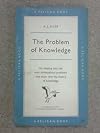
The Problem of Knowledge
by A. J. Ayer
On This Page
Description
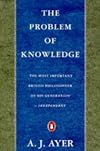
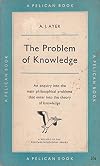
In this book, the author of "Language, Truth and Logic" tackles one of the central issues of philosophy - how we can know anything - by setting out all the sceptic's arguments and trying to counter them one by oneTags
Recommendations





















Member Reviews
As is evident from the title, this book is on the the philosophy of knowledge or epistemology.
Though it is quite suitable for the general reader, in that a knowledge of philosophy is not really presumed, it is the sort of book that must be concentrated upon when reading, as the arguments are many-sided and the logic quite expert. Despite its short length though, (220 pages), this book covers an impressive range of ideas, which is made possible by the density of the prose. This isn't to say though that the book is hard going, for what it is, as the style is quite readable and even enjoyable, providing that one can concentrate on it, as the ideas and arguments themselves require a bit of thought to appreciate.
The first chapter discusses show more knowledge, what it is, and what it isn't. The second chapter deals with certainty and scepticism, and outlines of the four main ways to address scepticism: Naive realism, Reductionism, the Scientific Approach, and Descriptive Analysis. What I found interesting in this chapter was the defence he put forward for Naive Realism, which is an approach that I hadn't seriously considered before. Arguments are presented in favour and against of each of the four approaches though, and none of them are yet decided upon.
The third chapter deals with perception, and I found this to be the dullest chapter as there was less that seemed new here. The fourth chapter deals with Memory, and I enjoyed reading this one. The thoughts on reverse causation and precognition seemed to me to be quite new, and stimulating, and stood out among many of the other views which seemed at least in part derived from previous thinkers (though this cannot be avoided in any comprehensive philosophical discussion).
The next chapter was on personal identity and continuity of self, and I couldn't quite see how all of this was relevant to the original question. But the final few pages did give support to the overall direction in which he has been heading in throughout the book, to give an answer on what knowledge is and how it is attained. As I interpret it, he says that the sceptic defines knowledge, and it is defined logically, in a way that prevents us of being sure of knowing things (except mathematical and logical truths), but that this is logically unavoidable given the definition of knowledge, so we should rely on the next best thing - empiricism. I don't recall falsification being mentioned at all, which is a very important part of the scientific method, but this is perhaps not within the scope of the book. show less
Though it is quite suitable for the general reader, in that a knowledge of philosophy is not really presumed, it is the sort of book that must be concentrated upon when reading, as the arguments are many-sided and the logic quite expert. Despite its short length though, (220 pages), this book covers an impressive range of ideas, which is made possible by the density of the prose. This isn't to say though that the book is hard going, for what it is, as the style is quite readable and even enjoyable, providing that one can concentrate on it, as the ideas and arguments themselves require a bit of thought to appreciate.
The first chapter discusses show more knowledge, what it is, and what it isn't. The second chapter deals with certainty and scepticism, and outlines of the four main ways to address scepticism: Naive realism, Reductionism, the Scientific Approach, and Descriptive Analysis. What I found interesting in this chapter was the defence he put forward for Naive Realism, which is an approach that I hadn't seriously considered before. Arguments are presented in favour and against of each of the four approaches though, and none of them are yet decided upon.
The third chapter deals with perception, and I found this to be the dullest chapter as there was less that seemed new here. The fourth chapter deals with Memory, and I enjoyed reading this one. The thoughts on reverse causation and precognition seemed to me to be quite new, and stimulating, and stood out among many of the other views which seemed at least in part derived from previous thinkers (though this cannot be avoided in any comprehensive philosophical discussion).
The next chapter was on personal identity and continuity of self, and I couldn't quite see how all of this was relevant to the original question. But the final few pages did give support to the overall direction in which he has been heading in throughout the book, to give an answer on what knowledge is and how it is attained. As I interpret it, he says that the sceptic defines knowledge, and it is defined logically, in a way that prevents us of being sure of knowing things (except mathematical and logical truths), but that this is logically unavoidable given the definition of knowledge, so we should rely on the next best thing - empiricism. I don't recall falsification being mentioned at all, which is a very important part of the scientific method, but this is perhaps not within the scope of the book. show less
Sir Alfred Jules "Freddie" Ayer (10/29/1910, London – 6/27/1989, London), British philosopher known for promoting logical positivism, particularly in Language, Truth, and Logic (1936) and The Problem of Knowledge (1956) http://en.wikipedia.org/wiki/A._J._Ayer
Ratings
Members
- Recently Added By
Author Information

48+ Works 5,073 Members
After attending Eton and Oxford University, Sir Alfred Jules Ayer studied philosophy at the University of Vienna, where he affiliated with the Vienna Circle, the school of logical positivism led by Moritz Schlick. On his return to England, he accepted an appointment in 1933 as lecturer at Oxford, and, except for his military service during World show more War II, he wrote and taught philosophy until his death. During World War II, Ayer was commissioned into the Welsh Guards, and in 1945 was an attache at the British Embassy in Paris. In 1946 he was appointed Grote Professor at the University of London and in 1959 Wykeham Professor of Logic at Oxford. Ayer's fame was established with the publication of his first book, Language, Truth and Logic, in 1936. This work introduced logical positivism to the English-speaking world in a clear, vigorous, and persuasive style. Building on the thought of Bertrand Russell and Ludwig Wittgenstein, Ayer sharpened their theses, boldly revealing the affiliations of logical positivism with traditional British empiricism, particularly the work of David Hume. Ayer claimed that only verifiable statements are true or false. He considered statements of religion or art as merely emotional expressions. For his contributions to philosophy, Ayer was knighted by the British Crown. He has provided an account of his life, at least of its professional and philosophical sides, in two autobiographies. (Bowker Author Biography) show less
Some Editions
Work Relationships
Common Knowledge
- Original publication date
- 1956
Classifications
Statistics
- Members
- 544
- Popularity
- 54,399
- Reviews
- 3
- Rating
- (3.47)
- Languages
- English, Italian, Portuguese, Spanish
- Media
- Paper
- ISBNs
- 6
- ASINs
- 22