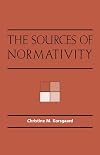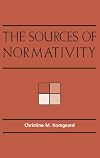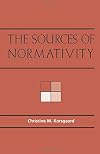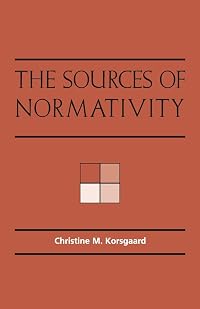
The Sources of Normativity
by Christine M. Korsgaard
On This Page
Description
Ethical concepts are, or purport to be, normative. They make claims on us: they command, oblige, recommend, or guide. Or at least when we invoke them, we make claims on one another; but where does their authority over us - or ours over one another - come from? Christine Korsgaard identifies four accounts of the source of normativity that have been advocated by modern moral philosophers: voluntarism, realism, reflective endorsement, and the appeal to autonomy. She traces their history, show more showing how each developed in response to the prior one and comparing their early versions with those on the contemporary philosophical scene. Kant's theory that normativity springs from our own autonomy emerges as a synthesis of the other three, and Korsgaard concludes with her own version of the Kantian account. Her discussion is followed by commentary from G. A. Cohen, Raymond Geuss, Thomas Nagel, and Bernard Williams, and a reply by Korsgaard. show lessTags
Recommendations




Member Reviews
Your reasons express your identity, your nature; your obligations spring from what that identity forbids. [...] For to violate them is to lose your integrity and so your identity, and to no longer be who you are. That is, it is to no longer be able to think of yourself under the description under which you value yourself and find your life to be worth living and your actions to be worth undertaking. It is to be for all practical purposes dead or worse than dead.
Korsgaard seeks to answer the "normative question": what justifies the claims that morality makes on us? In addition to addressing how and why moral ideas can have important practical and psychological effects on us, she also attempts to justify granting this kind of importance show more to morality. Her account is Kantian, with an emphasis on practical identity. The responses from Cohen, Nagel, Guess, and Williams fail to damage her project too much, before she provides a thorough and convincing reply in the final section of the book (the benefit of being the author of the book, I suppose). Nagel's objections seem to me the most convincing of the four, but it is worth reading The Sources of Normativity for anyone who wants to decide for themselves. show less
Korsgaard seeks to answer the "normative question": what justifies the claims that morality makes on us? In addition to addressing how and why moral ideas can have important practical and psychological effects on us, she also attempts to justify granting this kind of importance show more to morality. Her account is Kantian, with an emphasis on practical identity. The responses from Cohen, Nagel, Guess, and Williams fail to damage her project too much, before she provides a thorough and convincing reply in the final section of the book (the benefit of being the author of the book, I suppose). Nagel's objections seem to me the most convincing of the four, but it is worth reading The Sources of Normativity for anyone who wants to decide for themselves. show less
Ratings
Members
- Recently Added By
Lists

Better for Who?
11 works; 1 member

What is morality?
12 works; 1 member

In Our Time books
4,934 works; 2 members
Author Information
13+ Works 599 Members
Christine M. Korsgaard is Arthur Kingsley Porter Professor of Philosophy at Harvard University. She works on moral philosophy and its history, practical reason, agency, personal identity, and the relations between human beings and the other animals.
Series
Belongs to Publisher Series
Tanner Lectures (1992-1993, Cambridge)
Classifications
Statistics
- Members
- 247
- Popularity
- 131,071
- Reviews
- 1
- Rating
- (3.94)
- Languages
- English, Spanish
- Media
- Paper, Ebook
- ISBNs
- 7
- ASINs
- 2