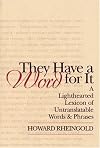
They Have a Word for It: Lighthearted Lexicon of Untranslatable Words & Phrases
by Howard Rheingold
On This Page
Description
Drawing from Chinese, Japanese, Italian, Yiddish, French, German, and Balinese languages, Rheingold offers an unusual cross-cultural word book introducing colorful, not easily translatable terms that deal with a variety of concepts. In topical chapters of words about human relationships, sex, beauty, politics, religion, and emotions, he describes both the narrow and broader meanings of foreign idioms that usually condense sentences, even paragraphs, of English into a few syllables. ISBN show more 0-87-87477-464-0 (pbk.): $7.95 (For use only in the library). show lessTags
Recommendations
























Member Recommendations
Member Reviews
Pretty good overall. Some of the featured words have actually entered mainstream English usage (e.g. "wabi-sabi", "mantra", "zeitgeist", and "schadenfreude") in the ~30 years since this book was written, and it's fun to think that not so long ago they were foreign and novel. Will any of the other words in the book become mainstream in the next ~30 years? I, for one, will be doing my best to use and spread these words: "esprit de l'escalier", the clever remark that come to mind when it is too late to utter it; "fusto", a man who like to flex his muscles and dress provocatively"; "yugen", an awareness of the universe that triggers feelings too deep and mysterious for words"; and "schlimmbesserung", a so-called improvement that makes show more things worse.
Some of the featured words/phrases don't seem like they are expressing anything that we don't already have a word or phrase for in English (e.g. "bustarella", a cash bribe), and other words/phrases don't seem like they would ever, EVER, be needed in American life (e.g. "nadi", to temporarily inhabit another dimension). That isn't a big deal, it was still nice to read through them, but I definitely got the feeling that some of this was filler to meet a particular page count. show less
Some of the featured words/phrases don't seem like they are expressing anything that we don't already have a word or phrase for in English (e.g. "bustarella", a cash bribe), and other words/phrases don't seem like they would ever, EVER, be needed in American life (e.g. "nadi", to temporarily inhabit another dimension). That isn't a big deal, it was still nice to read through them, but I definitely got the feeling that some of this was filler to meet a particular page count. show less
Reading just an entry or two at a time. It took awhile to get into it, as the organization is from the relatively trivial, easily translatable words, to the more challenging concepts that are 'foreign' to the native English speaker. The latter is what I was hoping for when I bought the book.
-----
Finally done. When one is in the right frame of mind for the theme of the chapter, one is fascinated. Mostly I found myself bored though - and yet, it was not a honest sense of boredom. After all, the principle behind the book, as Rheingold expresses, We all inherit a worldview along with our native language. Untranslatable words help us notice the cracks between our own worldview and those of others," is both intriguing & important.
The material show more isn't boring, nor is the presentation. I think it's that I'm too cynical, too set in my ways, to feel the need to adopt any of these words. The few I did like, that is to say, the few I thought expressed an idea that English needs but does not have an expression for, were words that would be too long & difficult to use in conversation.
For example, consider 'wundersucht' - which Rheingold translates as 'a passion for miracles.' I agree with him that people universally have a hunger to experience or at least to witness the miraculous. But I'm not going to go around mangling German phonemes to try to spread a word for this concept. Sorry.
Otoh, 'maya,' which is Sanskrit for 'the mistaken belief that a symbol is the same as the reality it represents,' is a short & handy word. Alfred Korzybski, a semanticist, says it's the belief in "the illusion of mistaking the map for the territory." Unfortunately, after reading the fable meant to illustrate the concept, I don't think I actually understand it well enough to use it.
Overall, the book can be read as a fun collection of trivia, or as a multicultural enrichment study. I do recommend it to those interested in world politics or diplomacy, languages, cultures, etc.
I also really liked this quote, used to open the chapter on 'conceptions of beauty:'
For the Navajo, beauty is not so much in the eye of the beholder as it is in the mind of its creator and in the creator's relationship to the created (that is, the transformed or the organized). The Navajo does not look for beauty; he generates it within himself and projects it onto the universe.... Beauty is not 'out there' in things to be perceived by the perceptive and appreciative viewer; it is a creation of thought.
(Gary Witherspoon, Language and Art in the Navajo Universe)
I wish I'd read that before I'd read [b:Laughing Boy|1820803|Laughing Boy|Oliver La Farge|https://d202m5krfqbpi5.cloudfront.net/books/1188803588s/1820803.jpg|1148394] with all its 'I travel in beauty' lines." show less
-----
Finally done. When one is in the right frame of mind for the theme of the chapter, one is fascinated. Mostly I found myself bored though - and yet, it was not a honest sense of boredom. After all, the principle behind the book, as Rheingold expresses, We all inherit a worldview along with our native language. Untranslatable words help us notice the cracks between our own worldview and those of others," is both intriguing & important.
The material show more isn't boring, nor is the presentation. I think it's that I'm too cynical, too set in my ways, to feel the need to adopt any of these words. The few I did like, that is to say, the few I thought expressed an idea that English needs but does not have an expression for, were words that would be too long & difficult to use in conversation.
For example, consider 'wundersucht' - which Rheingold translates as 'a passion for miracles.' I agree with him that people universally have a hunger to experience or at least to witness the miraculous. But I'm not going to go around mangling German phonemes to try to spread a word for this concept. Sorry.
Otoh, 'maya,' which is Sanskrit for 'the mistaken belief that a symbol is the same as the reality it represents,' is a short & handy word. Alfred Korzybski, a semanticist, says it's the belief in "the illusion of mistaking the map for the territory." Unfortunately, after reading the fable meant to illustrate the concept, I don't think I actually understand it well enough to use it.
Overall, the book can be read as a fun collection of trivia, or as a multicultural enrichment study. I do recommend it to those interested in world politics or diplomacy, languages, cultures, etc.
I also really liked this quote, used to open the chapter on 'conceptions of beauty:'
For the Navajo, beauty is not so much in the eye of the beholder as it is in the mind of its creator and in the creator's relationship to the created (that is, the transformed or the organized). The Navajo does not look for beauty; he generates it within himself and projects it onto the universe.... Beauty is not 'out there' in things to be perceived by the perceptive and appreciative viewer; it is a creation of thought.
(Gary Witherspoon, Language and Art in the Navajo Universe)
I wish I'd read that before I'd read [b:Laughing Boy|1820803|Laughing Boy|Oliver La Farge|https://d202m5krfqbpi5.cloudfront.net/books/1188803588s/1820803.jpg|1148394] with all its 'I travel in beauty' lines." show less
I like this book, but I found the tone of the author a little condescending at times.
This book was lent to me by a similarly language-loving friend. Despite, yes, getting "razliubit" wrong, I found this book to be fun and informative. It was a pleasure to read, from someone who rarely reads non-fiction.
Charming. Meant to be dipped into, not read through. Witty explanations.
The basic idea sounds good enough. Discuss various words that English could use from other languages. Ought to be interesting, except
1) The author either doesn't himself really understand the words, or else can't describe it well enough to make it clear.
2) His phonetic transcriptions are just plain wrong.
3) English doesn't need many of these words, having short phrases that mean the same thing (usually shorter than the words he wants to introduce).
4) His suggestions of how we might use the word in English has little or no relationship to how the word is used in the original language.
5) Even if anyone could remember all these polysylabic expressions in the first place.
1) The author either doesn't himself really understand the words, or else can't describe it well enough to make it clear.
2) His phonetic transcriptions are just plain wrong.
3) English doesn't need many of these words, having short phrases that mean the same thing (usually shorter than the words he wants to introduce).
4) His suggestions of how we might use the word in English has little or no relationship to how the word is used in the original language.
5) Even if anyone could remember all these polysylabic expressions in the first place.
This was a great book. Very entertaining, very informative, a must-read for folks who love words.
Members
- Recently Added By
Author Information

29+ Works 3,284 Members
Howard Rheingold, an influential writer and thinker on social media, is the author of Smart Mobs: The Next Social Revolution and many other books.
Common Knowledge
- Alternate titles
- There's a Word for It
- Original publication date
- 1988
- Dedication
- To Judy and Mamie, who fill my life with light. Because of you I am a cuor contento.
- First words
- This book is meant to be fun.
- Last words
- (Click to show. Warning: May contain spoilers.)Will San Francisco begin to add new words to the vocabulary in order to describe new American subcultures?
Classifications
Statistics
- Members
- 691
- Popularity
- 41,493
- Reviews
- 11
- Rating
- (3.71)
- Languages
- Dutch, English
- Media
- Paper
- ISBNs
- 8
- ASINs
- 1