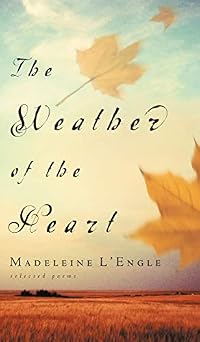
The Weather of the Heart (Wheaton Literary)
by Madeleine L'Engle
On This Page
Description
Madeleine L'Engle bids us, in her own words, to "sit at sacrament" with her "across a strange and distant table." It is a paschal event, a meal of rememberence. Where her own hurt is cruciform, we are the more alive. When she admits arrogance in Gethsemane, we, too, remember glutting on unleavened loaves. But as she herself declares: "Never was a feast finer than this. Come, eat and drink, unfreeze and live." --Calvin Miller, author of The Singer TrilogyTags
Recommendations










Member Reviews
The poems in Madeleine L'Engle's 'The Weather of the Heart' form a highly personal collection; this is both its strength and its weakness. The poems which fall flat are mostly those which focus on the passage of family life, commemorating births, anniversaries and holidays, events without significance to most readers. More engaging are those poems focusing on emotional and religous subjects, where L'Engle opens up herself in verse, laying bare her doubts, struggles and celebrations. These poems resonate with honesty, allowing the reader to feel an understanding of the author and share the sentiments expressed.
L'Engle uses a variety of verse forms in this volume, again with varying degrees of success. I found some of the strongest poems show more to be those which used the most formal verse forms, the discipline of the structure helping to give the most clarity to the emotions expressed within. show less
L'Engle uses a variety of verse forms in this volume, again with varying degrees of success. I found some of the strongest poems show more to be those which used the most formal verse forms, the discipline of the structure helping to give the most clarity to the emotions expressed within. show less
I was reading this book in August and misplaced it. Last week I found it and reread many of the poems and finished the book. L’Engle’s poetry ranges from okay to brilliant flashes of light. In rereading, I discovered that some of the poems that didn’t seem to have those flashes the first time, spoke to me more deeply the second time. I’m finding it difficult to review this book because it seems to be a collection of personal “communions” that she is sharing with the reader as one would share with a friend. These poems are spiritual and because she is a Christian they are written from that perspective. However, I would not call most of these “Christian” poems because the emphasis is on a spiritual inner life rather than show more on any religion. Many times I felt that “aha!” moment of seeing myself in her poetry.
Here are a few examples. The first one I posted in October on the previous thread because it was my “birthday” poem this year. It is also the poem that give the title to the book.
To a Long Loved Love: 3
I know why a star gives light
Shining quietly in the night;
Arithmetic helps me unravel
The hours and years this light must travel
To penetrate our atmosphere.
I count the craters on the moon
With telescopes to make them clear.
With delicate instruments I measure
Secrets of barometric pressure.
Therefore I find it inexpressibly queer
That with my own soul I am out of tune,
That I have not stumbled on the art
Of forecasting the weather of the heart.
Here are two others I particularly love.
…Set to the Music of the Spheres
Pain is a partner I did not request;
This is a dance I did not ask to join;
whirled in a waltz when I would stop and rest,
Jolted and jerked, I ache in bone and loin.
Pain strives to hold me close in his embrace;
If I resist and try to pull away
His grasp grows tighter; closer comes his face;
hotter his breath. If he is here to stay
Then I must learn to dance this painful dance,
Move to its rhythm, keep my lagging feet
In time with his. Thus have I a chance
To work with pain, and so may pain defeat.
Pain is my partner. If I dance with pain
Then may this wedlock be not loss but gain.
Sonnet, Trinity 18
Peace is the center of the Atom, the core
Of quiet within the storm. It is not
A cessation, a nothingness; more
The lightning in reverse is what
Reveals the light. It is the law that binds
The atom’s structure, ordering the dance
Of proton and electron, and that finds
Within the midst of flame and wind, the glance
In the still eye of the vast hurricane.
Peace is not placidity; peace is
The power to endure the megatron of pain
With joy, the silent thunder of release,
The ordering of Love. Peace is the atom’s start,
The primal image: God within the heart. show less
Here are a few examples. The first one I posted in October on the previous thread because it was my “birthday” poem this year. It is also the poem that give the title to the book.
To a Long Loved Love: 3
I know why a star gives light
Shining quietly in the night;
Arithmetic helps me unravel
The hours and years this light must travel
To penetrate our atmosphere.
I count the craters on the moon
With telescopes to make them clear.
With delicate instruments I measure
Secrets of barometric pressure.
Therefore I find it inexpressibly queer
That with my own soul I am out of tune,
That I have not stumbled on the art
Of forecasting the weather of the heart.
Here are two others I particularly love.
…Set to the Music of the Spheres
Pain is a partner I did not request;
This is a dance I did not ask to join;
whirled in a waltz when I would stop and rest,
Jolted and jerked, I ache in bone and loin.
Pain strives to hold me close in his embrace;
If I resist and try to pull away
His grasp grows tighter; closer comes his face;
hotter his breath. If he is here to stay
Then I must learn to dance this painful dance,
Move to its rhythm, keep my lagging feet
In time with his. Thus have I a chance
To work with pain, and so may pain defeat.
Pain is my partner. If I dance with pain
Then may this wedlock be not loss but gain.
Sonnet, Trinity 18
Peace is the center of the Atom, the core
Of quiet within the storm. It is not
A cessation, a nothingness; more
The lightning in reverse is what
Reveals the light. It is the law that binds
The atom’s structure, ordering the dance
Of proton and electron, and that finds
Within the midst of flame and wind, the glance
In the still eye of the vast hurricane.
Peace is not placidity; peace is
The power to endure the megatron of pain
With joy, the silent thunder of release,
The ordering of Love. Peace is the atom’s start,
The primal image: God within the heart. show less
Ratings
Members
- Recently Added By
Author Information

123+ Works 128,278 Members
Author Madeleine L'Engle was born in New York City on November 29, 1918. She graduated from Smith College. She is best known for A Wrinkle in Time (1962), which won the 1963 Newbery Medal for best American children's book. While many of her novels blend science fiction and fantasy, she has also written a series of autobiographical books, including show more Two Part Invention: The Story of a Marriage, which deals with the illness and death of her husband, soap opera actor Hugh Franklin. In 2004, she received a National Humanities Medal from President George W. Bush. She died on September 6, 2007 of natural causes. Since 1976, Wheaton College in Illinois has maintained a special collection of L'Engle's papers, and a variety of other materials, dating back to 1919. (Bowker Author Biography) show less
Classifications
Statistics
- Members
- 202
- Popularity
- 161,346
- Reviews
- 2
- Rating
- (3.88)
- Languages
- English
- Media
- Paper
- ISBNs
- 2