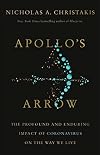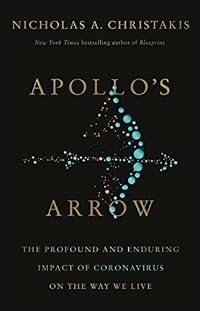
Apollo's Arrow: The Profound and Enduring Impact of Coronavirus on the Way We Live
by Nicholas A. Christakis MD PhD
On This Page
Description
A deep, science-backed look at how the coronavirus pandemic will change the way we live forever -- from renowned physician and sociologist Nicholas Christakis. APOLLO'S ARROW offers a riveting account of the impact of the coronavirus pandemic on American society as it unfolded in 2020, and on how the recovery will unfold in the coming years. Drawing on a combination of fascinating case studies and cutting-edge research from a range of scientific disciplines, bestselling author, physician, show more and sociologist Nicholas Christakis explores what it means to live in a time of plague -- an experience that is paradoxically uncommon to the vast majority of humans who are alive, yet deeply fundamental to our species as a whole. Unleashing new divisions in our society and new opportunities for cooperation, this 21st century pandemic has upended our society in ways that will test, but not vanquish, our already frayed culture's capacity to endure and thrive. Featuring many novel, provocative arguments and vivid examples ranging across medicine, history, sociology, epidemiology, data science, and genetics, APOLLO'S ARROW envisions what happens when the great force of a deadly germ meets the enduring reality of our evolved social nature. show lessTags
Recommendations






Member Reviews
The COVID-19 pandemic came on so suddenly and with such relative ferocity that one can be forgiven for being confused by all the misinformation floating around in the first few months after March 2020. However, epidemiologists did know how to predict and prepare for what was happening, but unfortunately this was also at a time when public trust in experts and institutions was down. Warnings from scientists and top officials weren't granted any special consideration in the minds of the populace. Also, people were scared and scared people love to turn to pseudoscience for answers.
Nicholas Christakis' Apollo's Arrow is an informed review of what happened before, during, and after the worst global pandemic in 100 years. It's also a forecast show more of what to expect for the next pandemic, which surprisingly would be different if it happened in 20 or 30 years (our collective memory of 2020 remains intact) versus in 100 years (no collective memory).
The biggest revelation for me was how much epidemiologists DO know about viruses and how they move about a population. What looks like an impossible web of contract tracing is a much tighter science than would otherwise seem. However, little of this matters if the public doesn't believe the evidence presented. Humans survived this 'dress rehearsal' COVID-19 pandemic but barely and at great cost. How are we going to respond to the next one? show less
Nicholas Christakis' Apollo's Arrow is an informed review of what happened before, during, and after the worst global pandemic in 100 years. It's also a forecast show more of what to expect for the next pandemic, which surprisingly would be different if it happened in 20 or 30 years (our collective memory of 2020 remains intact) versus in 100 years (no collective memory).
The biggest revelation for me was how much epidemiologists DO know about viruses and how they move about a population. What looks like an impossible web of contract tracing is a much tighter science than would otherwise seem. However, little of this matters if the public doesn't believe the evidence presented. Humans survived this 'dress rehearsal' COVID-19 pandemic but barely and at great cost. How are we going to respond to the next one? show less
The COVID-19 pandemic is arguably the most important and disruptive global event—in terms of impact on health, the political economy, and culture—of the twenty-first century. Understanding the details and full complexity of the pandemic, therefore, is a necessity for understanding the current state of the US and the world.
Achieving this nuanced perspective is not easy, however, considering the amount of misinformation, disinformation, and superficial black-and-white thinking circulating the web. That’s why it’s beneficial to be able to get the full picture on the pandemic from a source that is actually qualified to discuss it.
In Apollo’s Arrow, Nicholas Christaskis, a physician and sociologist from Yale University that has show more been tracking the virus from the beginning, covers the pandemic from all angles, including the epidemiological characteristics of the virus, the history of pandemics, mitigation and treatment options, psychological impact and reactions (both positive and negative), sources of misinformation, political negligence and mishandling, the development of treatments and vaccines, and possible outcomes over the next few years.
Christakis is uniquely qualified to write this book; as a physician and sociologist, he is able to explain both the epidemiological characteristics of the virus (including containment and treatment protocols) as well as the psychological and social aspects of our various responses to the virus. While the pandemic has undoubtedly deepened political polarization and summoned our inner demons, it has also brought out our better angels as demonstrated through countless acts of altruism and charity.
The COVID-19 pandemic is therefore complex both biologically and socially; not only are we learning about this new virus on the fly, we are simultaneously dealing with its psychological, social, and economic ramifications, forcing us to confront difficult tradeoffs and ambiguities on a daily basis, which Christakis effectively communicates in a deep yet clearly written way.
You will learn, for example, that while the virus is not as deadly as we first assumed, it is significantly deadlier than the seasonal flu, in terms of its higher rates of mortality and community transmission and its more dangerous physiological effects on the respiratory system, captured in the greater number of deaths, in absolute terms, compared to the flu (30,000–60,000 flu-related deaths per year in the US versus 243,000 COVID-19 deaths as of 11/13/2020).
COVID-19 has proven difficult to contain because, in addition to its high rate of transmission, infected individuals can transmit COVID-19 asymptomatically (unlike SARS). This makes contact tracing nearly impossible and makes quarantining the infected far less effective (they’ve already spread the disease in an asymptomatic state). This is why non-pharmaceutical interventions (NPIs) such as mask wearing, social distancing, and prohibiting large gatherings are necessary to slow the spread of the virus. (Christakis notes how mask wearing has been politicized, but, epidemiologically speaking, is a very uncontroversial and effective method of reducing community transmission rates.)
The reader may wonder what the point of reducing the transmission rate (“flattening the curve”) is if the virus will not stop spreading until we hit herd immunity, which occurs when a high enough percentage of the community is immune to the virus, making the spread of COVID-19 from person to person unlikely. As Christakis explains, adopting measures to flatten the curve prevents unnecessary or excess deaths by (1) preventing a large number of deaths from occurring over a short period of time and thus avoiding overwhelming our healthcare system, (2) buying time so that vaccines or better treatment options can be developed, and (3) allowing time for the virus to potentially mutate into a less lethal form. All three factors can potentially lower the total number of deaths.
An effective and safe vaccine is our best bet because it allows us to achieve herd immunity without hundreds of thousands of excess deaths, although, as Christakis points out, there is no guarantee that a vaccine will become available anytime soon, as the fastest vaccine to ever be developed was the mumps vaccine—and that took four years (although some promising vaccines are currently in trials).
There is of course the question of whether or not closing down the economy is worth the lives it will save, but the evidence seems to suggest that even if a country chooses to remain open, as Sweden did, the economy will still suffer as people refuse to go out—leaving you with a depressed economy AND a higher death count. Even Sweden—the only Nordic country not to implement widespread lockdown—has since reversed its course after experiencing higher infection rates and deaths, as Christakis points out.
The reader of course can decide for themselves how to evaluate the tradeoffs, and must confront difficult questions such as whether or not a mass lockdown is justified, whether a vaccine will actually become available in time, how much personal risk they are willing to bear, and how their own personal and political biases might be affecting their own judgment. But if you take anything away from the book, it should be (1) the pandemic is complex and these are not easy questions, (2) trust the science and credible sources and argue with facts, not conspiracy theories, and (3) our ability to bind together to fight the virus as a common enemy—and stop fighting each other—is the key to keeping the virus in check and preventing excess deaths (by following long established NPIs, not as a political badge of honor, but as scientifically-grounded measures of containment). show less
Achieving this nuanced perspective is not easy, however, considering the amount of misinformation, disinformation, and superficial black-and-white thinking circulating the web. That’s why it’s beneficial to be able to get the full picture on the pandemic from a source that is actually qualified to discuss it.
In Apollo’s Arrow, Nicholas Christaskis, a physician and sociologist from Yale University that has show more been tracking the virus from the beginning, covers the pandemic from all angles, including the epidemiological characteristics of the virus, the history of pandemics, mitigation and treatment options, psychological impact and reactions (both positive and negative), sources of misinformation, political negligence and mishandling, the development of treatments and vaccines, and possible outcomes over the next few years.
Christakis is uniquely qualified to write this book; as a physician and sociologist, he is able to explain both the epidemiological characteristics of the virus (including containment and treatment protocols) as well as the psychological and social aspects of our various responses to the virus. While the pandemic has undoubtedly deepened political polarization and summoned our inner demons, it has also brought out our better angels as demonstrated through countless acts of altruism and charity.
The COVID-19 pandemic is therefore complex both biologically and socially; not only are we learning about this new virus on the fly, we are simultaneously dealing with its psychological, social, and economic ramifications, forcing us to confront difficult tradeoffs and ambiguities on a daily basis, which Christakis effectively communicates in a deep yet clearly written way.
You will learn, for example, that while the virus is not as deadly as we first assumed, it is significantly deadlier than the seasonal flu, in terms of its higher rates of mortality and community transmission and its more dangerous physiological effects on the respiratory system, captured in the greater number of deaths, in absolute terms, compared to the flu (30,000–60,000 flu-related deaths per year in the US versus 243,000 COVID-19 deaths as of 11/13/2020).
COVID-19 has proven difficult to contain because, in addition to its high rate of transmission, infected individuals can transmit COVID-19 asymptomatically (unlike SARS). This makes contact tracing nearly impossible and makes quarantining the infected far less effective (they’ve already spread the disease in an asymptomatic state). This is why non-pharmaceutical interventions (NPIs) such as mask wearing, social distancing, and prohibiting large gatherings are necessary to slow the spread of the virus. (Christakis notes how mask wearing has been politicized, but, epidemiologically speaking, is a very uncontroversial and effective method of reducing community transmission rates.)
The reader may wonder what the point of reducing the transmission rate (“flattening the curve”) is if the virus will not stop spreading until we hit herd immunity, which occurs when a high enough percentage of the community is immune to the virus, making the spread of COVID-19 from person to person unlikely. As Christakis explains, adopting measures to flatten the curve prevents unnecessary or excess deaths by (1) preventing a large number of deaths from occurring over a short period of time and thus avoiding overwhelming our healthcare system, (2) buying time so that vaccines or better treatment options can be developed, and (3) allowing time for the virus to potentially mutate into a less lethal form. All three factors can potentially lower the total number of deaths.
An effective and safe vaccine is our best bet because it allows us to achieve herd immunity without hundreds of thousands of excess deaths, although, as Christakis points out, there is no guarantee that a vaccine will become available anytime soon, as the fastest vaccine to ever be developed was the mumps vaccine—and that took four years (although some promising vaccines are currently in trials).
There is of course the question of whether or not closing down the economy is worth the lives it will save, but the evidence seems to suggest that even if a country chooses to remain open, as Sweden did, the economy will still suffer as people refuse to go out—leaving you with a depressed economy AND a higher death count. Even Sweden—the only Nordic country not to implement widespread lockdown—has since reversed its course after experiencing higher infection rates and deaths, as Christakis points out.
The reader of course can decide for themselves how to evaluate the tradeoffs, and must confront difficult questions such as whether or not a mass lockdown is justified, whether a vaccine will actually become available in time, how much personal risk they are willing to bear, and how their own personal and political biases might be affecting their own judgment. But if you take anything away from the book, it should be (1) the pandemic is complex and these are not easy questions, (2) trust the science and credible sources and argue with facts, not conspiracy theories, and (3) our ability to bind together to fight the virus as a common enemy—and stop fighting each other—is the key to keeping the virus in check and preventing excess deaths (by following long established NPIs, not as a political badge of honor, but as scientifically-grounded measures of containment). show less
I got this from the library after listening to an extended interview with the author, whom I found both incredibly depressing but so erudite that I couldn't stop listening. The book is a bit of the same. It came out in the summer of 2020 before the fall/winter surge and the rollout of the vaccines so some of it's predictions are a bit off but the general sense of how this has affected us, not just in health terms, but with a broader perspective is worth reading. I don't know if Everything will Change or it will be as usual but I enjoyed his thoughts on how we emerge from the pandemic and what shape society will take.
A very good, well-researched treatment of the COVID-19 pandemic, written in the summer of 2020. The author does a good job of placing this pandemic in the history of pandemics and illness in general, and in the U.S. more specifically. Observations of what might come are interesting - regarding the track of the medical side of the pandemic his calls were fairly accurate, but the political and social predictions wer unfortunately too optimistic (the possibility of which he appears to be afraid).
Highly recommended to those interested in pandemics, the track of COVID-19, and the history of medical practice.
Highly recommended to those interested in pandemics, the track of COVID-19, and the history of medical practice.
This book was fine? But a bit underwhelming. Not what I expected somehow. As a summary of how we got to now it was thorough, but while there were some interesting flashes here and there, much of it felt familiar from reading I'd been doing all along. I also was hoping for a little more prognosticating — I feel like it was at least implied by the subtitle. Then again, it does say "on the way we live," not "on the way we will live."
That said, this was a solid and accessible history of COVID-19, and connections to past pandemics. While I was sometimes a bit impatient with the amount of familiar material, it was also nice to have this all together in one place.
That said, this was a solid and accessible history of COVID-19, and connections to past pandemics. While I was sometimes a bit impatient with the amount of familiar material, it was also nice to have this all together in one place.
Amidst the daily infection and morbidity reports comes the welcome and insightful overview of the Coronavirus as a national disaster and its impact in the present and future. The author ’s conversation is erudite, witty yet readable with historical incidents of past pandemics and how we did or did not react with lessons learned. Pandemics are not new occurring every 50 to 100 years. When we politicize and weaponize them and offer snake -oil solutions or hide our heads in the sand hoping everything will go away, they don’t. Our current crisis show how vulnerable we are necessitating everyone’s cooperation. This book is a must read.
Story of the first 6 months of Covid19. Well written, easy to read. But, with all the Covid news everywhere everyday, not really giving new insights. Some intersting links to past events. Overall, an ok book.
Members
- Recently Added By
Lists

Best History Books about Epidemics
27 works; 24 members

Economist Books of the Year 2020
41 works; 5 members
Author Information
5+ Works 1,558 Members
Nicholas A. Christakis is a physician and sociologist who explores the ancient origins and modern implications of human nature. He directs the Human Nature Lab at Yale University, where he is the Sterling Professor of Social and Natural Science in the departments of Sociology, Medicine, Ecology and Evolutionary Biology, Statistics and Data show more Science, and Biomedical Engineering. He is the co-director of the Yale Institute for Network Science and the coauthor of Connected. show less
Some Editions
Awards and Honors
Distinctions
Classifications
- Genres
- Sociology, Nonfiction, General Nonfiction, Science & Nature, History
- DDC/MDS
- 362.1962 — Society, government, & culture Social problems and social services Social Welfare People with physical illnesses Services to people with specific conditions Diseases Respiratory system
- LCC
- RA644 .C67 .C57 — Medicine Public aspects of medicine Public aspects of medicine Public health. Hygiene. Preventive medicine Disease (Communicable and noninfectious) and public
- BISAC
Statistics
- Members
- 290
- Popularity
- 110,544
- Reviews
- 11
- Rating
- (3.80)
- Languages
- English, Portuguese
- Media
- Paper, Audiobook, Ebook
- ISBNs
- 9
- ASINs
- 3