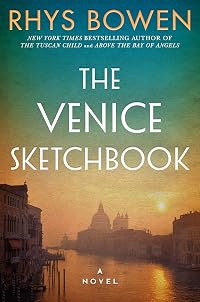
The Venice Sketchbook
by Rhys Bowen
On This Page
Description
"Caroline Grant is struggling to accept the end of her marriage when she receives an unexpected bequest. Her beloved great-aunt Lettie leaves her a sketchbook, three keys, and a final whisper ... Venice. Caroline's quest: to scatter Juliet "Lettie" Browning's ashes in the city she loved and to unlock the mysteries stored away for more than sixty years. It's 1938 when art teacher Juliet Browning arrives in romantic Venice. For her students, it's a wealth of history, art, and beauty. For show more Juliet, it's poignant memories and a chance to reconnect with Leonardo Da Rossi, the man she loves whose future is already determined by his noble family. However star-crossed, nothing can come between them. Until the threat of war closes in on Venice and they're forced to fight, survive, and protect a secret that will bind them forever. Key by key, Lettie's life of impossible love, loss, and courage unfolds. It's one that Caroline can now make right again as her own journey of self-discovery begins."--Publisher. show lessTags
Recommendations
























Member Reviews
I enjoy historical fiction (although WWII storylines need to have something extra to interest me at this point) and I am fascinated by Venice and Venetian society. I've read and enjoyed a couple of books from Rhys Bowen's Her Royal Spyness series. So I thought that her novel, The Venice Sketchbook, this dual timeline story of uncovering secrets from a beloved deceased relative through a bequest would be enjoyable. It would be predictable, sure. How could it not with a premise like it had? And it was fine. Yep. Just fine. And that was a disappointment.
Juliet "Lettie" Browning first goes to Venice in 1928 with her formidable Aunt Hortensia. She meets a handsome Venetian man named Leonardo Da Rossi and sneaks out of her room to share a show more late night picnic with him, and a kiss too. She is whisked away from Venice after this but she cannot forget Leo, who, it turns out, is from a wealthy, prominent, and respected family. A decade later, after her family's financial hardship has forced her to give up her place at art college and take on the position of art mistress at an all girls school, she leads a school trip to Venice where she meets Leo again, dines with him, and discovers that he is to be married to the woman who was chosen for him at her birth. Once again she leaves and cannot forget him or the forbidden kiss they again shared. A year later she returns to Venice again, despite Europe being on the cusp of war. This time she has been granted a year's bursary, during she will be able to take classes at the art accadamia. And again she runs into the now unhappily married Leo. The shadow of the looming war and their decade long feelings for each other create unforeseeable complications.
In 2001, Lettie's great niece Caroline is processing her divorce. Her ex is now dating a famous American pop star and he has asked for their six year old son Teddy to spend the summer with them. When Teddy is supposed to fly home to England and his mother, 9/11 happens and he has to stay in the US. Even when it's safe for him to come home, ex Josh contends that Teddy's too traumatized to fly and so won't send him home, leaving Caroline no recourse to get her son back. In the meantime, her beloved Great Aunt Lettie, who lives with the grandmother who raised Caroline, has a stroke and is clearly dying. Caroline rushes to her in time to hear her dying wish that Caroline go to Venice and that she be given the box in Lettie's closet. The box contains sketchbooks from Venice, glass beads, a ring, and an unlabeled set of keys. A bit lost without Teddy, unhappy with her job, and having unused vacation time, Caroline decides to go to Venice to scatter some of Lettie's ashes and see if she can uncover what her great aunt clearly wanted her to discover. While there, she will meet her own handsome Da Rossi.
The novel moves back and forth between the historical and the more modern day timelines. Juliet's story, told in first person through her diaries, is at least 2/3 of the novel, while Caroline's sections are third person narration and at most 1/3 of the story. Juliet's story was definitely more interesting than Caroline's so this imbalance was fine. There is a prologue that is repeated quite far into the novel which implies a very different book than the one we get. It is not a spy story. It is a love story (maybe times two). There is the ever frustrating insta-love (twice!) on which the whole story hinges. Early on, Caroline repeats, on almost every page, that she wishes Aunt Lettie had just told her what she wanted her to know rather than it being such a mystery. Granted, without this ambiguity from Aunt Lettie, there would be no story, but even so, Caroline's frustration got incredibly repetitious. The mystery of Aunt Lettie's time in Venice was never really mysterious to the reader though and the novel is littered with too many unlikely coincidences in order to make what we know has to happen actually come about. The novel is slow to start (perhaps because of all the repetition) and all of the action piles up in the end. There are many descriptive passages about Venice, really drawing a picture of the tourist areas of the city for the reader, and Bowen has focused on the feasts and celebrations that set Venetians apart, including from their fellow Italians, even to the point of continuing to hold their traditional festivals as the world sinks into WWII. Perhaps it is this sense of partying while the rest of the world burns that leads to a far less than expected amount of tension when the war does finally come to Venice. There are likewise certain plot elements that arise that should be blockbusters and yet they just peter out and get dropped. There is a kernel of a stronger story here, even with the predictable elements, and I'm sorry that it didn't come to fruition. This is okay for the romance, weak on the mystery, but a decent enough read if you're just killing time. How's that for damning it with faint praise? show less
Juliet "Lettie" Browning first goes to Venice in 1928 with her formidable Aunt Hortensia. She meets a handsome Venetian man named Leonardo Da Rossi and sneaks out of her room to share a show more late night picnic with him, and a kiss too. She is whisked away from Venice after this but she cannot forget Leo, who, it turns out, is from a wealthy, prominent, and respected family. A decade later, after her family's financial hardship has forced her to give up her place at art college and take on the position of art mistress at an all girls school, she leads a school trip to Venice where she meets Leo again, dines with him, and discovers that he is to be married to the woman who was chosen for him at her birth. Once again she leaves and cannot forget him or the forbidden kiss they again shared. A year later she returns to Venice again, despite Europe being on the cusp of war. This time she has been granted a year's bursary, during she will be able to take classes at the art accadamia. And again she runs into the now unhappily married Leo. The shadow of the looming war and their decade long feelings for each other create unforeseeable complications.
In 2001, Lettie's great niece Caroline is processing her divorce. Her ex is now dating a famous American pop star and he has asked for their six year old son Teddy to spend the summer with them. When Teddy is supposed to fly home to England and his mother, 9/11 happens and he has to stay in the US. Even when it's safe for him to come home, ex Josh contends that Teddy's too traumatized to fly and so won't send him home, leaving Caroline no recourse to get her son back. In the meantime, her beloved Great Aunt Lettie, who lives with the grandmother who raised Caroline, has a stroke and is clearly dying. Caroline rushes to her in time to hear her dying wish that Caroline go to Venice and that she be given the box in Lettie's closet. The box contains sketchbooks from Venice, glass beads, a ring, and an unlabeled set of keys. A bit lost without Teddy, unhappy with her job, and having unused vacation time, Caroline decides to go to Venice to scatter some of Lettie's ashes and see if she can uncover what her great aunt clearly wanted her to discover. While there, she will meet her own handsome Da Rossi.
The novel moves back and forth between the historical and the more modern day timelines. Juliet's story, told in first person through her diaries, is at least 2/3 of the novel, while Caroline's sections are third person narration and at most 1/3 of the story. Juliet's story was definitely more interesting than Caroline's so this imbalance was fine. There is a prologue that is repeated quite far into the novel which implies a very different book than the one we get. It is not a spy story. It is a love story (maybe times two). There is the ever frustrating insta-love (twice!) on which the whole story hinges. Early on, Caroline repeats, on almost every page, that she wishes Aunt Lettie had just told her what she wanted her to know rather than it being such a mystery. Granted, without this ambiguity from Aunt Lettie, there would be no story, but even so, Caroline's frustration got incredibly repetitious. The mystery of Aunt Lettie's time in Venice was never really mysterious to the reader though and the novel is littered with too many unlikely coincidences in order to make what we know has to happen actually come about. The novel is slow to start (perhaps because of all the repetition) and all of the action piles up in the end. There are many descriptive passages about Venice, really drawing a picture of the tourist areas of the city for the reader, and Bowen has focused on the feasts and celebrations that set Venetians apart, including from their fellow Italians, even to the point of continuing to hold their traditional festivals as the world sinks into WWII. Perhaps it is this sense of partying while the rest of the world burns that leads to a far less than expected amount of tension when the war does finally come to Venice. There are likewise certain plot elements that arise that should be blockbusters and yet they just peter out and get dropped. There is a kernel of a stronger story here, even with the predictable elements, and I'm sorry that it didn't come to fruition. This is okay for the romance, weak on the mystery, but a decent enough read if you're just killing time. How's that for damning it with faint praise? show less
This historical romance is a colorful homage to Venice, its watery splendor, and its idiosyncratic residents. Two Englishwomen, a great-aunt and niece, experience the city during WW II and post-9/11, and both become entangled with men of an aristocratic family. In 1928, Juliet Browning, a budding artist, escapes her dull life in rural England and, after falling into a canal, returns twice and develops a permanent connection to the city and a spy's role fighting fascism and Mussolini. After her death in 2001, grandniece Caroline visits Venice to scatter Juliet's ashes and uncovers the mysteries of her aunt’s surprising life, most unlike that of the "quiet spinster" she thought she knew. The vivid portraits of proud Venetians are show more beautifully rendered, and although there's space for a sequel, the denouement is pleasing in the saga, performed winningly on audio. show less
This is a fair story poorly written. The dialogue is never realistic, and the voice of the young British woman of the late 1920s sounds suspiciously like modern American. This bothered me all the way through and made an unbelievable story even more so. Lots of little things don't add up, and overall, it reminded me other similar books by other authors who set their stories in Italy or France. I don't know about you, but I will read the occasional mediocre novel if it is set in Italy or Fance. A lost Paris apartment; a lost Venetian apartment; a lost wine cellar... I guess these all rate as easy, summer reads. Juliet's stupidity only grows with time, and what is presented as love seemed to me selfishness. And a word to anyone betrayed in show more time of war. Don't not tell another concerned party so as not to hurt their feelings. Unless made public, that person who betrayed you will go on to betray others. show less
I can’t believe it…this is the first book I have read by prolific writer Rhys Bowen. Although I thought it somewhat fairytailish, after the last few years, maybe it was just nice to escape into a fairy tale, albeit bittersweet.
Although somewhat formulaic, I found the story gripping; I couldn’t put it down. I liked how the plot unfolded by moving forward and backward in time. As a bonus, the beautiful city of Venice is also one of the main characters….and I enjoyed revisiting some of my favorite experiences, locations, and foods.
Although somewhat formulaic, I found the story gripping; I couldn’t put it down. I liked how the plot unfolded by moving forward and backward in time. As a bonus, the beautiful city of Venice is also one of the main characters….and I enjoyed revisiting some of my favorite experiences, locations, and foods.
This is the book to read when you've had enough of Paris during World War II, but still want to read a historical novel set in that time period. I enjoyed the change of city with Juliet leaving England to spend most of the novel in Venice (instead of Paris) before and during the second world war. This dual timeline story alternates between the years 1939-40's and 2001, when Caroline inherits her great aunt Lettie's sketchbook and old keys, with her only clue Lettie's whispered last word "Venice."
Author Rhys Bowen writes descriptively of the city of Venice - the streets, the canals, the holidays and festivals, the people, the art, and the food. I felt as if I had taken a trip there myself by the close of the book. She accurately presents show more the political climate of the time, just before Venice is overtaken by Hitler, and then continues to present the fear and danger the characters experience when the country is actually involved in the war. Juliet's romance in 1938 with Leo was difficult for me to believe, as was Caroline's romance with Leo's great uncle in 2001 - very coincidental.
So suspend your disbelief when reading this novel if you want a "feel-good" World War II story containing romance and mystery, and without too much description of the actual wartime horrors of concentration camps. show less
Author Rhys Bowen writes descriptively of the city of Venice - the streets, the canals, the holidays and festivals, the people, the art, and the food. I felt as if I had taken a trip there myself by the close of the book. She accurately presents show more the political climate of the time, just before Venice is overtaken by Hitler, and then continues to present the fear and danger the characters experience when the country is actually involved in the war. Juliet's romance in 1938 with Leo was difficult for me to believe, as was Caroline's romance with Leo's great uncle in 2001 - very coincidental.
So suspend your disbelief when reading this novel if you want a "feel-good" World War II story containing romance and mystery, and without too much description of the actual wartime horrors of concentration camps. show less
Caroline Grant's marriage has fallen apart and she is struggling to move forward when her Great Aunt Lettie dies and leaves her all of her possessions: a cardboard box containing two leather-bound books and a jewelry case with three keys, an old-fashioned ring with a row of small diamonds, and a string of glass beads, along with a whisper ...Venice. Caroline's son, Teddy, has gone to visit his father in NYC. Caroline decides to go to Venice to scatter Great Aunt Lettie's ashes and see if she can find out what the keys open. There begins Caroline's journey to discover Juliet Browning's time in Venice where she began her first sketchbook in May 1928 when her aunt took her to a Italy for a visit before she began her art studies in London. show more While out on her own, she rescues a box of kittens floating in a canal and almost drowns before being rescued by Leonardo Da Rossi, the son of a wealthy and noble family in Venice. Juliette goes out with Leo one night, but is seen and is summarily taken away from Venice by her aunt. Unfortunately 1929 happened and the family lost most of their money forcing Letty to take a job teaching in a girl's school to support her mother and herself. Fast forward to 1938 when Juliette co-leads an excursion of students to Venice to sketch and take in the attractions of Venice. While there she sees Leo again. In 1939, a 1-year sabbatical with stipend becomes available to Juliette to study in Venice. She jumps at this chance and enrolls in art school in Venice as a foreign student along with several others from around Europe. World War II is gearing up, but Venetians expect things to continue as they always have. The story follows Juliette's experiences in Venice just before and during WWII and Caroline's quest for information about Juliette's time there. Caroline finds some surprising answers and meets Luca Da Rossi, the current son and heir to the Da Rossi name and fortune. show less
Another book about WWII, clandestine activities, love found and denied, a time when men and women were a bit more selfless, willing to suffer to serve their country and fellow man, trying to endure through the worst personal losses. Setting this story in Venice was a huge plus as the city became perhaps the most important distraction and component. In this dual time line story I found the war years much more interesting and important than the story that evolved in 2001. The mechanism to get the reader back to the mystery worked even in its shallow framework, but was it really necessary to cast a newly divorced mother as so completely helpless?
The lead up to the ending became obvious and the neat tidy package was just a little too show more perfect. Wishing once again for half stars this was a 3-1/2 star read for me.Thank you NetGalley and Lake Union Publishing for a copy. show less
The lead up to the ending became obvious and the neat tidy package was just a little too show more perfect. Wishing once again for half stars this was a 3-1/2 star read for me.Thank you NetGalley and Lake Union Publishing for a copy. show less
Members
- Recently Added By
Lists

Italian adventures
21 works; 1 member
Author Information

191+ Works 28,371 Members
Rhys Bowen was born Janet Quin-Harkin in 1941 in Bath, England. She earned her bachelors degree from the University of London. Soon after graduation she worked for the British Broadcasting Corporation as a studio manager and writer. She then took a job working for a textbook company developing reading texts before writing her own books. Her first show more picture book - Peter Penny's Dance - was published in 1976 and changed her career to children's book author. The book earned praise and won numerous awards. In 1981 she wrote a teen novel entitled California Girl which became the first installment in Bantam's Sweet Dreams series. This series grew to include novels such as Love Match, Daydreamer, and Ten-Boy Summer. These Sweet Dreams books started a major trend in young adult publishing. they were praised as an encouragement to reading. Janet Quin-Harkin also authored non-series fiction for adolescents such as award winning novel Wanted: Date for Saturday Night and Summer Heat. She also wrote the young adult historical novels Madam Sarah and Fool's Gold. She then moved on to writng mystery novels whcih included her Constable Evans series. Her book Royal Blood made the New York Times Bestseller list. (Bowker Author Biography) show less
Some Editions
Awards and Honors
Common Knowledge
- Canonical title
- The Venice Sketchbook
- Important places
- Venice, Veneto, Italy
- Dedication
- This book is dedicated to my dear friend and choir director extraordinaire, Ann Weiss. Singing with her choir has been one of the most meaningful experiences of my life. Not only does Ann have the voice of an angel, she also... (show all) has a love affair with Venice I hope she'll enjoy revisiting vicariously with this novel.
- First words
- "I have an ulterior motive for visiting you, apart from saying goodbye."
- Last words
- (Click to show. Warning: May contain spoilers.)And she pictured Josh's face when she arrived in New York with Luca at her side, to bring Teddy home.
Classifications
Statistics
- Members
- 457
- Popularity
- 66,832
- Reviews
- 29
- Rating
- (3.93)
- Languages
- English
- Media
- Paper, Audiobook, Ebook
- ISBNs
- 11
- ASINs
- 3