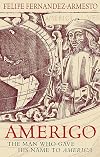
Amerigo: The Man Who Gave His Name to America
by Felipe Fernández-Armesto
On This Page
Description
In this groundbreaking work, leading historian Felipe Fernandez-Armesto tells the story of our hemisphere as a whole, showing why it is impossible to understand North, Central, and South America in isolation without turning to the intertwining forces that shape the region. With imagination, thematic breadth, and his trademark wit, Fernandez-Armesto covers a range of cultural, political, and social subjects, taking us from the dawn of human migration to North America to the colonial and show more independence periods to the "American century" and beyond. Fernandez-Armesto does nothing less than revise the conventional wisdom about cross-cultural exchange, conflict, and interaction, making and supporting some brilliantly provocative conclusions about the Americas' past and where we are headed. show lessTags
Recommendations













Member Reviews
Fernández-Armesto is ever-witty, erudite, and engaging. His research is wide and detailed. His story told with verve. This is the best biography of Amerigo Vespucci that exists, and probably will be the best for generations.
Vespucci was nothing special. He was not a navigator. Unlike Columbus the Genoese, he was a landlubbing Florentine. He was not a competent businessman. He made no vast sums. He was not a conquistador. He found no riches like Cortés. Vespucci was a middling factotum for larger Florentine interests who probably captained no ships and only made two voyages, not the three or four often ascribed to him.
Fernández-Armesto calls him a magus. A trickster who parleyed his late-Renaissance learning, his Florentine-Medici show more connections, and his gift for self-promotion into a sort of fame, or infamy. He wrote to his sometime patron, Lorenzo di Pierfrancesco de' Medici, and others, playing up his travels. He exaggerated and hyperbolized his mere tagging along on a Spanish expedition and a Portuguese expedition, turning these into grand explorations under his captaincy. All poppycock. But the books that came into print under his name, Fernández-Armesto claims that he had a hand in all of them, made him into a superstar. The books had the standard tropes of the genre (Sir John Mandeville and Columbus were his models): cannibals, naked savages, wild birds, exotic fauna and flora, and the like. These books became bestsellers, and Vespucci's fame brought him a job with the Spanish (a job that he did not do particularly well) and reputation. This reputation led to the strange incident of Martin Waldseemüller and Matthias Ringmann slapping his name on the South American continent they put on their 1507 wall map of the world. Why? They believed Vespucci's P.R. that he had found a "new world," a "new continent." Fernández-Armesto points out, he didn't discover it, he didn't land on it first, and he wasn't the first to call it something new (Columbus himself had called it an "otro mundo," an "other world"). But he got the credit. And the name stuck.
A fine book all around: writing, research, reading. Good endnotes, good index, decent images (Fernández-Armesto dismisses the conjecture via Vasari that the boy painted in the Madonna della Misericordia by Domenico Ghirlandaio at the Ognissanti church in Florence is a young Amerigo), one map. The only thing which knocked it down to 4.5 stars is the lack of a bibliography/suggested readings. show less
Vespucci was nothing special. He was not a navigator. Unlike Columbus the Genoese, he was a landlubbing Florentine. He was not a competent businessman. He made no vast sums. He was not a conquistador. He found no riches like Cortés. Vespucci was a middling factotum for larger Florentine interests who probably captained no ships and only made two voyages, not the three or four often ascribed to him.
Fernández-Armesto calls him a magus. A trickster who parleyed his late-Renaissance learning, his Florentine-Medici show more connections, and his gift for self-promotion into a sort of fame, or infamy. He wrote to his sometime patron, Lorenzo di Pierfrancesco de' Medici, and others, playing up his travels. He exaggerated and hyperbolized his mere tagging along on a Spanish expedition and a Portuguese expedition, turning these into grand explorations under his captaincy. All poppycock. But the books that came into print under his name, Fernández-Armesto claims that he had a hand in all of them, made him into a superstar. The books had the standard tropes of the genre (Sir John Mandeville and Columbus were his models): cannibals, naked savages, wild birds, exotic fauna and flora, and the like. These books became bestsellers, and Vespucci's fame brought him a job with the Spanish (a job that he did not do particularly well) and reputation. This reputation led to the strange incident of Martin Waldseemüller and Matthias Ringmann slapping his name on the South American continent they put on their 1507 wall map of the world. Why? They believed Vespucci's P.R. that he had found a "new world," a "new continent." Fernández-Armesto points out, he didn't discover it, he didn't land on it first, and he wasn't the first to call it something new (Columbus himself had called it an "otro mundo," an "other world"). But he got the credit. And the name stuck.
A fine book all around: writing, research, reading. Good endnotes, good index, decent images (Fernández-Armesto dismisses the conjecture via Vasari that the boy painted in the Madonna della Misericordia by Domenico Ghirlandaio at the Ognissanti church in Florence is a young Amerigo), one map. The only thing which knocked it down to 4.5 stars is the lack of a bibliography/suggested readings. show less
It's true that this book may not be everyone's cup of tea. It's got more methodological discussion than most popular histories but less detail than many academic histories. At the same time, its hybrid character is one of the things that makes it remarkably good if you have time to look more closely. In addition to giving a good biographical narrative of Amerigo Vespucci's life, Fernández-Armesto offers some nicely nuanced thoughts on how historians handle and debate figures who left so few primary sources behind. His discussion of disputes over the authenticity or inauthenticity of various printed travel accounts that bear Vespucci's name is particularly illuminating, as is his discussion of how Vespucci's writings reflect not just show more what he saw but what he had read (and therefore had used to interpret what he believed he had found). There is also some terrific contextual material on the intellectual, political, and commercial milieu of Florence and its relations to the Iberian voyages. Overall this is a concise but not necessarily quick read, but if you have time to savor it a bit, the rewards are there. show less
"Amerigo Vespucci, who gave his name to America, was a pimp in his youth and a magus in his maturity," writes Felipe Fernández-Armesto His subject is reminiscent of Melville's confidence man, a figure of protean energy and inventiveness, a Florentine operator constantly on the make and adept at the makeover. He is a startlingly contemporary personality, and so it is no wonder that the title of this biography puts us all on a first name basis with him.
Part of a n'er-do-well clan, Vespucci got his start working for the Medicis in Florence. Although previous biographers have assumed his early profession as a procurer of women and jewels signaled his close connection with the Medicis, his most recent biographer is skeptical. Lorenzo the show more Magnificent did not send his best boys to backwaters such as Seville. "Perhaps this is the moment to risk a speculation," Mr. Fernández-Armesto writes. Amerigo himself may have taken the initiative, desperate to cut loose from a dependent family and make his fortune.
Vespucci emerges in this witty biography as our hero, a picaresque merchant who goes broke backing Columbus's voyages and then decides to become an explorer himself, setting out in 1499 after his more famous predecessor was generally acknowledged to have failed to make good on his promises: No huge caches of gold, no pathway to Asia, no benign natives, and no paradisal climates.
Amerigo's two voyages brought him no significant riches but rather a wealth of stories about exotic lands and a whole new continent. So he wrote it all up. Lots of it was hooey, but some of it was based on personal observation. And Amerigo's reputation as a navigator, acquired through on-the-job training, grew. He put his name on maps, starting with a Florentine publication in 1504 that would go through 23 printings, describing harrowing adventures and miraculous escapes.
Other geographers, thrilled by Amerigo's accounts, published a huge map in 1507 with his name emblazoned on what is today Brazil. Oops! They soon realized that Vespucci had laid claim to too much. But without CNN and the 24-hour news cycle, it was too late. And so we all became Amerigonians.
Mr. Fernández-Armesto obviously relishes his subject's prevarications and those gullible followers who made so much of a name. In his retelling, history becomes a bit of a farce when it is not obscured by "romantic illusions." Even familiar concepts like the Renaissance get a drubbing. Sounding like the Senator Ted Stevens of biography, Mr. Fernández-Armesto shouts:
"It inaugurated modern times." No: Every generation has its own modernity, which grows out of the whole of the past. "It was revolutionary." No: Scholarship has detected half a dozen prior renaissances. … "It was art for art's sake." No: It was manipulated by plutocrats and politicians.
And there is much more to the list of no's in this iconoclastic, irreverent, but also superbly researched portrayal of a subject gifted at getting history to take him at his word.
We live in a country named by mistake. But to get the joke, you have to accept this biographer's shrewd research. show less
Part of a n'er-do-well clan, Vespucci got his start working for the Medicis in Florence. Although previous biographers have assumed his early profession as a procurer of women and jewels signaled his close connection with the Medicis, his most recent biographer is skeptical. Lorenzo the show more Magnificent did not send his best boys to backwaters such as Seville. "Perhaps this is the moment to risk a speculation," Mr. Fernández-Armesto writes. Amerigo himself may have taken the initiative, desperate to cut loose from a dependent family and make his fortune.
Vespucci emerges in this witty biography as our hero, a picaresque merchant who goes broke backing Columbus's voyages and then decides to become an explorer himself, setting out in 1499 after his more famous predecessor was generally acknowledged to have failed to make good on his promises: No huge caches of gold, no pathway to Asia, no benign natives, and no paradisal climates.
Amerigo's two voyages brought him no significant riches but rather a wealth of stories about exotic lands and a whole new continent. So he wrote it all up. Lots of it was hooey, but some of it was based on personal observation. And Amerigo's reputation as a navigator, acquired through on-the-job training, grew. He put his name on maps, starting with a Florentine publication in 1504 that would go through 23 printings, describing harrowing adventures and miraculous escapes.
Other geographers, thrilled by Amerigo's accounts, published a huge map in 1507 with his name emblazoned on what is today Brazil. Oops! They soon realized that Vespucci had laid claim to too much. But without CNN and the 24-hour news cycle, it was too late. And so we all became Amerigonians.
Mr. Fernández-Armesto obviously relishes his subject's prevarications and those gullible followers who made so much of a name. In his retelling, history becomes a bit of a farce when it is not obscured by "romantic illusions." Even familiar concepts like the Renaissance get a drubbing. Sounding like the Senator Ted Stevens of biography, Mr. Fernández-Armesto shouts:
"It inaugurated modern times." No: Every generation has its own modernity, which grows out of the whole of the past. "It was revolutionary." No: Scholarship has detected half a dozen prior renaissances. … "It was art for art's sake." No: It was manipulated by plutocrats and politicians.
And there is much more to the list of no's in this iconoclastic, irreverent, but also superbly researched portrayal of a subject gifted at getting history to take him at his word.
We live in a country named by mistake. But to get the joke, you have to accept this biographer's shrewd research. show less
No book on Vespucci is easy given his complicated and poorly documented life and explorations. Unfortunately, the author adds to the difficulty with a writing style that is overly academic and stilted. 30% of the work is devoted to the inner workings of life in early 16th century Florence and Seville, including unnecessarily detailed discussions of the Medici clan. While this background is helpful for an appreciation of both to whom and why Vespucci wrote some of his letters, one simple chapter would have sufficed. As another example, the author includes many references to persons of that period with no real importance to the work, other than perhaps to demonstrate the author's breadth of knowledge.
On the positive, the author's show more skeptical analysis of various claims and voyages by Vespucci is helpful, although a more concise writing style would have afforded more clarity.
Not recommended for the casual reader looking for an introduction into Vespucci's fascinating life. show less
On the positive, the author's show more skeptical analysis of various claims and voyages by Vespucci is helpful, although a more concise writing style would have afforded more clarity.
Not recommended for the casual reader looking for an introduction into Vespucci's fascinating life. show less
Armesto's biography of Amerigo Vespucci is a cautious (sometimes overly so) piece, given that there is so little evidence of his life. From the few things we do know, he pulls together a compelling work, quick to dispel fraudulent or apocryphal texts. The book gets a little dry when parsing through all the contemporaneous publications supposedly by Vespucci, and even the author admits it. It's a nice small read that helps to illuminate how America the place name came into being.
In this book we learn of the mediocre Amerigo Vespucci who was at the right place at the right time in History to have a hemisphere named after him. Not much has ever been known of things man and this book, though shedding some light, confirms that this figure of history will not have a detailed biography written about him. The author does his best to explore the Italian explorer Amerigo Vespucci life with all available references that could be found. The author describes Vespucci's various careers as jewel trader, navigator, cosmographer, and author. We read of Amerigo's business endeavors in the New World and his rivalry with Columbus. More importantly this biography document's Vespucci's lack of accomplishments and his knack for self show more -promotion. show less
This is an academic book and not for the feint of heart. It is full of excellent information and is well-presented.
Members
- Recently Added By
Published Reviews
ThingScore 100
Fernández-Armesto’s previous books about world history and exploration — “The Americas,” “Civilizations” and “Pathfinders,” among them — are must reading in these globally minded times. But even a historian of Fernández-Armesto’s learning and reach might have chosen to ignore the fact that 2007 marks the 500th anniversary of the naming of America. Except for a few brief show more narratives and letters, the record is maddeningly slight when it comes to Vespucci. But “Amerigo: The Man Who Gave His Name to America” is much more than an occasional throwaway. Using the bare bones of what is known about Vespucci to expatiate on subjects as diverse as the brutal world of Renaissance Italy, the importance of trade winds to world history and the poetics of travel writing, Fernández-Armesto has written a provocative primer on how navigators like Columbus and Vespucci set loose the cultural storm that eventually created the world we live in today. show less
added by bewogenlucht
Fernández-Armesto, a history professor at Tufts University, tells this complicated story with verve and skill, likening his own journey through its facts, forgeries, myths and prejudices to Vespucci's voyage of discovery. His lively style is effective in evoking the flashy and violent world of Renaissance Europe, and his wide-ranging knowledge of the period illuminates the boundaries of the show more Eurocentric mindset as it attempted to come to terms with a New World. show less
added by bewogenlucht
Author Information

65+ Works 6,177 Members
Felipe Fernandez-Armesto, a world-renowed scholar and author, is the Principe de Asturias Professor of Spanish Culture and Civilization at Tufts University
Awards and Honors
Distinctions
Common Knowledge
- Canonical title
- Amerigo: The Man Who Gave His Name to America
- Original publication date
- 2007-08-07
- People/Characters
- Amerigo Vespucci
- Important places
- Florence, Tuscany, Italy; Seville, Andalusia, Spain; Saint-Dié-des-Vosges, Grand-Est, France
Classifications
- Genres
- History, Nonfiction, Biography & Memoir, General Nonfiction
- DDC/MDS
- 970.01 — History & geography History of North America History of North America North America -1599
- LCC
- E125 .V5 .F47 — History of the United States America Discovery of America and early explorations Post-Columbian period. El Dorado
- BISAC
Statistics
- Members
- 209
- Popularity
- 156,030
- Reviews
- 9
- Rating
- (3.41)
- Languages
- English, Italian, Portuguese, Spanish
- Media
- Paper, Audiobook, Ebook
- ISBNs
- 14
- ASINs
- 4