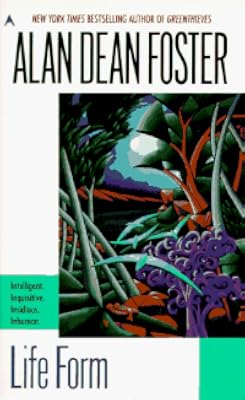
Life Form
by Alan Dean Foster
On This Page
Description
HTML:Humanity makes first—and possibly last—contact with an alien species in this sci-fi adventure from the New York Times–bestselling author of the Humanx Commonwealth series. Earth's most elite team of scientists has made an astonishing discovery. Far from our solar system is the life-sustaining planet Xica, home of an advanced intelligent species who have created a human-like civilization. Invited to visit, the scientists explore a world of miraculous wonders that defies the very show more laws of nature as they know it. But Xica's secrets may threaten not only their lives but the lives of everyone on Earth . . . Science Fiction. Fiction. show lessTags
Recommendations
































Member Reviews
Foster tends to write what might be called "middle-of-the-road" science fiction -- neither space opera (though Icerigger came close) nor high-tech tales, and Life Form slots nicely into his wheelhouse.
An group of human explorers has just landed on a planet that an early, unmanned flyby probe marked "promising", and has found an absolute cornucopia of strange and exotic life. But the planet holds both secrets and surprises, and not all of them are benign.
Foster has put a lot of thought into how such an expedition might actually work. (For one thing, his explorers don't Captain Kirk boldly into an unknown environment with nothing but brightly colored uniforms and futuristic blasters.) The life forms they discover are brilliantly original, show more and the story that develops has just enough twists to hold the reader's interest.
If there's a weak spot in the book, it's characterization. There are eleven members of the exploration team, and it's probably inevitable that not each of them is going to become a fully-developed character. Even a couple of the main cplayers (in the sense of their importance to the plot) don't get much more than a skin-deep analysis.
Still, it's an enjoyable read, and even manages to slip some existential questions in sideways. show less
An group of human explorers has just landed on a planet that an early, unmanned flyby probe marked "promising", and has found an absolute cornucopia of strange and exotic life. But the planet holds both secrets and surprises, and not all of them are benign.
Foster has put a lot of thought into how such an expedition might actually work. (For one thing, his explorers don't Captain Kirk boldly into an unknown environment with nothing but brightly colored uniforms and futuristic blasters.) The life forms they discover are brilliantly original, show more and the story that develops has just enough twists to hold the reader's interest.
If there's a weak spot in the book, it's characterization. There are eleven members of the exploration team, and it's probably inevitable that not each of them is going to become a fully-developed character. Even a couple of the main cplayers (in the sense of their importance to the plot) don't get much more than a skin-deep analysis.
Still, it's an enjoyable read, and even manages to slip some existential questions in sideways. show less
An elite Earth scientist team explores the planet Xica. They discover a seemingly idyllic, advanced humanoid civilization, but soon realize the world’s inhabitants and its flora/fauna are not what they appear, endangering the researchers in a fight for survival
Ratings
Members
- Recently Added By
Author Information

364+ Works 73,729 Members
Bestselling science fiction writer Alan Dean Foster was born in New York City in 1946, but raised mainly in California. He received a B.A. in Political Science from UCLA in 1968, and a M.F.A. in 1969. Foster enjoys traveling because it gives him opportunities to meet new people and explore new places and cultures. This interest is carried over to show more his writing, but with a twist: the new places encountered in his books are likely to be on another planet, and the people may belong to an alien race. Foster began his career as an author when a letter he sent to Arkham Collection was purchased by the editor and published in the magazine in 1968. His first novel, The Tar-Aiym Krang, introduced the Humanx Commonwealth, a galactic alliance between humans and an insectlike race called Thranx. Several other novels, including the Icerigger trilogy, are also set in the world of the Commonwealth. The Tar-Aiym Krang also marked the first appearance of Flinx, a young man with paranormal abilities, who reappears in other books, including Orphan Star, For Love of Mother-Not, and Flinx in Flux. Foster has also written The Damned series and the Spellsinger series, which includes The Hour of the Gate, The Moment of the Magician, The Paths of the Perambulator, and Son of Spellsinger, among others. Other books include novelizations of science fiction movies and television shows such as Star Trek, The Black Hole, Starman, Star Wars, and the Alien movies. Splinter of the Mind's Eye, a bestselling novel based on the Star Wars movies, received the Galaxy Award in 1979. The book Cyber Way won the Southwest Book Award for Fiction in 1990. His novel Our Lady of the Machine won him the UPC Award (Spain) in 1993. He also won the Ignotus Award (Spain) in 1994 and the Stannik Award (Russia) in 2000. He is the recipient of the Faust, the IAMTW Lifetime achievement award. Alan Dean Foster's Star Wars: The Force Awakens, was a 2015 New York Times bestseller. (Bowker Author Biography) show less
Some Editions
Common Knowledge
- Canonical title
- Life Form
- First words
- Twenty-four hours to wake up, and in all that time you didn’t even get to yawn once.
- Last words
- (Click to show. Warning: May contain spoilers.)So much so that he was contemplating the novel idea of trying to become one himself.
Classifications
Statistics
- Members
- 313
- Popularity
- 101,836
- Reviews
- 2
- Rating
- (3.32)
- Languages
- Czech, English
- Media
- Paper, Ebook
- ISBNs
- 5
- ASINs
- 2