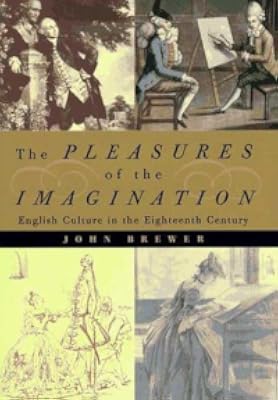
The Pleasures of the Imagination: English Culture in the Eighteenth Century
by John Brewer
On This Page
Description
'If you want to understand how British culture reinvented itself in the eighteenth century, read The Pleasures of the Imagination ... Like all really original achievements it makes us sharply rethink things we supposed we knew well, but it does so with humour and humanity, and through the text runs Brewer's remarkable intellect: forceful, lucid and penetrating.' Simon Schama'The Pleasures of the Imagination is a splendid cornucopia of a book. It describes the contortions of the eighteenth show more century as it developed a culture ... It is full of pure delight ... The marve show lessTags
Recommendations


























Member Reviews
And one of the pleasures is reading! A study of the role of culture in eighteenth century (mostly) English society. A study, in fact, of an explosion and an exciting one but the commercial and social explosion rather more than the individual cultural one as publications, prints, music and theatre became available to a wider and wider part of the population and were no longer the preserve of the aristocracy.
This was the time of the start of the Industrial Revolution and in some ways this is a cultural revolution. Books, newspapers, pamphlets, prints (as in etchings) and printed music were the subjects of technical change too and became increasingly cheaper. Theatres could get larger and so seats were cheaper.
It is not a sedate show more ‘eighteenth-century’ story. Raucous theatres, dubious pleasure gardens and even more dubious printed works feature, but so do the first novels, Handel’s Messiah and Pope’s translations of Homer.
Brewer is in many ways showing how British culture created itself through the market which is an interesting thought in itself. Britain lacked a monarchy with the means or inclination to champion or fund culture to any extent. Aristocrats lacked the inclination, perhaps because a high percentage of their time was spent in the country and they tended more to the huntin and shootin.
So the concert hall was invented and anyone who could buy a ticket could go to a public performance instead of one in a duke's palace. Or take 'books'. Once the writer had to rely on patronage from the very rich and powerful. This changed. There was an industry called Grub Street. You come across it in The Dunciad but Brewer itemises it. It was an arm of the publishing business. Booksellers/publishers saw openings in the market – because a rival bookshop had published a successful bestseller or a topic was very hot – and employed individuals or teams from Grub Street to compile, write, plagiarise or assemble something that could be sold. The London bookseller/publisher would sell them in his own outlet(s) and booksellers outside London would be constantly on the lookout for the fashionable or saleable. Yes, this is how Johnson's Dictionary was created. The result was perhaps not the more common instantly forgettable work but the process had a lot in common with all of the others. Like any successful market it created its own expansion. New booksellers opened in London as others went bankrupt or retired. They all had more and more books to sell. In the provinces each town wanted to emulate London's culture. So they had not only bookshops selling the latest books and prints but Meeting Rooms where concerts could be held or music societies could assemble using the printed music now available. In the larger cities a theatre would be opened.
And so 'culture' expanded – the pleasures of the imagination were spread about more widely. Some people may only have been following much of it for reasons of fashion but Brewer quotes contemporaries who enjoyed the delights of culture and sought it out for its own sake. Of course much of it was ephemeral – but as today a few works of permanent were spread across the land to all the middling classes. It led to the rise of the novel, the play, the oratorio, concerts and more which continued long after the end of the century. show less
This was the time of the start of the Industrial Revolution and in some ways this is a cultural revolution. Books, newspapers, pamphlets, prints (as in etchings) and printed music were the subjects of technical change too and became increasingly cheaper. Theatres could get larger and so seats were cheaper.
It is not a sedate show more ‘eighteenth-century’ story. Raucous theatres, dubious pleasure gardens and even more dubious printed works feature, but so do the first novels, Handel’s Messiah and Pope’s translations of Homer.
Brewer is in many ways showing how British culture created itself through the market which is an interesting thought in itself. Britain lacked a monarchy with the means or inclination to champion or fund culture to any extent. Aristocrats lacked the inclination, perhaps because a high percentage of their time was spent in the country and they tended more to the huntin and shootin.
So the concert hall was invented and anyone who could buy a ticket could go to a public performance instead of one in a duke's palace. Or take 'books'. Once the writer had to rely on patronage from the very rich and powerful. This changed. There was an industry called Grub Street. You come across it in The Dunciad but Brewer itemises it. It was an arm of the publishing business. Booksellers/publishers saw openings in the market – because a rival bookshop had published a successful bestseller or a topic was very hot – and employed individuals or teams from Grub Street to compile, write, plagiarise or assemble something that could be sold. The London bookseller/publisher would sell them in his own outlet(s) and booksellers outside London would be constantly on the lookout for the fashionable or saleable. Yes, this is how Johnson's Dictionary was created. The result was perhaps not the more common instantly forgettable work but the process had a lot in common with all of the others. Like any successful market it created its own expansion. New booksellers opened in London as others went bankrupt or retired. They all had more and more books to sell. In the provinces each town wanted to emulate London's culture. So they had not only bookshops selling the latest books and prints but Meeting Rooms where concerts could be held or music societies could assemble using the printed music now available. In the larger cities a theatre would be opened.
And so 'culture' expanded – the pleasures of the imagination were spread about more widely. Some people may only have been following much of it for reasons of fashion but Brewer quotes contemporaries who enjoyed the delights of culture and sought it out for its own sake. Of course much of it was ephemeral – but as today a few works of permanent were spread across the land to all the middling classes. It led to the rise of the novel, the play, the oratorio, concerts and more which continued long after the end of the century. show less
You happen to have some spare time one mid-afternoon and so you decide to pop into your local bookseller.
Meandering through the history section, you come upon this thick volume: "The Pleasures of the Imagination", by John Brewer. Humm! Why, this should be quite a book, You think (You are of course a fan of Boswell's Life of Johnson, the novels of Jane Austen and Henry Fielding, and other 18th century works)...
Indeed, such a very promising book--the culture of 18th century Britain, the plays, the critics, the booksellers, the rivalries, the ribaldry, the rabble. You pull the book from its place upon the shelf and open to the first page. How shalt the author pull the reader into this wonderful, dynamic world of art?
"High culture is less show more a set of discrete works of art than a phenomenon shaped by circles of conversation and criticism formed by its creators, distributors, and consumers."
Oh, uhm, yes...come to think of it, you have a couple shirts to be picked up at the dry cleaner's...
Yet another academic writer who has mistaken a work of history meant for popular consumption with some esoteric treatise on quantum mechanics. The info's there, but the means of conveyance is sadly lacking... show less
Meandering through the history section, you come upon this thick volume: "The Pleasures of the Imagination", by John Brewer. Humm! Why, this should be quite a book, You think (You are of course a fan of Boswell's Life of Johnson, the novels of Jane Austen and Henry Fielding, and other 18th century works)...
Indeed, such a very promising book--the culture of 18th century Britain, the plays, the critics, the booksellers, the rivalries, the ribaldry, the rabble. You pull the book from its place upon the shelf and open to the first page. How shalt the author pull the reader into this wonderful, dynamic world of art?
"High culture is less show more a set of discrete works of art than a phenomenon shaped by circles of conversation and criticism formed by its creators, distributors, and consumers."
Oh, uhm, yes...come to think of it, you have a couple shirts to be picked up at the dry cleaner's...
Yet another academic writer who has mistaken a work of history meant for popular consumption with some esoteric treatise on quantum mechanics. The info's there, but the means of conveyance is sadly lacking... show less
This book is a collection of ideas and incidents that illustrates the evolution of English culture in the eighteenth century. These details in this wonderful story foreshadow the present.
excellent
Ratings
Members
- Recently Added By
Lists

501 Must-Read Books
529 works; 72 members

Books Read in 2020
4,379 works; 124 members
Author Information

21+ Works 1,028 Members
Awards and Honors
Awards
Notable Lists
Common Knowledge
- Canonical title
- The Pleasures of the Imagination: English Culture in the Eighteenth Century
- Original publication date
- 1997
- People/Characters
- Jonathan Swift; James Boswell; Daniel Defoe; Rousseau, Jean-Jacques, 1712-1778
- Important places
- Covent Garden, London, England, UK
Classifications
Statistics
- Members
- 403
- Popularity
- 76,959
- Reviews
- 4
- Rating
- (3.94)
- Languages
- English, Italian
- Media
- Paper, Ebook
- ISBNs
- 11
- ASINs
- 3