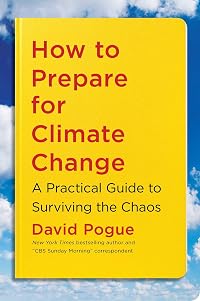
How to Prepare for Climate Change: A Practical Guide to Surviving the Chaos
by David Pogue
On This Page
Description
"A practical and comprehensive guide to surviving the greatest disaster of our time, from New York Times bestselling self-help author and beloved CBS Sunday Morning science and technology correspondent David Pogue"--Tags
Recommendations



Member Reviews
It is a truism that no one person understands all of the income tax law of the United States. It is that bizarre, convoluted and complicated. To this, David Pogue is adding all of the potential disasters from climate change. In his How to Prepare for Climate Change, Pogue exhaustively describes what readers can only hope is every conceivable disaster, weakness, aid agency and product to help readers survive. It is not merely exhaustive; it is exhausting.
From one angle, the book is an almanac of all the many destructive forces making their presence known on Earth. It describes floods, droughts, firestorms, hurricanes, tornadoes and other such fun in excruciating detail. And always with a view to escaping with your life.
From another show more angle, it’s a prepper book, detailing how to stock, reinforce and prepare your home and your life for the nearly inevitable evacuation order. Because pretty much everywhere has a climate weakness that can blow up into a once in 500 years disaster. As Pogue shows, they happen with record breaking variety and frequency. Drought and firestorm areas are enlarging frighteningly. So are tornado areas. Hurricanes are not only larger, they are slower and they linger. No longer over in a matter of hours, they hang around for days. So 150-225 mph winds are not just something to withstand overnight; houses must now survive them for days. Huddling in the safe room could become unbearable itself.
And from yet another angle, it is how to deal with aftermath. How to cope with insurance policies and companies, government agencies, disaster funds, breakdowns in communications, utilities, contractors and services. It is all very distressing, and we know so much about it now because it is happening all over the world all the time. Pogue says about a million Americans already lose their homes to disasters every year. And this is the calm era. Things won’t really get out of hand before mid century. Then we can look forward to millions losing their homes annually.
He begins by clarifying the terminology. Climate change is just a euphemism. He thinks we need to refer to it as climate chaos. If the climate itself wasn’t so chaotic, the way we deal with it would be sufficiently chaotic on its own. Pogue goes into great detail about how federal flood insurance works, how it distorts the market, has driven private insurers out of business, and has the perverse effect of making homeowners in flood zones feel secure instead of feeling like moving to somewhere drier. For example, no matter how many times victims tap their insurance, their rates never go up.
Dealing with insurance companies is another trial; their whole existence seems predicated on how much they can avoid paying out when disaster strikes. That means making it as burdensome as possible for those daring to make claims, also known as customers.
This might be an early warning of things to come. Insurance companies are already routinely denying renewals in disaster-prone areas. More and more people are going without insurance – and not by choice. Pogue cites an expert who thinks insurance might become “largely a luxury that might just be available for the rich.”
So a lot of ink is spent on the need to photograph all possessions, attach proof of value, and make several copies, including for safe deposit boxes, the cloud and a go bag.
Go bags come up repeatedly. Everyone should have a bag packed and ready to go at any moment. It needs to contain essentials like meds, which have to be refreshed continuously, backup prescriptions, which also need constant renewal (if you can even get a paper version), some clothing, flashlights, an NOAA radio, papers such a deeds so you can prove it’s your house when you return, and on and on. Pets need go bags too. Being at work when the evacuation order hits means being unable to get home first, so go bags must be duplicated for the office as well. The burden of being prepared means lots of work and lots of redundancy.
Then there are the effects and necessities of sustainability to survive climate chaos. I particularly appreciated his criticism of lawns: “Oh man. The lawn thing. Environmentalists, botanists, and horticulturalists cannot stand mowed lawns.” They are water hogs, with roots that only reach down an inch, necessitating 1.5 inches of rain every week. They need constant chemical feeding and of course, they need mowing, which pollutes the air. Clover is far better in all aspects except the golf-green look.
As you can see, Pogue likes to step out from behind the dispassionate reporter role and add a sly, snarky or sarcastic remark from time to time. It makes him human, the text more entertaining, and frankly, less depressing. He also refers readers back and forth a lot. Various topics show up more than once, under different headings. So the book is constantly self-referential, sending readers back to chapter two or forward to chapter 14 where the topic is also explained – sometimes a little differently.
The book goes so far as to dabble in the psychological aspects. Pogue consults experts, and recommends how to deal with children: “’Everything will be okay’ is the one thing you cannot say to children right now,” if you want any sort of trust, credibility or cooperation from them. It’s a time of increased suicides and women declining to have children at all. The whole world knows what is going on. Everyone can see it. It’s only the politicians who deny it. Okay, and Fox News viewers. The point is, it’s got the world in a state of taut stress that has consequences by itself.
There are also physical side effects to climate chaos. As Pogue explains it, periods of drought can cause increases in diarrhea and skin and eye infections because people don’t wash their hands as often. Today, 9% of children have hayfever, and noses run 27 days longer than they did in the 1950s. And by now everyone knows mosquitos, among other friends, are spreading towards the poles as the colder climes become more accommodating. He describes the various fatal and near fatal diseases they carry in painful detail.
Even when we do good we do bad. Pogue says water treatment plants dump more than 850 billion gallons of sewage into public waterways annually in the USA alone. In Chicago, just 2.5 inches of rain is enough to overwhelm the treatment plants, and raw sewage shoots up through manhole covers. After Hurricane Harvey in 2017, human feces were still washing up on Texas shores seven months later.
He doesn’t write much about the plastics plague, other than to warn against polyester clothing in a firestorm. The material will melt into your skin and burn it. On the other hand, in a hurricane, polyester will wick away water from your body better than natural fibers, which get soaked and heavy. If you’re in a car underwater because you stupidly figured you could drive through it, cotton will weigh you down. So everyone must evaluate every disaster differently.
It’s so complicated, Pogue sometimes finds himself giving contradictory advice. For example, he recommends not going out during the day, but to do everything outdoors at dawn or dusk during heatwaves and droughts. Triple digit temperatures can kill. (Construction workers in some places already must work nights instead of days.) But later, he says the most dangerous times of day are dawn and dusk, when mosquitos are most active during droughts. It transpires that mosquitos breed much more during droughts because streams stop flowing, leaving pools of standing, warm water everywhere. This is precisely what mosquitos require to breed.
Pogue provides a semi-useful list and description of cities and towns that have prepared better or will be spared the worst effects of climate chaos, in case readers are looking for where the grass is greener. They are thumbnail sketches of parkland, fresh water access and the cost of living. Unfortunately his list of attributes stops there. He doesn’t rate them by taxes or social ills. So while Chicago makes the list of most desirable places to move to, readers might be advised to check out crime, unrest and even Pogue’s own description of sewage backup from heavy rains there. They don’t call it The Windy City for nothing.
The last chapters list a bunch of experiments and trends that show we can potentially rein in the carbon and the pollution. From crazy geoengineering ideas to pollute space and the oceans to deflect sunlight and encourage plankton, to strict discipline in cutting back on carbon-burning, efforts are underway around the world. Every climate book seems to require this section, either to show there is hope or to minimize depression, but the truth is Man has yet to make a dent in the rise of sea or air temperatures. Carbon levels continue to set records going back millions of years. Things continue to worsen, and so the need for How to Prepare for Climate Change.
The book begins with a word that was new to me: solastalgia – the longing for your home the way it was. Having read the book, I know it is pointless to think in those terms. A new world is dawning, and it will little resemble the good old days. This is a fairly clear-eyed look into the tense and risky future.
David Wineberg show less
From one angle, the book is an almanac of all the many destructive forces making their presence known on Earth. It describes floods, droughts, firestorms, hurricanes, tornadoes and other such fun in excruciating detail. And always with a view to escaping with your life.
From another show more angle, it’s a prepper book, detailing how to stock, reinforce and prepare your home and your life for the nearly inevitable evacuation order. Because pretty much everywhere has a climate weakness that can blow up into a once in 500 years disaster. As Pogue shows, they happen with record breaking variety and frequency. Drought and firestorm areas are enlarging frighteningly. So are tornado areas. Hurricanes are not only larger, they are slower and they linger. No longer over in a matter of hours, they hang around for days. So 150-225 mph winds are not just something to withstand overnight; houses must now survive them for days. Huddling in the safe room could become unbearable itself.
And from yet another angle, it is how to deal with aftermath. How to cope with insurance policies and companies, government agencies, disaster funds, breakdowns in communications, utilities, contractors and services. It is all very distressing, and we know so much about it now because it is happening all over the world all the time. Pogue says about a million Americans already lose their homes to disasters every year. And this is the calm era. Things won’t really get out of hand before mid century. Then we can look forward to millions losing their homes annually.
He begins by clarifying the terminology. Climate change is just a euphemism. He thinks we need to refer to it as climate chaos. If the climate itself wasn’t so chaotic, the way we deal with it would be sufficiently chaotic on its own. Pogue goes into great detail about how federal flood insurance works, how it distorts the market, has driven private insurers out of business, and has the perverse effect of making homeowners in flood zones feel secure instead of feeling like moving to somewhere drier. For example, no matter how many times victims tap their insurance, their rates never go up.
Dealing with insurance companies is another trial; their whole existence seems predicated on how much they can avoid paying out when disaster strikes. That means making it as burdensome as possible for those daring to make claims, also known as customers.
This might be an early warning of things to come. Insurance companies are already routinely denying renewals in disaster-prone areas. More and more people are going without insurance – and not by choice. Pogue cites an expert who thinks insurance might become “largely a luxury that might just be available for the rich.”
So a lot of ink is spent on the need to photograph all possessions, attach proof of value, and make several copies, including for safe deposit boxes, the cloud and a go bag.
Go bags come up repeatedly. Everyone should have a bag packed and ready to go at any moment. It needs to contain essentials like meds, which have to be refreshed continuously, backup prescriptions, which also need constant renewal (if you can even get a paper version), some clothing, flashlights, an NOAA radio, papers such a deeds so you can prove it’s your house when you return, and on and on. Pets need go bags too. Being at work when the evacuation order hits means being unable to get home first, so go bags must be duplicated for the office as well. The burden of being prepared means lots of work and lots of redundancy.
Then there are the effects and necessities of sustainability to survive climate chaos. I particularly appreciated his criticism of lawns: “Oh man. The lawn thing. Environmentalists, botanists, and horticulturalists cannot stand mowed lawns.” They are water hogs, with roots that only reach down an inch, necessitating 1.5 inches of rain every week. They need constant chemical feeding and of course, they need mowing, which pollutes the air. Clover is far better in all aspects except the golf-green look.
As you can see, Pogue likes to step out from behind the dispassionate reporter role and add a sly, snarky or sarcastic remark from time to time. It makes him human, the text more entertaining, and frankly, less depressing. He also refers readers back and forth a lot. Various topics show up more than once, under different headings. So the book is constantly self-referential, sending readers back to chapter two or forward to chapter 14 where the topic is also explained – sometimes a little differently.
The book goes so far as to dabble in the psychological aspects. Pogue consults experts, and recommends how to deal with children: “’Everything will be okay’ is the one thing you cannot say to children right now,” if you want any sort of trust, credibility or cooperation from them. It’s a time of increased suicides and women declining to have children at all. The whole world knows what is going on. Everyone can see it. It’s only the politicians who deny it. Okay, and Fox News viewers. The point is, it’s got the world in a state of taut stress that has consequences by itself.
There are also physical side effects to climate chaos. As Pogue explains it, periods of drought can cause increases in diarrhea and skin and eye infections because people don’t wash their hands as often. Today, 9% of children have hayfever, and noses run 27 days longer than they did in the 1950s. And by now everyone knows mosquitos, among other friends, are spreading towards the poles as the colder climes become more accommodating. He describes the various fatal and near fatal diseases they carry in painful detail.
Even when we do good we do bad. Pogue says water treatment plants dump more than 850 billion gallons of sewage into public waterways annually in the USA alone. In Chicago, just 2.5 inches of rain is enough to overwhelm the treatment plants, and raw sewage shoots up through manhole covers. After Hurricane Harvey in 2017, human feces were still washing up on Texas shores seven months later.
He doesn’t write much about the plastics plague, other than to warn against polyester clothing in a firestorm. The material will melt into your skin and burn it. On the other hand, in a hurricane, polyester will wick away water from your body better than natural fibers, which get soaked and heavy. If you’re in a car underwater because you stupidly figured you could drive through it, cotton will weigh you down. So everyone must evaluate every disaster differently.
It’s so complicated, Pogue sometimes finds himself giving contradictory advice. For example, he recommends not going out during the day, but to do everything outdoors at dawn or dusk during heatwaves and droughts. Triple digit temperatures can kill. (Construction workers in some places already must work nights instead of days.) But later, he says the most dangerous times of day are dawn and dusk, when mosquitos are most active during droughts. It transpires that mosquitos breed much more during droughts because streams stop flowing, leaving pools of standing, warm water everywhere. This is precisely what mosquitos require to breed.
Pogue provides a semi-useful list and description of cities and towns that have prepared better or will be spared the worst effects of climate chaos, in case readers are looking for where the grass is greener. They are thumbnail sketches of parkland, fresh water access and the cost of living. Unfortunately his list of attributes stops there. He doesn’t rate them by taxes or social ills. So while Chicago makes the list of most desirable places to move to, readers might be advised to check out crime, unrest and even Pogue’s own description of sewage backup from heavy rains there. They don’t call it The Windy City for nothing.
The last chapters list a bunch of experiments and trends that show we can potentially rein in the carbon and the pollution. From crazy geoengineering ideas to pollute space and the oceans to deflect sunlight and encourage plankton, to strict discipline in cutting back on carbon-burning, efforts are underway around the world. Every climate book seems to require this section, either to show there is hope or to minimize depression, but the truth is Man has yet to make a dent in the rise of sea or air temperatures. Carbon levels continue to set records going back millions of years. Things continue to worsen, and so the need for How to Prepare for Climate Change.
The book begins with a word that was new to me: solastalgia – the longing for your home the way it was. Having read the book, I know it is pointless to think in those terms. A new world is dawning, and it will little resemble the good old days. This is a fairly clear-eyed look into the tense and risky future.
David Wineberg show less
***.5
Mostly a general purpose disaster preparedness manual, for the sorts of natural disasters that are being made worse by climate change (extreme heatwaves, hurricanes, tornadoes, wildfires, etc.) supplemented by a brief explanation of how they are related to climate change.
For starters, don’t be a poor. Most of the advice is quite expensive, and aimed squarely at upper middle class suburban men who own their own homes. Although he acknowledges that most people won't be able to actually follow the recommendations, it's still somewhat useful to at least have the ideal approaches in mind when making decisions and compromises.
He also covers the practical side of mundane things that are often overlooked, such as filing insurance show more claims. And in addition to the standard prepper repertoire of go bags, evacuation plans, and food/water storage, there are sections on investing and business that are equally valid to the urban reader than the sections on lawn management and house construction that only apply to suburban and rural homeowners.
Towards the end, he zooms out and addresses more societal level solutions, which are less immediately useful in the case of a local disaster, but present a roadmap for longterm survival. It's not as tangible as the earlier sections, but provides both hope that the situation is already so bad that we might as well give up and not even try, and also context on how individual action feeds into the global equation (e.g. how what we choose to eat impacts crop choice, irrigation methods, and deforestation). show less
Mostly a general purpose disaster preparedness manual, for the sorts of natural disasters that are being made worse by climate change (extreme heatwaves, hurricanes, tornadoes, wildfires, etc.) supplemented by a brief explanation of how they are related to climate change.
For starters, don’t be a poor. Most of the advice is quite expensive, and aimed squarely at upper middle class suburban men who own their own homes. Although he acknowledges that most people won't be able to actually follow the recommendations, it's still somewhat useful to at least have the ideal approaches in mind when making decisions and compromises.
He also covers the practical side of mundane things that are often overlooked, such as filing insurance show more claims. And in addition to the standard prepper repertoire of go bags, evacuation plans, and food/water storage, there are sections on investing and business that are equally valid to the urban reader than the sections on lawn management and house construction that only apply to suburban and rural homeowners.
Towards the end, he zooms out and addresses more societal level solutions, which are less immediately useful in the case of a local disaster, but present a roadmap for longterm survival. It's not as tangible as the earlier sections, but provides both hope that the situation is already so bad that we might as well give up and not even try, and also context on how individual action feeds into the global equation (e.g. how what we choose to eat impacts crop choice, irrigation methods, and deforestation). show less
There’s a lot of good, practical advice for stupid people who insist on living on floodplains, in high risk forest fire areas, on American coastal areas, and in tornado zones.
But Pogue ends the book on a naive upbeat that technology and electric cars will end our dependencies on fossil fuels. The green movement relies on too much of this fuzzy green boosterism.
Big companies will continue to finance Donald Trumpism, as will midwestern bumpkins. And he didn’t believe in climate change, remember?
But Pogue ends the book on a naive upbeat that technology and electric cars will end our dependencies on fossil fuels. The green movement relies on too much of this fuzzy green boosterism.
Big companies will continue to finance Donald Trumpism, as will midwestern bumpkins. And he didn’t believe in climate change, remember?
Very thorough and eminently practical. It even covers what to do if you find yourself in a riot, as well as more pedestrian situations like your house being caught in a wildfire. However, specific data and advice is targeted for U.S. readers.
Ratings
Members
- Recently Added By
Lists

Climate Change
50 works; 1 member
Author Information

102+ Works 6,231 Members
David Pogue is an American technology writer and TV science presenter. He was born in 1963 and grew up in Shaker Heights, Ohio. Pogue graduated summa cum laude from Yale University in 1985, with distinction in music. After graduation, Pogue wrote manuals for music software, worked on Broadway and Off-Broadway productions, and wrote for Macworld show more Magazine. He wrote Macs for Dummies, which became the best-selling Mac title, as well as other books in the Dummies series. He launched his own series of humorous computer books entitled the Missing Manual series, which includes 120 titles. He spent 13 years as the personal-technology columnist for the New York Times, before leaving to found Yahoo Tech. In addition to how-to manuals, he wrote Pogue's Basics: Essential Tips and Shortcuts (That No One Bothers to Tell You) for Simplifying the Technology in Your Life, collaborated on The World According to Twitter, and co-authored The Weird Wide Web. (Bowker Author Biography) show less
Classifications
- Genres
- Science & Nature, Nonfiction, General Nonfiction
- DDC/MDS
- 363.738 — Society, government, & culture Social problems and social services Public Safety - Police, Crime Investigation Environmental Issues - Pollution, Recycling, Global Warming Pollution Pollutants by source
- LCC
- QC903 .P64 — Science Physics Physics Meteorology. Climatology
- BISAC
Statistics
- Members
- 113
- Popularity
- 288,942
- Reviews
- 4
- Rating
- (4.13)
- Languages
- English
- Media
- Paper, Audiobook, Ebook
- ISBNs
- 5
- ASINs
- 1