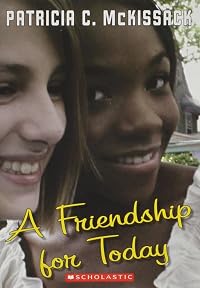
A Friendship for Today
by Patricia C. Mckissack
On This Page
Description
In 1954, when desegregation comes to Kirkland, Missouri, ten-year-old Rosemary faces many changes and challenges at school and at home as her parents separate.Tags
Recommendations














Member Recommendations
Member Reviews
Summary: Rosemary embarks on a new and terrifying adventure when her segregated school closes and she and her best friend J.J. are moved to an integrated school. When J.J. comes down with polio, Rosemary must face her class by herself, as the only colored girl in the entire sixth grade. Along with the normal challenges that come with entering middle school, Rosemary must face the unpleasant comments that come with her being colored. She soon finds herself in an odd predicament as Grace, the girl who used to constantly verbally abuse her because of being colored, is now standing up for Rosemary and they become friends. The book goes on about how Rosemary and Grace build their friendship even when Grace’s parents are clearly prejudiced. show more The two girls beat the odds as they become a strong pair of best friends and almost all of their class wants to be their friends too. In the end, the school year has finished up and Rosemary finds that Grace is moving back down south to where schools are still segregated because of her father’s wishes.
Review: McKissack has blown me away with this outstanding book that circles around teaching young readers the message of true friendship. In the beginning of the book Rosemary goes to a segregated school where she has gone her entire life with other colored children until she finds herself being moved to an integrated school the next year. At the start of the new school year she is faced with sitting next to Grace, a girl from her neighborhood that has constantly torn her apart verbally. The two girls found themselves out of the "in" crowd and when Rosemary is accused of stealing, by Grace, Grace then apologizes for her wrongdoing and this is the start of their unusual journey. Rosemary is able to teach Grace about her culture and ways and how they are not all that different from "white peoples" ways. Grace is able to then teach Rosemary that not all "white people" are prejudiced and some may not want to be, so they are trying their best to change, like Grace. The two grow an unbreakable bond by the end of the book and truly shows the reader that friendship is a fragile, yet strong, bond that is an essential part of growing up. show less
Review: McKissack has blown me away with this outstanding book that circles around teaching young readers the message of true friendship. In the beginning of the book Rosemary goes to a segregated school where she has gone her entire life with other colored children until she finds herself being moved to an integrated school the next year. At the start of the new school year she is faced with sitting next to Grace, a girl from her neighborhood that has constantly torn her apart verbally. The two girls found themselves out of the "in" crowd and when Rosemary is accused of stealing, by Grace, Grace then apologizes for her wrongdoing and this is the start of their unusual journey. Rosemary is able to teach Grace about her culture and ways and how they are not all that different from "white peoples" ways. Grace is able to then teach Rosemary that not all "white people" are prejudiced and some may not want to be, so they are trying their best to change, like Grace. The two grow an unbreakable bond by the end of the book and truly shows the reader that friendship is a fragile, yet strong, bond that is an essential part of growing up. show less
Extremely heartwarming and uplifting, Patricia C. McKissack's newest novel A Friendship for Today is an phenomenal example of the true importance of friendship. McKissack successfully shows readers that it's A-OK to be unique!
I think the characters in A Friendship for Today were actually quite well-done. They each had different "dementions" and unique personalities. Each character is so realistic as well!
The problem that I had in terms of characterization in A Friendship for Today was the character's relationships with other characters. These connections, at least for me, didn't seem very realistic or well-developed.
The plot was very intriguing - I typically don't read historical fiction THAT much, but A Friendship for show more Today stood out because of it's unique plot and amazing writing style. The way Patricia McKissack is able to write so darn accurately from the perspective of a middle schooler is something I will never be capable of!
However, I did find the whole scenario about Rosemary's parents kind of unnecessary to the plot. The relationship between Rosemary's parents (and the whole scenario between them, to say the least) was not very well developed either. However, it did make some great page-filling! :D
What actually surprised me was the Author's Note, saying that this whole book was practically an autobiography. Patricia McKissack...you are an amazing writer...and human being! Thank you for sharing so much with your readers! You are truly inspirational!
All in all, I highly enjoyed A Friendship for Today and would definitely recommend it to anyone interested in a heartwarming story about a powerful girl that you'll never forget! #4EverIntegrated show less
I think the characters in A Friendship for Today were actually quite well-done. They each had different "dementions" and unique personalities. Each character is so realistic as well!
The problem that I had in terms of characterization in A Friendship for Today was the character's relationships with other characters. These connections, at least for me, didn't seem very realistic or well-developed.
The plot was very intriguing - I typically don't read historical fiction THAT much, but A Friendship for show more Today stood out because of it's unique plot and amazing writing style. The way Patricia McKissack is able to write so darn accurately from the perspective of a middle schooler is something I will never be capable of!
However, I did find the whole scenario about Rosemary's parents kind of unnecessary to the plot. The relationship between Rosemary's parents (and the whole scenario between them, to say the least) was not very well developed either. However, it did make some great page-filling! :D
What actually surprised me was the Author's Note, saying that this whole book was practically an autobiography. Patricia McKissack...you are an amazing writer...and human being! Thank you for sharing so much with your readers! You are truly inspirational!
All in all, I highly enjoyed A Friendship for Today and would definitely recommend it to anyone interested in a heartwarming story about a powerful girl that you'll never forget! #4EverIntegrated show less
Reviewed by Mechele R. Dillard for TeensReadToo.com
On May 17, 1954, the Supreme Court of the United States made a historic ruling in the case of Brown v. Board of Education: Segregation of public schools was declared unconstitutional. And, like so many others, the life of twelve-year-old Rosemary Patterson was forever changed.
Rosemary doesn't really care for the idea of her school being closed just because of the decision. "If white people want to go to school with us so much, seems to me all they needed to do was ask. We'd make room for a few white kids at Attucks Elementary next year," she tells her mother. "Why did it take the Supreme Court to figure that out?" (p. 2). As was the case for many children of the time, Rosemary doesn't show more quite understand the significance of the ruling. Having grown up under the oppressive lie of "separate but equal," she just doesn't realize how wrong the system is, or how it actually affects her life. But, her mother promises, "Next year, when you are in a better school, you'll come to appreciate why this decision is so important" (p. 2).
As Rosemary goes through her classes at Robertson Elementary--the only "colored" student in the sixth grade after her best friend, J. J., is diagnosed with polio--she learns about hatred. She learns about intolerance. But she also learns about friendship. And she learns that sometimes people really can change. Things seem too much to handle in the beginning, but the local storekeeper, Mr. Bob, encourages her to keep her chin up: "You are a pioneer in the real sense of the word, Rosemary. Whenever you are the first, you are going to have it hard" (71).
This book, while fiction, is based on McKissack's own experience as a young girl in 1954 Missouri, facing her sixth-grade class as the only African-American student. Students today of every ethnic background will find the details fascinating, and will wonder, just as Rosemary did, "Why did it take the Supreme Court to figure that out?" (p. 2). And while it is a sign of success that children today cannot truly comprehend a society segregated by race, it is important that the struggles of those who led the fight--by choice or by circumstance--never be forgotten, as the fight for equality in the United States is still raging. A FRIENDSHIP FOR TODAY is an excellent example of courage and spirit for all children--and adults--to read, understand, admire, and, hopefully, carry forward. show less
On May 17, 1954, the Supreme Court of the United States made a historic ruling in the case of Brown v. Board of Education: Segregation of public schools was declared unconstitutional. And, like so many others, the life of twelve-year-old Rosemary Patterson was forever changed.
Rosemary doesn't really care for the idea of her school being closed just because of the decision. "If white people want to go to school with us so much, seems to me all they needed to do was ask. We'd make room for a few white kids at Attucks Elementary next year," she tells her mother. "Why did it take the Supreme Court to figure that out?" (p. 2). As was the case for many children of the time, Rosemary doesn't show more quite understand the significance of the ruling. Having grown up under the oppressive lie of "separate but equal," she just doesn't realize how wrong the system is, or how it actually affects her life. But, her mother promises, "Next year, when you are in a better school, you'll come to appreciate why this decision is so important" (p. 2).
As Rosemary goes through her classes at Robertson Elementary--the only "colored" student in the sixth grade after her best friend, J. J., is diagnosed with polio--she learns about hatred. She learns about intolerance. But she also learns about friendship. And she learns that sometimes people really can change. Things seem too much to handle in the beginning, but the local storekeeper, Mr. Bob, encourages her to keep her chin up: "You are a pioneer in the real sense of the word, Rosemary. Whenever you are the first, you are going to have it hard" (71).
This book, while fiction, is based on McKissack's own experience as a young girl in 1954 Missouri, facing her sixth-grade class as the only African-American student. Students today of every ethnic background will find the details fascinating, and will wonder, just as Rosemary did, "Why did it take the Supreme Court to figure that out?" (p. 2). And while it is a sign of success that children today cannot truly comprehend a society segregated by race, it is important that the struggles of those who led the fight--by choice or by circumstance--never be forgotten, as the fight for equality in the United States is still raging. A FRIENDSHIP FOR TODAY is an excellent example of courage and spirit for all children--and adults--to read, understand, admire, and, hopefully, carry forward. show less
It's the last day of school, 1954, and Rosemary has just learned that next year she'll be going to a brand new integrated school. She's a little nervous about it, but everyone keeps telling her now nice this new school will be and how it's a great opportunity. Rosemary's sure she can handle it as long as her best friend J.J. is by her side. But then just before school starts, J.J. is stricken with polio and Rosemary learns that she'll be going to this new school by herself, the only black kid in her class. And what's worse? On her first day she discovers that Grace the Tasteless, one of the relentless Hamilton siblings that's made Rosemary's life miserable, is in her class and assigned to sit right next to her. As the school year goes show more on, Rosemary and Grace realize that maybe they have more in common than they thought...
I enjoyed this book about school integration. I think it's definitely a book about an important subject, but I could see it more being used to supplement educational curriculum than being picked up for pleasure. show less
I enjoyed this book about school integration. I think it's definitely a book about an important subject, but I could see it more being used to supplement educational curriculum than being picked up for pleasure. show less
Recommended Ages: Gr. 5-7
Plot Summary: Rosemary just finished a wonderful school year, but she's nervous about starting 6th grade because she and her best friend, JJ, will be the only black students in the class. For the first time, Robertson school is being integrated. When JJ misses the entire year because he is getting hydrotherapy treatment for polio, Rosemary doesn't have any friends left in her class, or even her school. When Katherine offers her a chance to come to her birthday party if she insults Grace, Rosemary refuses. Grace does the same for Rosemary and they slowly become friends.
Setting: Kirkland, Missouri, 1954
Characters:
Rosemary - 10 y/o
James Johnson Stenson, Jr. - AKA J.J., Rosemary's best friend, likes to run but show more isn't as fast as Rosemary until the day before he gets polio
Mama - seamstress, doesn't take Daddy back when he begs, officially divorces by end of book
Daddy - owns auto shop, fights with Mama all the time because he doesn't think she should be so independent
Miss Jean - daddy's new girlfriend, secretary at auto shop
Aunt Betty and Uncle John - JJ's parents, not Rosemary's real Aunt and Uncle
Mr. Bob - owns grocery store, was a member of the Tuskegee Airmen
Bevvy - high schooler who walks Rosemary and JJ to school
Jane Hamilton - 17 y/o, oldest
Stevie the Snake Hamilton - 15 y/o
Wayne the Whiner Hamilton - 16 y/o
Marty Hamilton - 12 y/o
Grace the Tasteless Hamilton - 10 y/o, goes to school with Rosemary at Robertson, was Rosemary's worst enemy but they become friends, despite Grace's family, ends up moving back to Arkansas where it's still segregated, very poor, live on Dead End a white block in the middle of the black neighborhood
Mr. Hamilton - moved family from Arkansas, racist
Mrs. Washington - JJ and Rosemary's beloved 5th grade teacher, tutors JJ when he's in the hospital
Estelean - Rosemary's friend from Attucks, goes to a different school for 6th grade that is more racist
Katherine Hogan - most popular girl at Robertson school
Ms. Denapolis - Rosemary's 6th grade teacher at Robertson, teaches "tolerance" as word for the year, does the blue eye-brown eye experiment for less than one day
Rags - Rosemary's cat she found badly injured on the train tracks
Ms. Lancet - principal at Robertson, very friendly and is happy school is integrated
Mr. Keggley - superintendent, racist, tries to get Rosemary to transfer into a remedial class at a different school
Recurring Themes: racism, segregation, divorce, integration, friendship, family, polio, school, teachers, bullying
Controversial Issues:
pg. 97 nigger
Personal Thoughts: This book seems to cover all of the major topics of this time period, even if it's just a brief mention. I thought it was a little too convenient, but the author's note explains the book is based on her experience as a child. I'm not sure if the author was as mature as Rosemary, however. Rosemary seemed to be wise beyond her years in every way. For example, she told JJ to get rid of his wheelchair because it would force him to use his legs. She never broke her morals in order to become popular. The symbolism with the injured cat rags is easy to understand.
Genre: historical fiction show less
Plot Summary: Rosemary just finished a wonderful school year, but she's nervous about starting 6th grade because she and her best friend, JJ, will be the only black students in the class. For the first time, Robertson school is being integrated. When JJ misses the entire year because he is getting hydrotherapy treatment for polio, Rosemary doesn't have any friends left in her class, or even her school. When Katherine offers her a chance to come to her birthday party if she insults Grace, Rosemary refuses. Grace does the same for Rosemary and they slowly become friends.
Setting: Kirkland, Missouri, 1954
Characters:
Rosemary - 10 y/o
James Johnson Stenson, Jr. - AKA J.J., Rosemary's best friend, likes to run but show more isn't as fast as Rosemary until the day before he gets polio
Mama - seamstress, doesn't take Daddy back when he begs, officially divorces by end of book
Daddy - owns auto shop, fights with Mama all the time because he doesn't think she should be so independent
Miss Jean - daddy's new girlfriend, secretary at auto shop
Aunt Betty and Uncle John - JJ's parents, not Rosemary's real Aunt and Uncle
Mr. Bob - owns grocery store, was a member of the Tuskegee Airmen
Bevvy - high schooler who walks Rosemary and JJ to school
Jane Hamilton - 17 y/o, oldest
Stevie the Snake Hamilton - 15 y/o
Wayne the Whiner Hamilton - 16 y/o
Marty Hamilton - 12 y/o
Grace the Tasteless Hamilton - 10 y/o, goes to school with Rosemary at Robertson, was Rosemary's worst enemy but they become friends, despite Grace's family, ends up moving back to Arkansas where it's still segregated, very poor, live on Dead End a white block in the middle of the black neighborhood
Mr. Hamilton - moved family from Arkansas, racist
Mrs. Washington - JJ and Rosemary's beloved 5th grade teacher, tutors JJ when he's in the hospital
Estelean - Rosemary's friend from Attucks, goes to a different school for 6th grade that is more racist
Katherine Hogan - most popular girl at Robertson school
Ms. Denapolis - Rosemary's 6th grade teacher at Robertson, teaches "tolerance" as word for the year, does the blue eye-brown eye experiment for less than one day
Rags - Rosemary's cat she found badly injured on the train tracks
Ms. Lancet - principal at Robertson, very friendly and is happy school is integrated
Mr. Keggley - superintendent, racist, tries to get Rosemary to transfer into a remedial class at a different school
Recurring Themes: racism, segregation, divorce, integration, friendship, family, polio, school, teachers, bullying
Controversial Issues:
pg. 97 nigger
Personal Thoughts: This book seems to cover all of the major topics of this time period, even if it's just a brief mention. I thought it was a little too convenient, but the author's note explains the book is based on her experience as a child. I'm not sure if the author was as mature as Rosemary, however. Rosemary seemed to be wise beyond her years in every way. For example, she told JJ to get rid of his wheelchair because it would force him to use his legs. She never broke her morals in order to become popular. The symbolism with the injured cat rags is easy to understand.
Genre: historical fiction show less
A great historical fiction novel based on the author's experiences during the initial years of school integration in St. Louis. So fun to read this and recognize many of the St. Louis landmarks that were mentioned.
Quick, easy read that would be good to focus on for character development. Both the main character, Rosemary, and her antagonist, Grace "The Tasteless", show good character foil and change throughout the novel.
Members
- Recently Added By
Author Information

152+ Works 26,665 Members
Patricia C. McKissack was born in Smyrna, Tennessee on August 9, 1944. She received a bachelor's degree in English from Tennessee State University in 1964 and a master's degree in early childhood literature and media programming from Webster University in 1975. After college, she worked as a junior high school English teacher and a children's book show more editor at Concordia Publishing. Since the 1980's, she and her husband Frederick L. McKissack have written over 100 books together. Most of their titles are biographies with a strong focus on African-American themes for young readers. Their early 1990s biography series, Great African Americans included volumes on Frederick Douglass, Marian Anderson, and Paul Robeson. Their other works included Black Hands, White Sails: The Story of African-American Whalers and Days of Jubilee: The End of Slavery in the United States. Over their 30 years of writing together, the couple won many awards including the C.S. Lewis Silver Medal, a Newbery Honor, nine Coretta Scott King Author and Honor awards, the Jane Addams Peace Award, and the NAACP Image Award for Sojourner Truth: Ain't I a Woman?. In 1998, they received the Coretta Scott King-Virginia Hamilton Award for Lifetime Achievement. She also writes fiction on her own. Her book included Flossie and the Fox, Stitchin' and Pullin': A Gee's Bend Quilt, A Friendship for Today, and Let's Clap, Jump, Sing and Shout; Dance, Spin and Turn It Out! She won the Newberry Honor Book Award and the King Author Award for The Dark Thirty: Southern Tales of the Supernatural in 1993 and the Caldecott Medal for Mirandy and Brother Wind. She dead of cardio-respiratory arrest on April 7, 2017 at the age of 72. (Bowker Author Biography) show less
Awards and Honors
Awards
Common Knowledge
- Canonical title
- A Friendship for Today
Classifications
Statistics
- Members
- 749
- Popularity
- 37,454
- Reviews
- 13
- Rating
- (4.09)
- Languages
- English, French
- Media
- Paper
- ISBNs
- 4
- ASINs
- 1