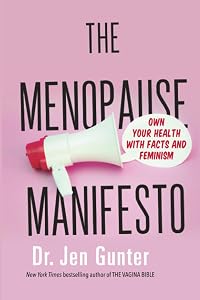
The Menopause Manifesto: Own Your Health with Facts and Feminism
by Jen Gunter
On This Page
Description
The only thing predictable about menopause is its unpredictability. Factor in widespread misinformation, a lack of research, and the culture of shame around women's bodies, and it's no wonder women are unsure what to expect during the menopause transition and beyond. Menopause is not a disease--it's a planned change, like puberty. And just like puberty, we should be educated on what's to come years in advance, rather than the current practice of leaving people on their own with bothersome show more symptoms and too much conflicting information. Knowing what is happening, why, and what to do about it is both empowering and reassuring. Filled with practical, reassuring information, this essential guide will revolutionize how women experience menopause--including how their lives can be even better for it! show lessTags
Recommendations

Member Reviews
The Menopause Manifesto is an owner's manual for your body for women in their 40s and 50s. Different chapters cover biological mechanics of menopause, the understanding of menopause in different historical periods across the world (primarily Europe and Asia), the change in risk profiles for adverse events (e.g. osteoporosis, heart disease), common symptoms and ways to address them, and the efficacy of different therapeutic interventions.
The absolute best part of the book is Dr. Gunter's insistence on going through the entire catalog of symptoms and writing about effective interventions. Is every woman going to choose an intervention? Probably not. But seriously, thank goodness for a medical professional *not* giving you that blank look show more that means they have NO IDEA how to help you.
This is my favorite type of science writing: practical and opinionated with plenty of citations and references, and a little bit of history. Note to people accustomed to footnotes: there are chapter endnotes but they're not referenced in the text. Keep a bookmark in the endnote section for the chapter you're reading. show less
The absolute best part of the book is Dr. Gunter's insistence on going through the entire catalog of symptoms and writing about effective interventions. Is every woman going to choose an intervention? Probably not. But seriously, thank goodness for a medical professional *not* giving you that blank look show more that means they have NO IDEA how to help you.
This is my favorite type of science writing: practical and opinionated with plenty of citations and references, and a little bit of history. Note to people accustomed to footnotes: there are chapter endnotes but they're not referenced in the text. Keep a bookmark in the endnote section for the chapter you're reading. show less
When I started going through perimenopause, my symptoms were causing me a lot of discomfort. When I spoke to my female doctor, I was told with a smile, "oh, that's just you being you! Grin and bear it!" WTAF? Gunter actually takes perimenopause and menopause symptoms seriously and offers science-based solutions. I wish I had read this ten years ago (if it had existed).
Not all doctors agree on all things, but Gunter offers reasons why she believes what she does, the science behind her recommendations and treatments. But there isn't a great body of science that has been done around menopause. That fact alone should infuriate you. When it is known that half the population is going to experience a given condition, you'd think there'd be show more more effort to understand it. #LifeInThePatriarchy show less
Not all doctors agree on all things, but Gunter offers reasons why she believes what she does, the science behind her recommendations and treatments. But there isn't a great body of science that has been done around menopause. That fact alone should infuriate you. When it is known that half the population is going to experience a given condition, you'd think there'd be show more more effort to understand it. #LifeInThePatriarchy show less
Listen sisters, there are over 45 million women in the USA alone who are in some stage of menopause, yet there is no chatter. Whether you’ve been through it, are there now or have it to look forward to (haha), this is a part of our natural body process, and we need to be talking about it… with each other, our doctors, our partners. We need to normalize talking about the mood swings, heavy bleeds, 6 week periods (omg seriously!), clots the size of golfballs, and what options are out there for relief. It’s a lonely, scary and wtf kind of place to try to navigate alone, and with so many of us, there’s no need. My sista friend was kind and open enough to talk with me recently & she recommended this book- it saved my sanity, opened show more conversation on this new adventure and I challenge us all to keep it going.
The Menopause Manifesto was written by an OB/GYN who understands not only the physiology of menopause but also the emotional and social aspects to it. Her voice is like talking to your smartest girl friend about wth is going on with your body when it seems like you no longer know yourself! There’s some female medical history, where we were and why we're here with the silence, a lot of what’s happening to your body and why, and options broken down. Dr Gunter is witty and real, this does not read like a medical or self help book but let me tell you, a lot of validation was occurring within the first hour of reading and I didn’t feel so alone in this. Like ‘Taking Charge of Your Fertility’ (not just about fertility- this teaches you about your female body & how it changes throughout your cycle each month!) and ‘What to Expect when You’re Expecting’, this book needs to be on your shelf. Facebook group posts mention some kind of women's health here & there which is great to get conversations started, but the misinformation and lack of knowledge about our bodies and how they function is rather shocking. Too many of us don’t know what’s happening within us, from puberty through menopause, or why, and this book goes a long way in entertainingly educating us about so much of it. Do yourself a favor and pick it up. Let’s normalize what over half the world population is going through that no one talks about. show less
The Menopause Manifesto was written by an OB/GYN who understands not only the physiology of menopause but also the emotional and social aspects to it. Her voice is like talking to your smartest girl friend about wth is going on with your body when it seems like you no longer know yourself! There’s some female medical history, where we were and why we're here with the silence, a lot of what’s happening to your body and why, and options broken down. Dr Gunter is witty and real, this does not read like a medical or self help book but let me tell you, a lot of validation was occurring within the first hour of reading and I didn’t feel so alone in this. Like ‘Taking Charge of Your Fertility’ (not just about fertility- this teaches you about your female body & how it changes throughout your cycle each month!) and ‘What to Expect when You’re Expecting’, this book needs to be on your shelf. Facebook group posts mention some kind of women's health here & there which is great to get conversations started, but the misinformation and lack of knowledge about our bodies and how they function is rather shocking. Too many of us don’t know what’s happening within us, from puberty through menopause, or why, and this book goes a long way in entertainingly educating us about so much of it. Do yourself a favor and pick it up. Let’s normalize what over half the world population is going through that no one talks about. show less
I received an advance edition of this book via NetGalley.
"Apparently there is nothing of lower value than an aging woman's body, and many in our society treat menopause not as a phase of life, but rather as a phase of death. Sort of a pre-death."
Jen Gunter confronts the subject of menopause through a distinctly matter-of-fact, feminist view in her book The Menopause Manifesto. She is an OB/GYN with decades of experience in her field, but also speaks from personal experience, having recently gone through 'the change' herself. As a person of 41 years, most definitely in perimenopause, I found her perspective refreshing. She discusses subjects like sex, bleeding, and hot flashes in blunt terms, and confronts the immense misinformation put show more forth by the media and lousy doctors. She brings in the history behind the very term and idea of menopause.
The book isn't always an easy read. While the subject is always interesting, some stretches were a bit dry. This wasn't something I could sit and read straight through, but in patches here and there. I found tremendous value in her words. Her humor is wry and witty, and her attitude wonderfully positive. For example, she points out, "Fat-phobia among health care providers has caused many women with hot flushes and night sweats to be dismissed. 'If you'd just lose weight' isn't appropriate medical therapy nor is it compassionate, and the horrible implication is some women deserve their symptoms." PREACH IT, JEN.
My gosh, but I wish I'd had a doctor like her early in my life. I wish I had a doctor like her now! I have a feeling that I will be returning to this book many, many times in the coming years. show less
"Apparently there is nothing of lower value than an aging woman's body, and many in our society treat menopause not as a phase of life, but rather as a phase of death. Sort of a pre-death."
Jen Gunter confronts the subject of menopause through a distinctly matter-of-fact, feminist view in her book The Menopause Manifesto. She is an OB/GYN with decades of experience in her field, but also speaks from personal experience, having recently gone through 'the change' herself. As a person of 41 years, most definitely in perimenopause, I found her perspective refreshing. She discusses subjects like sex, bleeding, and hot flashes in blunt terms, and confronts the immense misinformation put show more forth by the media and lousy doctors. She brings in the history behind the very term and idea of menopause.
The book isn't always an easy read. While the subject is always interesting, some stretches were a bit dry. This wasn't something I could sit and read straight through, but in patches here and there. I found tremendous value in her words. Her humor is wry and witty, and her attitude wonderfully positive. For example, she points out, "Fat-phobia among health care providers has caused many women with hot flushes and night sweats to be dismissed. 'If you'd just lose weight' isn't appropriate medical therapy nor is it compassionate, and the horrible implication is some women deserve their symptoms." PREACH IT, JEN.
My gosh, but I wish I'd had a doctor like her early in my life. I wish I had a doctor like her now! I have a feeling that I will be returning to this book many, many times in the coming years. show less
“I demand that the era of silence and shame about menopause yield to facts and feminism. I proclaim that we must stop viewing menopause as a disease, because that means being a woman is a disease and I reject that shoddily constructed hypothesis. I also declare that what the patriarchy thinks of menopause is irrelevant. Men do not get to define the value of women at any age.”
After 38 years of regular but long, heavy and painful periods (minus 4 successful pregnancies and three miscarriages), I’ve actually been looking forward to menopause in some ways. At 48, I have now been experiencing the symptoms of peri menopause for about 18 months, and while I expected some of the more well known effects such as hot flushes, insomnia and show more irregular bleeding, I now realise, thanks to Jen Gunter and The Menopause Manifesto, that the inexplicable joint pain I have been suffering may also be related.
For the uninformed, menopause occurs when there are no more follicles in the ovaries capable of ovulating, meaning there are no more eggs, and menstruation ceases. The average age when this happens is 50-52 years. However the transition to menopause (often referred to as peri menopause) can start several years earlier, and the length, and the severity of symptoms, may vary significantly from woman to woman. There are dozens of common symptoms and conditions associated with menopause from an increased risk of heart disease to a decrease in libido, but they don’t just occur in a vacuum - they may be influenced by general health, age and lifestyle factors. Gunter provides detailed but mostly accessible medical facts about the biological process of menopause, its medical ramifications, and a comprehensive guide to treatment options. Useful chapter summaries in point form are provided if you are inclined to skim the denser scientific material. Personal anecdotes and blunt observations from the author ensures the material is rarely dry.
The Menopause Manifesto not only delivers the science but also explores how menopause is perceived (primarily in America and similar cultures). Gunter includes discussion about patriarchal medicine’s tendency to dismiss or minimise the experience of menopause, the culture of shame attached to the transition, and the lack of education surrounding the process. The feminist slant of the book is unapologetic as Gunter encourages women to empower themselves with knowledge so as to better advocate for their own health.
The Menopause Manifesto is a comprehensive, practical resource for all in possession of female reproductive organs. I wish I had read something like this five years ago and strongly recommend that women aged from in their early forties consider educating themselves about menopause well in advance. show less
After 38 years of regular but long, heavy and painful periods (minus 4 successful pregnancies and three miscarriages), I’ve actually been looking forward to menopause in some ways. At 48, I have now been experiencing the symptoms of peri menopause for about 18 months, and while I expected some of the more well known effects such as hot flushes, insomnia and show more irregular bleeding, I now realise, thanks to Jen Gunter and The Menopause Manifesto, that the inexplicable joint pain I have been suffering may also be related.
For the uninformed, menopause occurs when there are no more follicles in the ovaries capable of ovulating, meaning there are no more eggs, and menstruation ceases. The average age when this happens is 50-52 years. However the transition to menopause (often referred to as peri menopause) can start several years earlier, and the length, and the severity of symptoms, may vary significantly from woman to woman. There are dozens of common symptoms and conditions associated with menopause from an increased risk of heart disease to a decrease in libido, but they don’t just occur in a vacuum - they may be influenced by general health, age and lifestyle factors. Gunter provides detailed but mostly accessible medical facts about the biological process of menopause, its medical ramifications, and a comprehensive guide to treatment options. Useful chapter summaries in point form are provided if you are inclined to skim the denser scientific material. Personal anecdotes and blunt observations from the author ensures the material is rarely dry.
The Menopause Manifesto not only delivers the science but also explores how menopause is perceived (primarily in America and similar cultures). Gunter includes discussion about patriarchal medicine’s tendency to dismiss or minimise the experience of menopause, the culture of shame attached to the transition, and the lack of education surrounding the process. The feminist slant of the book is unapologetic as Gunter encourages women to empower themselves with knowledge so as to better advocate for their own health.
The Menopause Manifesto is a comprehensive, practical resource for all in possession of female reproductive organs. I wish I had read something like this five years ago and strongly recommend that women aged from in their early forties consider educating themselves about menopause well in advance. show less
After a few chapters of history/rumination on misogyny in medicine, a very comprehensive overview of what we know about menopause’s physical—including cognitive/emotional—effects and variations, as well as potential treatments for different symptoms that are causing distress. I definitely agree that we need more information about and discussion of menopause: I had no idea that much, much heavier periods—enough so that I became anemic—were reasonably common in the menopause transition, until I started researching. She’s a fan of properly prescribed hormone therapy, and down on compounded medications, whose quality control/dose regularity is worse than Big Pharma’s even though their chemical composition is no more show more “natural” or better in any other way: “Compounded hormones aren’t helping women avoid the gaps in medicine; they’re exploiting them.” show less
I came to Dr. Jen Gunter's THE MENOPAUSE MANIFESTO through my gynecologist, who recommended it to me as an informative way to learn as much as possible about this next stage in life. I thought I was already fairly well-informed, as I spent the previous three years trying to understand why my body seemed to be going haywire. It turns out that you cannot learn enough about menopause because there is so much misinformation out there.
Dr. Gunter's manifesto provides you with all the details you could ever want about the menopause transition. Each section comes with its own set of Main Takeaways bullet points to remind you of what is truly important for you to remember. You can easily skip sections that don't interest you because she show more references any previous mention of a topic, should you need or want to refresh your memory.
THE MENOPAUSE MANIFESTO reads like Dr. Gunter recorded a general discussion she was having with one of her patients. Her tone is very informal, which helps when she is explaining the science behind medications, hormones, organ function, and the like. I did find the lax grammar usage a distraction. While I'm used to reading review copies with grammatical errors because they are still in the editing stage, I was surprised by how many errors made it through to the published version. It annoyed me, but I tried to believe that this was a deliberate editing choice to maintain the conversational tone.
Dr. Gunter's guide to menopause has a little something for any person with a uterus, whether they have started the transition or not. Not only does she provide the technical details behind what is happening to your body, but she also offers great advice on what to look for when online or from your doctor. In addition, she provides brief historical context to show how the idea of menopause and menopause treatments have evolved over the centuries.
I've followed Dr. Gunter on Instagram for over a year now, and she is one of the few sources of gynecological information not selling anything, including her books. She genuinely wants to ensure women have the most scientifically accurate information currently available. Everything she states, both online and in THE MENOPAUSE MANIFESTO, has scientific research behind it. Moreover, she takes the time to explain why a research study is good, bad, inconclusive, or promising. She does not hesitate to point out the misleading studies other menopause influencers cite, again with explanations as to why they are misleading.
Dr. Gunter brings to Instagram the same careful attention as you find in THE MENOPAUSE MANIFESTO. I recommend it to anyone who wants to learn more about the process, what to expect, and how best to handle the changes in your body as it starts going wonky. I even recommend sharing it with your partner so they know what to expect as well. The more everyone knows, the better it will be for all of your loved ones! show less
Dr. Gunter's manifesto provides you with all the details you could ever want about the menopause transition. Each section comes with its own set of Main Takeaways bullet points to remind you of what is truly important for you to remember. You can easily skip sections that don't interest you because she show more references any previous mention of a topic, should you need or want to refresh your memory.
THE MENOPAUSE MANIFESTO reads like Dr. Gunter recorded a general discussion she was having with one of her patients. Her tone is very informal, which helps when she is explaining the science behind medications, hormones, organ function, and the like. I did find the lax grammar usage a distraction. While I'm used to reading review copies with grammatical errors because they are still in the editing stage, I was surprised by how many errors made it through to the published version. It annoyed me, but I tried to believe that this was a deliberate editing choice to maintain the conversational tone.
Dr. Gunter's guide to menopause has a little something for any person with a uterus, whether they have started the transition or not. Not only does she provide the technical details behind what is happening to your body, but she also offers great advice on what to look for when online or from your doctor. In addition, she provides brief historical context to show how the idea of menopause and menopause treatments have evolved over the centuries.
I've followed Dr. Gunter on Instagram for over a year now, and she is one of the few sources of gynecological information not selling anything, including her books. She genuinely wants to ensure women have the most scientifically accurate information currently available. Everything she states, both online and in THE MENOPAUSE MANIFESTO, has scientific research behind it. Moreover, she takes the time to explain why a research study is good, bad, inconclusive, or promising. She does not hesitate to point out the misleading studies other menopause influencers cite, again with explanations as to why they are misleading.
Dr. Gunter brings to Instagram the same careful attention as you find in THE MENOPAUSE MANIFESTO. I recommend it to anyone who wants to learn more about the process, what to expect, and how best to handle the changes in your body as it starts going wonky. I even recommend sharing it with your partner so they know what to expect as well. The more everyone knows, the better it will be for all of your loved ones! show less
Members
- Recently Added By
Lists

Globe and Mail | Canadian Non-Fiction: Jan. 15, 2022
10 works; 1 member

Globe and Mail | Canadian Non-Fiction: March 11, 2023
10 works; 1 member

Books Read in 2023
5,547 works; 145 members

Globe and Mail | Canadian Non-Fiction: February 17, 2024
10 works; 1 member
Globe and Mail | Canadian Non-Fiction: March 2, 2024
10 works; 1 member

Globe and Mail | Canadian Non-Fiction: March 9, 2024
10 works; 1 member
Globe and Mail | Canadian Non-Fiction: March 16, 2024
10 works; 1 member
Author Information

6 Works 1,435 Members
Jennifer Gunter, Md, is an internationally renowned OB/GYN and a leading expert in the field of women's pain medicine. She lives with her family in Mill Valley, California.
Awards and Honors
Awards
Common Knowledge
- Original publication date
- 2021
- First words
- If menopause were on Yelp it would have one star.
- Last words
- (Click to show. Warning: May contain spoilers.)That's my manifesto.
Classifications
- Genres
- Sexuality and Gender Studies, General Nonfiction, Nonfiction, Science & Nature, Health & Wellness
- DDC/MDS
- 618.175 — Applied science & technology Medicine & health Gynecology, obstetrics, pediatrics, geriatrics Gynecology; Diseases of women Menopause
- LCC
- RG186 .G86 — Medicine Gynecology and Obstetrics Gynecology and obstetrics Functional and systemic disorders. Endocrine gynecology
- BISAC
Statistics
- Members
- 524
- Popularity
- 57,097
- Reviews
- 24
- Rating
- (4.12)
- Languages
- English, French, German, Spanish
- Media
- Paper, Audiobook, Ebook
- ISBNs
- 13
- ASINs
- 7