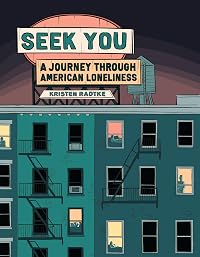
Seek You: A Journey Through American Loneliness
by Kristen Radtke
On This Page
Description
"When Kristen Radtke was in her twenties, she learned that, as her father was growing up, he would crawl onto his roof in rural Wisconsin and send signals out on his ham radio. Those CQ calls were his attempt to reach somebody--anybody--who would respond. In Seek You, Radtke uses this image as her jumping off point into a piercing exploration of loneliness and the ways in which we attempt to feel closer to one another. She looks at the very real current crisis of loneliness through the show more lenses of gender, violence, technology, and art. Ranging from the invention of the laugh-track to Instagram to Harry Harlow's experiments in which infant monkeys were given inanimate surrogate mothers, Radtke uncovers all she can about how we engage with friends, family, and strangers alike, and what happens--to us and to them--when we disengage. With her distinctive, emotionally charged drawings and unflinchingly sharp prose, Kristen Radtke masterfully reframes some of our most vulnerable and sublime moments"-- show lessTags
Recommendations






















Member Reviews
(Full disclosure: I received a free e-ARC for review through Edelweiss. Content warning for animal abuse and discussions of mental health.)
-- 3.5 stars --
I want us to use loneliness - yours, and mine - to find our way back to one another.
Social distancing. Quarantine. Zoom calls. Air hugs and masked faces. Two million, six hundred and sixty thousand dead - and counting! - many buried without a proper funeral. As we observe the one-year birthday of the coronavirus pandemic, few among us can say that we're strangers to loneliness. Yet, when Radtke began this book waaay back in 2016, America was already in the grip of a loneliness epidemic.
https://www.flickr.com/photos/smiteme/51043122563/
Using her own history with loneliness as a show more backdrop, Radtke delves into the science, philosophy, and everyday experience of loneliness. Her discussion is far-reaching and eclectic; she touches upon topics as varied as laugh tracks, attachment theory, romantic comedies, sexual harassment, traffic congestion, the cowboy archetype, Las Vegas, conspiracy theories and paranoia, robots, elder care, mass shootings, banishment, Mad Men, gossiping and storytelling, social engineering, touch therapy and cuddle parties, Casey Kasum, American gun culture, and - of course! - social media. The section on Princess Diana is especially moving.
https://www.flickr.com/photos/smiteme/51043945977/
Naturally, a survey of isolation and loneliness wouldn't be complete without a look at psychologist Harry Harlow and his infamous studies of maternal attachment, social isolation, and dependency, conducted on rhesus monkeys in the 1950s and '60s. Second only to the author, Harlow is the MC of SEEK YOU, as Radtke returns to his work time and again, for better or worse (spoiler alert: it's always worse).
I've got to give props to psychologist and animal activist pattrice jones for eschewing animal research in her own writing, as difficult an exercise as it can be. Harlow's research might have been seminal, but was also sadistic and depraved, even for the times. Reading about it made my stomach churn (and my heart grow stabby). Thankfully, Radtke doesn't pull any punches, correctly identifying Harlow's studies as torture and quoting contemporaries who believed he went too far - but she also seems to give him a bit of a pass, attributing his heartlessness to his own personal tragedies (his second wife, Margaret Kuenne, died of cancer, and during this time Harlow sought treatment for depression) and ending with "one cannot study love without acknowledging its darkness."
Okay, sure, but does that really justify building rape racks and a pit of despair?
https://www.flickr.com/photos/smiteme/51043945967/
Harlow's cruelty aside, SEEK YOU is a thoughtful and aching exploration of loneliness - one that's added yet another worry to my bottomless pile. If loneliness is correlated with a shortened life span, what does this mean for a forty-something widow like me, who lives alone and has spent most of the past 365 days with two only somewhat social nonhumans for company?
Of course, loneliness does not equal being alone; you can be in a room full of partygoers and still feel lonely. I'm shy, and an introvert, and have social anxiety: humans generally trigger my fight or flight response, I don't know how to talk to most of them, and even when I do, I end up exhausted after a twenty-minute interaction. In many ways, I'm well-suited for the pandemic; I don't mind being alone, can occupy myself endlessly, and mostly prefer being left to my own devices. My social anxiety has even improved since I lost my husband, as he's no longer around to shield me from the social interactions I'd rather avoid. Go figure.
All of which is just a long-winded way of saying that loneliness is in the eye of the beholder. show less
-- 3.5 stars --
I want us to use loneliness - yours, and mine - to find our way back to one another.
Social distancing. Quarantine. Zoom calls. Air hugs and masked faces. Two million, six hundred and sixty thousand dead - and counting! - many buried without a proper funeral. As we observe the one-year birthday of the coronavirus pandemic, few among us can say that we're strangers to loneliness. Yet, when Radtke began this book waaay back in 2016, America was already in the grip of a loneliness epidemic.
https://www.flickr.com/photos/smiteme/51043122563/
Using her own history with loneliness as a show more backdrop, Radtke delves into the science, philosophy, and everyday experience of loneliness. Her discussion is far-reaching and eclectic; she touches upon topics as varied as laugh tracks, attachment theory, romantic comedies, sexual harassment, traffic congestion, the cowboy archetype, Las Vegas, conspiracy theories and paranoia, robots, elder care, mass shootings, banishment, Mad Men, gossiping and storytelling, social engineering, touch therapy and cuddle parties, Casey Kasum, American gun culture, and - of course! - social media. The section on Princess Diana is especially moving.
https://www.flickr.com/photos/smiteme/51043945977/
Naturally, a survey of isolation and loneliness wouldn't be complete without a look at psychologist Harry Harlow and his infamous studies of maternal attachment, social isolation, and dependency, conducted on rhesus monkeys in the 1950s and '60s. Second only to the author, Harlow is the MC of SEEK YOU, as Radtke returns to his work time and again, for better or worse (spoiler alert: it's always worse).
I've got to give props to psychologist and animal activist pattrice jones for eschewing animal research in her own writing, as difficult an exercise as it can be. Harlow's research might have been seminal, but was also sadistic and depraved, even for the times. Reading about it made my stomach churn (and my heart grow stabby). Thankfully, Radtke doesn't pull any punches, correctly identifying Harlow's studies as torture and quoting contemporaries who believed he went too far - but she also seems to give him a bit of a pass, attributing his heartlessness to his own personal tragedies (his second wife, Margaret Kuenne, died of cancer, and during this time Harlow sought treatment for depression) and ending with "one cannot study love without acknowledging its darkness."
Okay, sure, but does that really justify building rape racks and a pit of despair?
https://www.flickr.com/photos/smiteme/51043945967/
Harlow's cruelty aside, SEEK YOU is a thoughtful and aching exploration of loneliness - one that's added yet another worry to my bottomless pile. If loneliness is correlated with a shortened life span, what does this mean for a forty-something widow like me, who lives alone and has spent most of the past 365 days with two only somewhat social nonhumans for company?
Of course, loneliness does not equal being alone; you can be in a room full of partygoers and still feel lonely. I'm shy, and an introvert, and have social anxiety: humans generally trigger my fight or flight response, I don't know how to talk to most of them, and even when I do, I end up exhausted after a twenty-minute interaction. In many ways, I'm well-suited for the pandemic; I don't mind being alone, can occupy myself endlessly, and mostly prefer being left to my own devices. My social anxiety has even improved since I lost my husband, as he's no longer around to shield me from the social interactions I'd rather avoid. Go figure.
All of which is just a long-winded way of saying that loneliness is in the eye of the beholder. show less
Exquisite. Radtke's talent is evident on every single page, not only in the amazing drawings, but in the thoughtful text that is simultaneously self-revelatory and thoroughly researched. The topic, loneliness, is one that everyone can relate to, but few have examined in such depth. Starting with the clever transformation of her title from the ham radio reach out, "CQ" (say it out loud), she looks at the ways we strive to connect with others and the consequences of that not happening. "A CQ call is a reaching outward, an attempt to make a connection across a wavelength with someone you've never met. It means, essentially, 'Is there anyone out there?' and invites anyone listening to answer." (19) So timely, but really timeless as she show more notes that this is not a new problem, but perhaps one that is reaching a crescendo. Though she covers the topic in broad strokes, the places she chooses to focus are enlightening: the laugh track of TV sitcoms was developed to cue people watching alone that something was funny, since humor tends to be a communal experience. She posits: "Perhaps we see loneliness in others simply to feel less lonely ourselves." (37). She looks at the rise of city living - close proximity, but no connection, and technology of course is examined, though not entirely blamed. She incorporates research from the controversial U of WI mastermind Harry Harlow whose isolation of monkeys and attachment experiments could nearly be called torture, yet revolutionized the second half of the 20th century's parenting techniques. show less
This book just bowled me over. I had only read a handful of graphic novels* over the years, before Kristen Radtke so impressed me with this one. She works in marketing and sales at Pantheon/Random, and has been the art director and deputy publisher for The Believer, and has also worked for The Reader magazine. This book is done in a three-color printing, which I don’t normally like, but the visual and the text were so interesting that they overcame that limitation. This book impressed me enough that I ordered her other book, Imagine Wanting Only This. Seek You was just released this month and is getting a lot of press, she’s “hot” in the industry.
I’ve been watching and reading online interviews of the author, and she’s show more impressively thoughtful, smart, funny, and clever. One of the interviews was of her at a big European book convention, where booksellers were walking by the couch where she was answering questions. For several decades I went to regional and national book conventions in this country, but watching those European booksellers passing by, I quickly learned that they were much better dressed than my American compatriots, but the variety and style was still recognizable as bookseller-like.
The text is a narrative that reaches from her personal experiences, and deep into social science, philosophy, pop culture, and even evolutionary biology. She writes personally and broadly about loneliness, looking at the science of solitude, and how it effects individual people and the larger society. The book looks at how so much isolation is built into our society, how that comes about, how it affects us, and how we can battle it, because it so strongly changes our mental and physical well-being. Some call isolation a silent epidemic in America, one that most don’t even want to talk about. She clearly shows her serious concern about people’s emotional, physical, and psychological wellbeing.
There is a section of the book that focuses on the work of the scientist Harry Harlow, and it is uncomfortable to read because of the horrible abuse perpetrated on monkeys, but also unforgettable because it illustrates how crucial interaction with others is. “Vivek Murthy, a former surgeon general, has said that the most prevalent health issue in America is isolation.”
I found the section where she writes about actual human connection most fascinating. “Psychologists call our appetite for human touch ‘skin hunger.’ It’s an odd and beautiful name that connotes not a want but a need. When we are hungry, we must eat. So, too, is the body’s desire for touch designed to bring us toward another person, because so much—our immune system, our hormone release, our mental health—relies in part on human contact to continue functioning as it should.” I thought of my Vermont upbringing when she wrote, “I was raised with the tenets of Midwestern Politeness. Be quiet. Don’t touch.” Similarly, she (and I) changed as we matured. “I find myself going out of my way to touch people at parties when we’re chatting casually, to test myself and them, putting my hand on the small of their back when they make me laugh, clutching their elbow when I lean in to make a point. I do it to them because when other people do it to me, I feel so at the center of their focus, elevate to some new level of importance during a casual exchange.” She then went on to write about how in self-help books on communication and negotiation very often it’s stated that “one of the easiest ways to manipulate someone is to touch them: you are important to me and you are heard and I am the one that hears you.”
A curious side-note: The book’s title of Seek You comes about from the world of amateur radio operators (which her father so loved) and their use of monotone beeps “CQ call” (French being the official language of international telecommunications)—CQ sounded like the first two letters of sécurité, and over time, English speakers took it to stand for Seek You, as in, “Is there anyone out there?”
She writes about the power of the crowd. The original laugh track, the process of “sweetening” an audience’s laughter, was from the 1950s and the recorded laugher for a comic, Bob Burns, who was on Bing Crosby’s radio show. Actor David Niven was not a fan, and called the laugh track “The single greatest affront to public intelligence I know.” Yet Radtke points out that, “A joke that would elicit only a subdued chuckle from a TV viewer on their couch, can receive a roar from a theater full of people, because the shared experience of public entertainment grants us license to give in.” She also said that it was watching Friends that taught her what she was supposed to find funny, oh socialization.
“When I observe teenagers in public now, I sometimes wonder if their experience of adolescence has any overlap with mine, because the access I had to the world—downright quaint when juxtaposed with what’s available to a bored thirteen-year-old today.” There are 93,000,000 selfies posted every day, and one has to wonder how that will affect the future of all of us. Along that line, the following line most likely includes you the reader at least once. “Loneliness generally peaks at three ages: late twenties, mid-fifties, and eighties.”
Let me include this fine comment on the book. “Seek You stunned me. Kristen Radthe, one of our best literary artists, shines her brilliant light into modern America’s experiment in loneliness with this supremely elegant and devastating book. It was my companion during a long, dark night of the soul; I emerged grateful to have had such sleekness and wit, such calm intelligence to guide me back to daylight.” – Lauren Groff
I’ve read the book twice already and will most certainly return to it again. Massive loneliness is something that I deal with every day since my long-time wife and partner died a few years ago. Radtke has created a most intelligent and involving book that’s a treat for the eye and the mind. She speaks directly to a very serious issue in today’s world, an issue most definitely amped up in a major way by the isolation of this pandemic. Good luck to all of us.
* This book is a mash-up of an essay and a memoir, yet many booksellers would still call it and shelve it as a graphic novel—because no other term has carried the day. Yeah, there is nonfiction comics, graphic memoir, graphic nonfiction, and the ridiculous nonfiction graphic novel. All the people who deal with words for a living (writers, publishers, and booksellers) have agreed on no clear alternative or replacement. Come on people. show less
I’ve been watching and reading online interviews of the author, and she’s show more impressively thoughtful, smart, funny, and clever. One of the interviews was of her at a big European book convention, where booksellers were walking by the couch where she was answering questions. For several decades I went to regional and national book conventions in this country, but watching those European booksellers passing by, I quickly learned that they were much better dressed than my American compatriots, but the variety and style was still recognizable as bookseller-like.
The text is a narrative that reaches from her personal experiences, and deep into social science, philosophy, pop culture, and even evolutionary biology. She writes personally and broadly about loneliness, looking at the science of solitude, and how it effects individual people and the larger society. The book looks at how so much isolation is built into our society, how that comes about, how it affects us, and how we can battle it, because it so strongly changes our mental and physical well-being. Some call isolation a silent epidemic in America, one that most don’t even want to talk about. She clearly shows her serious concern about people’s emotional, physical, and psychological wellbeing.
There is a section of the book that focuses on the work of the scientist Harry Harlow, and it is uncomfortable to read because of the horrible abuse perpetrated on monkeys, but also unforgettable because it illustrates how crucial interaction with others is. “Vivek Murthy, a former surgeon general, has said that the most prevalent health issue in America is isolation.”
I found the section where she writes about actual human connection most fascinating. “Psychologists call our appetite for human touch ‘skin hunger.’ It’s an odd and beautiful name that connotes not a want but a need. When we are hungry, we must eat. So, too, is the body’s desire for touch designed to bring us toward another person, because so much—our immune system, our hormone release, our mental health—relies in part on human contact to continue functioning as it should.” I thought of my Vermont upbringing when she wrote, “I was raised with the tenets of Midwestern Politeness. Be quiet. Don’t touch.” Similarly, she (and I) changed as we matured. “I find myself going out of my way to touch people at parties when we’re chatting casually, to test myself and them, putting my hand on the small of their back when they make me laugh, clutching their elbow when I lean in to make a point. I do it to them because when other people do it to me, I feel so at the center of their focus, elevate to some new level of importance during a casual exchange.” She then went on to write about how in self-help books on communication and negotiation very often it’s stated that “one of the easiest ways to manipulate someone is to touch them: you are important to me and you are heard and I am the one that hears you.”
A curious side-note: The book’s title of Seek You comes about from the world of amateur radio operators (which her father so loved) and their use of monotone beeps “CQ call” (French being the official language of international telecommunications)—CQ sounded like the first two letters of sécurité, and over time, English speakers took it to stand for Seek You, as in, “Is there anyone out there?”
She writes about the power of the crowd. The original laugh track, the process of “sweetening” an audience’s laughter, was from the 1950s and the recorded laugher for a comic, Bob Burns, who was on Bing Crosby’s radio show. Actor David Niven was not a fan, and called the laugh track “The single greatest affront to public intelligence I know.” Yet Radtke points out that, “A joke that would elicit only a subdued chuckle from a TV viewer on their couch, can receive a roar from a theater full of people, because the shared experience of public entertainment grants us license to give in.” She also said that it was watching Friends that taught her what she was supposed to find funny, oh socialization.
“When I observe teenagers in public now, I sometimes wonder if their experience of adolescence has any overlap with mine, because the access I had to the world—downright quaint when juxtaposed with what’s available to a bored thirteen-year-old today.” There are 93,000,000 selfies posted every day, and one has to wonder how that will affect the future of all of us. Along that line, the following line most likely includes you the reader at least once. “Loneliness generally peaks at three ages: late twenties, mid-fifties, and eighties.”
Let me include this fine comment on the book. “Seek You stunned me. Kristen Radthe, one of our best literary artists, shines her brilliant light into modern America’s experiment in loneliness with this supremely elegant and devastating book. It was my companion during a long, dark night of the soul; I emerged grateful to have had such sleekness and wit, such calm intelligence to guide me back to daylight.” – Lauren Groff
I’ve read the book twice already and will most certainly return to it again. Massive loneliness is something that I deal with every day since my long-time wife and partner died a few years ago. Radtke has created a most intelligent and involving book that’s a treat for the eye and the mind. She speaks directly to a very serious issue in today’s world, an issue most definitely amped up in a major way by the isolation of this pandemic. Good luck to all of us.
* This book is a mash-up of an essay and a memoir, yet many booksellers would still call it and shelve it as a graphic novel—because no other term has carried the day. Yeah, there is nonfiction comics, graphic memoir, graphic nonfiction, and the ridiculous nonfiction graphic novel. All the people who deal with words for a living (writers, publishers, and booksellers) have agreed on no clear alternative or replacement. Come on people. show less
“If loneliness can cause us to lose sense of what is real, how do we function within a country that is constantly telling us what we trust and know cannot be trusted or known.”
“There is a reason that, short of execution, banishment was the harshest punishment a king could bestow.”
“If we no longer feel tethered to the communities our species was molded into needing, the act of posting a selfie or a carefully edited portrait of our banal domestic lives could just be a muted form of personal rescue.”
Using the graphic novel format, Radtke explores loneliness, in all it’s different forms. A meditation on longing and isolation. She goes deep here and has really done her research. There is plenty to ponder here. The author has show more suffered through these various maladies herself, for most of her adult life, so she has an insider’s grasp on this topic. I highly recommend it. show less
“There is a reason that, short of execution, banishment was the harshest punishment a king could bestow.”
“If we no longer feel tethered to the communities our species was molded into needing, the act of posting a selfie or a carefully edited portrait of our banal domestic lives could just be a muted form of personal rescue.”
Using the graphic novel format, Radtke explores loneliness, in all it’s different forms. A meditation on longing and isolation. She goes deep here and has really done her research. There is plenty to ponder here. The author has show more suffered through these various maladies herself, for most of her adult life, so she has an insider’s grasp on this topic. I highly recommend it. show less
Somehow not as intimate as Imagine Wanting Only This but it pecks at all the sensitive places that startle upright at being recognized.
A surprisingly deep and moving look at the topic of loneliness: what causes it, how it manifests, how it effects us, and how we can help combat its debilitating consequences on individuals, communities, and societies. The drawings are often quite empathetic and affecting, though at other times rather cool and removed (which perhaps is appropriate). The text can get a bit wonky, but overall this was a great meditation on isolation, and a good companion to [b:Together: Why Social Connection Holds the Key to Better Health, Higher Performance, and Greater Happiness|43309159|Together Why Social Connection Holds the Key to Better Health, Higher Performance, and Greater Happiness|Vivek H. show more Murthy|https://i.gr-assets.com/images/S/compressed.photo.goodreads.com/books/1569893285l/43309159._SY75_.jpg|67210974] by Vivek H. Murthy. show less
This book is really interesting. The way the author/illustrator put it together is unique. It’s a beautiful book and the illustrator and book designer use color in a way I found fascinating and absorbing, in both the illustrations and images and on blank pages too. Not too many colors or hues are used but on each page and in each section they’re used in a stunning manner. I found the illustration style odd but pleasant. The print on several of the pages was so tiny I had to assume readers were not meant to really read it. I tried to read it though.
The author gives autobiographical information, biographical information about others, information about and results & quotes from various studies about loneliness and related topics, show more lists books and other sources, all within the book proper. Many of the images combine illustration/images and pertinent text on many of the pages.
For me there was a melancholy feel to the narrative, apropos for the subject of loneliness.
I enjoyed reading snippets of information I don’t remember ever knowing about the lives of some of the psychology researchers whose work I studied when I was in college. I wish I’d known even more back then about how mentally unhealthy some of them were. I supposed I should have realized that in most cases, even without knowing details about their personal lives.
One finding I hadn’t considered and found interesting is how loneliness is contagious. I’ve known that anxiety could be contagious but I never thought of loneliness as contagious and that it was through more than just the people actually relating with one another, that people never near the lonely person can be affected by someone who has been. A lot of the accounts in this book are a criticism of modern American society. I found that particularly true in the section on old age and loneliness but it was true of the entire book, even though it was made clear that individuals can and do experience feelings of loneliness even when they’re not alone, are married, and are engaged with the world.
In a way this book has depth and it has substance, but in terms of volume of substance there isn’t that much. Without the graphic content this could be a couple of short essays or maybe an article/paper. The six pages of notes at the end were interesting.
This is not a book to read as an audio book! The images cannot be separated from the text and the text on its own would not have the same power. I don’t think there should be an audio edition of this book.
I’m glad that I read this book and I have another book by this author/illustrator on my to read list that I also want to read. show less
The author gives autobiographical information, biographical information about others, information about and results & quotes from various studies about loneliness and related topics, show more lists books and other sources, all within the book proper. Many of the images combine illustration/images and pertinent text on many of the pages.
For me there was a melancholy feel to the narrative, apropos for the subject of loneliness.
I enjoyed reading snippets of information I don’t remember ever knowing about the lives of some of the psychology researchers whose work I studied when I was in college. I wish I’d known even more back then about how mentally unhealthy some of them were. I supposed I should have realized that in most cases, even without knowing details about their personal lives.
One finding I hadn’t considered and found interesting is how loneliness is contagious. I’ve known that anxiety could be contagious but I never thought of loneliness as contagious and that it was through more than just the people actually relating with one another, that people never near the lonely person can be affected by someone who has been. A lot of the accounts in this book are a criticism of modern American society. I found that particularly true in the section on old age and loneliness but it was true of the entire book, even though it was made clear that individuals can and do experience feelings of loneliness even when they’re not alone, are married, and are engaged with the world.
In a way this book has depth and it has substance, but in terms of volume of substance there isn’t that much. Without the graphic content this could be a couple of short essays or maybe an article/paper. The six pages of notes at the end were interesting.
This is not a book to read as an audio book! The images cannot be separated from the text and the text on its own would not have the same power. I don’t think there should be an audio edition of this book.
I’m glad that I read this book and I have another book by this author/illustrator on my to read list that I also want to read. show less
Members
- Recently Added By
Published Reviews
At once a memoir, a personal essay about loneliness, an exploration of the science of solitude and its effects, and an invitation to come together in a world built to separate us, Seek You looks at isolation as a problem and investigates where it comes from, how it shapes us, and why we should battle against it....Seek You is more than the sum of its parts; this book is loneliness dissected, show more and the dissection involves all of us in a personal way that's impossible to not care about. show less
added by Lemeritus
Lists

Looking Forward to 2021
14 works; 2 members

Books Read in 2021
5,361 works; 114 members

Best Graphic Novel Nonfiction
199 works; 101 members

Psychology: Abuse, Grief, Self-Help
189 works; 1 member
Author Information

6+ Works 716 Members
Awards and Honors
Awards
Distinctions
Notable Lists
Series
Belongs to Publisher Series
Common Knowledge
- Canonical title
- Seek You: A Journey Through American Loneliness
- Original publication date
- 2021-07
- People/Characters
- Kristen Radtke; Harry Harlow; Bob Burns; Charley Douglass; David Niven; Robert Provine (show all 51); Vivek Murthy; Jacqueline Olds; Richard S. Schwartz; Robin Dunbar; Steven Pinker; Steven Cole (doctor); John T. Cacioppo (doctor); Philip Slater; John Wayne; Donald Trump; Jimmy McNulty (from The Wire TV show); Earnest Marks (from Atlanta TV show); Elliot Alderson (from Mr. Robot TV show); Rick Grimes (from The Walking Dead TV show); Don Draper (from Mad Men TV show); Roy Baumeister; Jean Twenge; Hannah Arendt; Don Dutton; Stephen Paddock; Philip-Lorca diCorcia; Robert D. Putnam; Lars Svendsen; Yayoi Kusama; Sophie Andrews (of the Silver Line organization); Sandra Bullock; Diana, Princess of Wales; Princess Diana; Diana Spencer; John B. Watson (John Broadus Watson); Clara Mears; Lewis Terman; Margaret Kuenne Harlow; Sherry Turkle; Kurt Vonnegut; William Mason; Casey Kasem; Romeo Montague; Napoleon Bonaparte; Adam; Lucifer; Lucille Ball; Robert E. Hogan (captain, from Hogan's Heroes TV show); Wilhelm Klink (colonel, from Hogan's Heroes TV show); Lucy Ricardo (from I Love Lucy TV show)
- Important places
- Wisconsin, USA; New York, New York, USA; Las Vegas, Nevada, USA
- Dedication
- For my dad, who keeps seeking
- First words
- In amateur radio, operators call out across frequencies with a series of punctuated monotone beeps know as a "CQ call."
- Quotations
- The more I’ve watched companionless strangers, the more I’ve come to think that these moments are only lonely for those who are observing them.
Perhaps we see loneliness in others simply to feel less lonely ourselves.
...anthropologist Robin Dunbar proposed that humans developed spoken language not to more effectively hunt or build or conquer, but to gossip.
...friendships often carry with them some desire for possession, in which a hope to belong morphs into a shameful urge for ownership.
Almost all of his actions are laced with a disinterest in others, but this is the important part: it implies superiority, and only when a man is superior to others is his loneliness meaningful instead of pathetic.
What my mother and the news both failed to recognize was that the real gang violence that ravaged the ’90s preyed on its most vulnerable children, who were rarely the same children the country seemed interested in protectin... (show all)g.
If I were to discuss it with a friend, I might say: ‟I don’t know how to love someone who once walked into a store and purchased a handgun for fun,” but I do know how to love him.
there are so many ways to bear arms, and we do, all of us, all the time, whether we are the shooter or the mourner or some confused, twisted thing that might still be both.
To arm ourselves is the most extreme form of separation I can imagine.
To move through a life without weapons is another way to remain open to the world, and at its mercy.
As a woman I was trained to understand that with each passing year the gap between ‟then” and ‟never again” widens with a greater, more violent force, and that everything I cherished when I was becoming who I was, lik... (show all)e the apartment I’d carefully arranged with my secondhand furniture and Alphabetized books, would become more insignificant as I aged, because so would I.
Sex work, after all, is about a lot more than sexual gratification. Anyone who pays for sex certainly knows how to procure their own orgasm for free.
Grab a self-help book on communication or negotiation and you’ll read that one of the easiest ways to manipulate someone is to touch them: You are important to me and you are heard and I am the one who hears you.
Loneliness is often exacerbated by a perception that one is lonely while everyone else is connected. It's exaggerated by a sensation of being outside something that others seem to be in on: a family, a couple, a friendship, a... (show all) joke. (p 12) - Last words
- (Click to show. Warning: May contain spoilers.)I want us to use loneliness -- yours, and mine -- to find our way back to each other. I want us to play songs for each other on the radio. And when we call out across an airwave or a telephone or a chatroom or an app or a city street or an open field or our bedroom, I want us each to hear, miraculously, a voice calling back.
- Blurbers
- Jacob, Mira; Groff, Lauren; Ware, Chris
- Original language
- English
- Canonical DDC/MDS
- 741.5973; 155.92
- Canonical LCC
- PN6727.R334
Classifications
- Genre
- Graphic Novels & Comics
- DDC/MDS
- 155.92 — Philosophy & psychology Psychology Differential and developmental psychology Environmental psychology Social Influences
- LCC
- PN6727 .R334 — Language and Literature Literature (General) Literature (General) Collections of general literature Comic books, strips, etc.
- BISAC
Statistics
- Members
- 412
- Popularity
- 75,404
- Reviews
- 19
- Rating
- (4.04)
- Languages
- English
- Media
- Paper, Audiobook, Ebook
- ISBNs
- 4
- ASINs
- 2