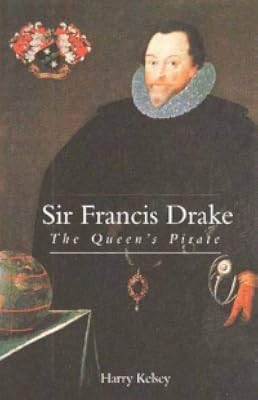
Sir Francis Drake: The Queen's Pirate
by Harry Kelsey
On This Page
Description
In this lively and engaging new biography, Harry Kelsey shatters the familiar image of Sir Francis Drake. The Drake of legend was a pious, brave, and just seaman who initiated the move to make England a great naval power and whose acts of piracy against his country’s enemies earned him a knighthood for patriotism. Kelsey paints a different and far more interesting picture of Drake as an amoral privateer at least as interested in lining his pockets with Spanish booty as in forwarding the show more political goals of his country, a man who became a captain general of the English navy, but never waged traditional warfare with any success. Drawing on much new evidence, Kelsey describes Drake’s early life as the son of a poor family in sixteenth-century England. He explains how Drake dabbled in piracy, gained modest success as a merchant, and then took advantage of the hostility between Spain and England to embark on a series of daring pirate raids on undefended Spanish ships and ports, preempting Spanish demands for punishment by sharing much of his booty with the Queen and her councillors. Elizabeth I liked Drake because he was a charming rogue, and she made him an integral part of her war plans against Spain and its armada, but she quickly learned not to trust him with an important command: he was unable to handle a large fleet, was suspicious almost to the point of paranoia, and had no understanding of personal loyalty. For Drake, the mark of success was to amass great wealth, preferably by taking it from someone else and the primary purpose of warfare was to afford him the opportunity to accomplish this. show lessTags
Recommendations
























Member Reviews
I think one of the biggest surprises from this biography is that Francis Drake didn't come into his own as a pirate until he was 36 years old. At an early age, he was put under the care of his Hawkins relatives, a-well to-do merchant family. He sailed with John Hawkins, actively participating in the slave trade, something other historians have apparently glossed over. But Hawkins narrowly avoids capture after Drake abandons him to the Spanish after an unsuccessful raid. He had no qualms with partnering with Dutch or French pirates either, but they better keep up. Continuous raids offered gold, silver, and wine but also yellow fever and in one instance execution.
Eventually he would take part in the Irish campaign of 1575 and even show more circumnavigate the globe, the first by an English commander. I have no doubt that sections comparing the various maps of his global voyage could've been trimmed down significantly. But if you can power through this part, the book really picks up again. This was no longer the South America of Magellan's day after all. He didn't stop there either. The raids of the West Indies, the raid on Cadiz and of course the defeat of the Spanish Armada was the pirate history I was here for.
While I do agree that Kelsey "shattered" the popular, patriotic image of this English hero, I don't think he nailed Drake as a person. Drake as a husband? As a friend in court? In that regard, Kelsey didn't come through, but you know actions speak louder than words. We can certainly judge Drake by how cruelly he treated his shipmates, his disregard for authority, and by his greed. At least he had the skills to back it up. There's a reason the Spanish called him "the Dragon" and why Elizabeth I favored him as a leader. He was every bit the lucrative pirate, even if he didn't want to be referred to as one. show less
Eventually he would take part in the Irish campaign of 1575 and even show more circumnavigate the globe, the first by an English commander. I have no doubt that sections comparing the various maps of his global voyage could've been trimmed down significantly. But if you can power through this part, the book really picks up again. This was no longer the South America of Magellan's day after all. He didn't stop there either. The raids of the West Indies, the raid on Cadiz and of course the defeat of the Spanish Armada was the pirate history I was here for.
While I do agree that Kelsey "shattered" the popular, patriotic image of this English hero, I don't think he nailed Drake as a person. Drake as a husband? As a friend in court? In that regard, Kelsey didn't come through, but you know actions speak louder than words. We can certainly judge Drake by how cruelly he treated his shipmates, his disregard for authority, and by his greed. At least he had the skills to back it up. There's a reason the Spanish called him "the Dragon" and why Elizabeth I favored him as a leader. He was every bit the lucrative pirate, even if he didn't want to be referred to as one. show less
Ratings
Members
- Recently Added By
Lists

Books in the Bibliography of Contested Continent by Peter Mancall
495 works; 1 member
Author Information
20 Works 210 Members
Harry Kelsey is a research scholar at the Huntington Library.
Common Knowledge
- Canonical title
- Sir Francis Drake: The Queen's Pirate
- People/Characters
- Sir Francis Drake; Edmund Drake; Anna Myllwaye; John Hawking; John Harte; John Lovell (show all 37); John Hawkins; Rene Laudonniere; Jean Bontemps; Mary Newman; John Drake; Guillaume Le Testu; Captin John Norris; Walter Deveraux, Earl of Essex; Sir Brian MacPhelim O'Neill; Acerbo Velutelli; Francis Fletcher; Sir William Wynter; Richard Hakluyt; Thomas Doughty; Thomas Drake; Robert Winterhey; John Wynter; John Doughty; Queen Elizabeth I; San Juan de Anton; Alonso Sanchez Colchero; John Blitheman; Henry Owtread; Sir Walter Raleigh; Elizabeth Sydenham; Ralph Lane; Pedro Sarmiento de Gamboa; William Borough; Marques de Santa Cruz; Medina Sidonia; Dom Antonio
- Important places
- Crowndale, Tavistock, Devon, England, UK; Plymouth, Devon, England, UK; Borburata, Carabobo, Venezuela; San Juan de Ulúa, Veracruz, Mexico; Riohacha, Riohacha Municipality, La Guajira Department, Colombia; Republic of Cabo Verde, West Africa (show all 18); Nombre de Dios, Santa Isabel District, Colón Province, Panama; Cartagena, Bolivar Department, Colombia; Mogador Island, Iles Purpuraires, Morocco; Puerto San Julián, Patagonia, Santa Cruz Province, Argentina; Cape Horn, Tierra del Fuego, Chile; Mocha Island, Chile; City of Ternate, North Maluku, Maluku Islands, Indonesia; Republic of Palau, Micronesia; Buckland Abbey, Buckland Monachorum, Devon, England, UK; Cádiz, Province of Cádiz, Andalusia, Spain; Lisbon, Lisbon District, Estremadura, Portugal; Commonwealth of Puerto Rico, United States
- Important events
- Anglo-Spanish War (1585 | 1604); Rathlin Island Massacre (1575-07-26); Battle of Gravelines (1558-07-13)
- Dedication
- For Giles Mead, who tempts life from dirt to wine in a habit of seasons stronger than love. From The Lord and the General Din of the World, by Jane Mead
- First words
- No hero ever dies. He lives, instead, in myth and legend.
- Last words
- (Click to show. Warning: May contain spoilers.)This is the Drake who emerges from the historical record, an interesting fellow but not eh Francis Drake of patriotic myth.
- Blurbers
- Parker, Geoffrey
Classifications
Statistics
- Members
- 91
- Popularity
- 351,634
- Reviews
- 1
- Rating
- (3.92)
- Languages
- English, Spanish
- Media
- Paper
- ISBNs
- 4