We All Play
by Julie Flett
On This Page
Description
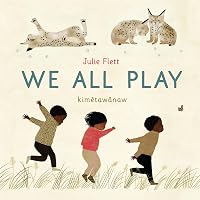
"Join celebrated artist Julie Flett on a joyful romp with animals. From chasing, chirping birds, to swimming, squirting whales, this book for young readers reminds them how animals play just like them. This picture book, with gorgeous images and sweet simple text, is a marvelous celebration of the interconnectedness of all creatures, and includes some Cree phrases. It is based on the Cree teaching of wahkohtowin, interconnectedness and play, and includes as well the English and Cree names of show more the animals in the book, all of whom are from 'Turtle Island' (North America)."-- show lessTags
Recommendations






Member Reviews
Everyone loves to play! Award-winning author/illustrator Flett shares the joyful antics of young animals as they romp in much the same way as human children.
The rhythmic text offers both rich vocabulary and a page-turning chant. Woodland animals “hide and hop / and sniff and sneak” while Indigenous children, depicted in differing shades of brown, run, skip, jump, and hunt for butterflies. “We play too! kimêtawânaw mîna,” they proclaim in the refrain. Aquatic animals “swim and squirt / and bubble and bend” while children swim under the water and float on its surface, in inner tubes. On the prairie, snakes “slip and slide” through the grass while buffalo “rumble and roll.” And bears “wiggle and wobble” as both show more they and children play (in separate double-page spreads) in the snow. At last, “side by side, animals fall asleep,” and after a day full of fun, “we do too. nîstanân mîna.” The animals are not named within the primary text, leaving it to readers to identify the hopping bunnies, the spouting beluga whale calves, and the yawning wolf pups. Flett’s characteristically minimalist compositions are deceptively simple. Readers who slow down to look will be charmed by the cricket that hops in tandem with a rabbit and the fox that stares in bemusement at a turtle. This celebration of nature is sprinkled with words from the Cree language, and a closing glossary provides both Cree and English names of the animals depicted; a note provides guidance on Cree pronunciation for readers not familiar with the language.
Simple text and bold, graphic illustrations celebrate our interconnection with the creatures who share our world. (author's note) (Picture book. 3-7)
-Kirkus Review show less
The rhythmic text offers both rich vocabulary and a page-turning chant. Woodland animals “hide and hop / and sniff and sneak” while Indigenous children, depicted in differing shades of brown, run, skip, jump, and hunt for butterflies. “We play too! kimêtawânaw mîna,” they proclaim in the refrain. Aquatic animals “swim and squirt / and bubble and bend” while children swim under the water and float on its surface, in inner tubes. On the prairie, snakes “slip and slide” through the grass while buffalo “rumble and roll.” And bears “wiggle and wobble” as both show more they and children play (in separate double-page spreads) in the snow. At last, “side by side, animals fall asleep,” and after a day full of fun, “we do too. nîstanân mîna.” The animals are not named within the primary text, leaving it to readers to identify the hopping bunnies, the spouting beluga whale calves, and the yawning wolf pups. Flett’s characteristically minimalist compositions are deceptively simple. Readers who slow down to look will be charmed by the cricket that hops in tandem with a rabbit and the fox that stares in bemusement at a turtle. This celebration of nature is sprinkled with words from the Cree language, and a closing glossary provides both Cree and English names of the animals depicted; a note provides guidance on Cree pronunciation for readers not familiar with the language.
Simple text and bold, graphic illustrations celebrate our interconnection with the creatures who share our world. (author's note) (Picture book. 3-7)
-Kirkus Review show less
I've been a fan of Julie Flett's illustrations for a long while, and this book brings her gorgeous and distinctive aesthetic together with simple but compelling text, perfect for little ones both in an individual setting as well as in storytime. Action words invite the reader to think of ways to embody them, and the book as a whole is playful. The text itself plays with alliteration and similar vowel sounds, and the illustrations play with animals both big and small demonstrating the same words. Poses from both animals and children are highly energetic and expressive. Three Cree phrases are used and repeated, rooting the book firmly in Flett's culture, but the author's notes on pronunciation, Cree words for the animals in the show more illustrations, and a sweet note about her memories of play with her father invite us all to play along with her. Just perfect. show less
This books is for grades 1-2.
This book is about how animals within nature play and connect to the idea that children of all ages play too! Through the descriptions of how animals play, as well as humans, a connection is formed between the different forms of play and adventure.
I would read this book to my class and then have them reflect on how they enjoy play time by drawing pictures of their interests and hobbies. Then, I would have students share how they like to play with the class.
This book is about how animals within nature play and connect to the idea that children of all ages play too! Through the descriptions of how animals play, as well as humans, a connection is formed between the different forms of play and adventure.
I would read this book to my class and then have them reflect on how they enjoy play time by drawing pictures of their interests and hobbies. Then, I would have students share how they like to play with the class.
"Animals hide
and hop
and sniff
and sneak
and peek
and peep."
The first sentence is spread over three double-page spreads (of bunnies, foxes, and owls), followed by a spread of children playing and the words "We play too! kimêtawânaw mîna." This pattern is repeated throughout, until "slowly, side by side, animals fall asleep. We do too. nîstanân mîna."
Back matter includes a list of animals in English and Plains Cree (different words for one animal, more than one, and "younger, smaller, cuter"), and a note to "Dear Reader."
See also: Hello Hello by Brendan Wenzel
and hop
and sniff
and sneak
and peek
and peep."
The first sentence is spread over three double-page spreads (of bunnies, foxes, and owls), followed by a spread of children playing and the words "We play too! kimêtawânaw mîna." This pattern is repeated throughout, until "slowly, side by side, animals fall asleep. We do too. nîstanân mîna."
Back matter includes a list of animals in English and Plains Cree (different words for one animal, more than one, and "younger, smaller, cuter"), and a note to "Dear Reader."
See also: Hello Hello by Brendan Wenzel
This book is ideal for younger readers, such as kindergarten or first grade, due to its simple and lighthearted nature. It respectfully incorporates Native language into the story in a way that feels authentic and meaningful. The book also highlights the cultural significance of the relationship between animals and humans, fostering connections across diverse backgrounds. The tribal nation referenced is Cree, as noted in the author's note at the end of the book. The story's timeless nature makes it accessible to everyone, transcending any specific era. The carefully chosen words avoid bias, with those used clearly identified as belonging to a specific Native group.
This book would be great for younger readers like kinder and 1st graders because of how light-hearted and simple it is. This book Authentically uses the Native language in a very respectful and informational way. This book is also relevant not only to Native American people, but to any child because it is all about fun and play and animals. the Author specifies the tribe by speaking the language of Cree. The Author does not specify a time period because it is about children playing just like animals, past, present, and future. This book does not indicate any bias, it very lightly includes Native speech and explains what that means at the end of the book.
Animals and kids love to play! This book celebrates diversity and the interconnectedness of nature through an Indigenous perspective, complete with a glossary of Cree words for wild animals at the back of the book, and children repeating a Cree phrase throughout the book and it is WONDERFUL. The illustrations are charming too!
Members
- Recently Added By
Lists

Youth: DEI
296 works; 2 members

VBL Picturebooks
110 works; 1 member

SYES Library Wishlist
1,080 works; 4 members

Rainbow Gardens Wish List: Seedlings & Saplings
104 works; 3 members

Children's Picture Books
188 works; 1 member
Author Information

16+ Works 1,857 Members
Awards and Honors
Awards
Distinctions
Notable Lists
Classifications
Statistics
- Members
- 299
- Popularity
- 107,394
- Reviews
- 23
- Rating
- (4.51)
- Languages
- English, French
- Media
- Paper, Ebook
- ISBNs
- 5