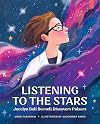
Listening to the Stars: Jocelyn Bell Burnell Discovers Pulsars (She Made History)
by Jodie Parachini
She Made History
On This Page
Description
"A biography of astrophysicist Jocelyn Bell Burnell, who helped build a radio telescope that helped her discover pulsars, a new type of star. Some scientists consider it the greatest astronomical discovery of the twentieth century. Despite this achievement, she was overlooked in favor of two male colleagues when the Nobel Prize for physics was awarded. Bell is still working and teaching today, with recognition"--Tags
Recommendations

















Member Reviews
Jocelyn Bell, born in Northern Ireland in 1943, was fascinated by astronomy from the time she was a child.
In school she excelled in math, astronomy, and physics, and was often the only female in her classes. She didn’t care for the idea that astronomers had to stay up late at night, however, and decided she would listen to the galaxy rather than look at it, which could be done at any time of day.
At the University of Cambridge, she helped construct a radio telescope made of wires stretched across a 4.5 acre field. It took two years to make, and was ready in 1967.
She began to analyze the sounds it captured, and discovered pulsars - a type of neutron star that sends out radio waves when it spins. (Neutron stars are stars that have show more exploded and condensed into small, spinning objects, as the glossary in the back matter tells us.) Jocelyn identified the first four neutron stars ever found. But in 1974, when the Nobel Prize for physics was awarded for the discovery of pulsars, it went to the two male professors who worked with her on the project.
She went on to win other awards, however, including the $3 million Special Breakthrough Prize in Fundamental Physics. She used the prize money to set up a fund for young women who wanted to study the cosmos.
The book concludes with a glossary, Author’s Note, and list of other books about women in physics and astrophysics.
Charming illustrations in rich colors by Alexandra Badiu reflect her background in animation as well as her own interest in astronomy.
Evaluation: The author does a great job of presenting research into the universe in a very accessible way. It also shows the obstacles faced by girls and women when they want to participate in fields traditionally dominated by and/or restricted to men. show less
In school she excelled in math, astronomy, and physics, and was often the only female in her classes. She didn’t care for the idea that astronomers had to stay up late at night, however, and decided she would listen to the galaxy rather than look at it, which could be done at any time of day.
At the University of Cambridge, she helped construct a radio telescope made of wires stretched across a 4.5 acre field. It took two years to make, and was ready in 1967.
She began to analyze the sounds it captured, and discovered pulsars - a type of neutron star that sends out radio waves when it spins. (Neutron stars are stars that have show more exploded and condensed into small, spinning objects, as the glossary in the back matter tells us.) Jocelyn identified the first four neutron stars ever found. But in 1974, when the Nobel Prize for physics was awarded for the discovery of pulsars, it went to the two male professors who worked with her on the project.
She went on to win other awards, however, including the $3 million Special Breakthrough Prize in Fundamental Physics. She used the prize money to set up a fund for young women who wanted to study the cosmos.
The book concludes with a glossary, Author’s Note, and list of other books about women in physics and astrophysics.
Charming illustrations in rich colors by Alexandra Badiu reflect her background in animation as well as her own interest in astronomy.
Evaluation: The author does a great job of presenting research into the universe in a very accessible way. It also shows the obstacles faced by girls and women when they want to participate in fields traditionally dominated by and/or restricted to men. show less
I like the idea of this book, but I felt there was a little too much emphasis on"hearing" the stars. Just because she used radio waves, which are used to transmit sounds on earth, does not mean that the pulsars were emitting sounds. Radio waves are electro-magnetic radiation (of a different wavelength than visible light). And to my knowledge, she did not listen to the output, just scanned the miles of output printed on paper.
Another notable female scientist; men who worked with her on pulsars got the Nobel Prize, not her.
Ratings
Members
- Recently Added By
Lists

Children's Books About Science and Math
461 works; 12 members

Youth: Women's History
34 works; 1 member
Author Information
20 Works 232 Members
All Editions
Series

Common Knowledge
- People/Characters
- Jocelyn Bell Burnell
Classifications
Statistics
- Members
- 24
- Popularity
- 1,110,757
- Reviews
- 3
- Rating
- (4.00)
- Languages
- English
- Media
- Paper, Ebook
- ISBNs
- 2