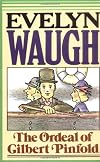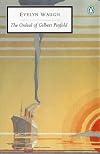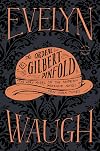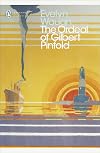
The Ordeal of Gilbert Pinfold
by Evelyn Waugh 
On This Page
Description
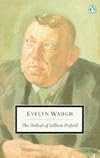
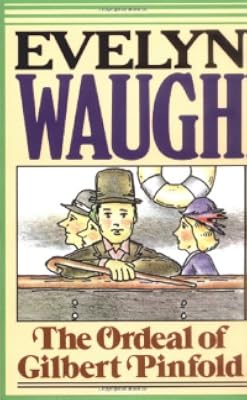
"The very model of the modern paranoid novel" (New York Times) and an ambitious work of semi-autobiographical fiction from one of England's greatest novelists. Gilbert Pinfold is a reclusive Catholic novelist suffering from acute inertia. In an attempt to defeat insomnia he has been imbibing an unappetizing cocktail of bromide, chloral, and creme de menthe. He books a passage on the SS Caliban and, as it cruises towards Ceylon, rapidly slips into madness. Almost as soon as the gangplank show more lifts, Pinfold hears sounds coming out of the ceiling of his cabin: wild jazz bands, barking dogs, and loud revival meetings. He is convinced that an erratic public-address system is letting him hear everything that goes on aboard ship . . . until instead of just sounds he hears voices. And not just any voices. These voices are talking, in the most frighteningly intimate way, about him! show lessTags
Recommendations






















Member Recommendations

Member Reviews
Some people can only read a book if they know that the events it describes 'really happened.' I'm the other way round: if, as with OGP, the book fictionalizes actual events, I often get bored. There's a good reason for that--what I most appreciate in fiction is the distance between author, narrator and characters. When someone is describing what actually happened to him/her, all of that distance gets squished into a tiny, tiny little span, and I often end up feeling like the author is an idiot who's incapable of self-reflection.
That's particularly sad in the case of Waugh, who often has great swathes of distance in his work. But here... well, I just can't help feeling like it's just a bunch of self pity. Had I come out of the book show more feeling like Waugh himself had learned from his Pinfoldian experience (i.e., that some of his various sillinesses were not harmlessly silly, but actually obnoxious), I might have had a better time. As it was, Pinfold comes out of it feeling like he's a superman who can defeat psychological disturbance with an apt phrase, and that therefore he's quite right to ignore the accusations leveled at him. Is that how Waugh felt? I can't help but believe that it was. If someone can convince me otherwise, I'd really appreciate it, because I suspect this book has made it much harder for me to go back and enjoy Waugh's earlier works. show less
That's particularly sad in the case of Waugh, who often has great swathes of distance in his work. But here... well, I just can't help feeling like it's just a bunch of self pity. Had I come out of the book show more feeling like Waugh himself had learned from his Pinfoldian experience (i.e., that some of his various sillinesses were not harmlessly silly, but actually obnoxious), I might have had a better time. As it was, Pinfold comes out of it feeling like he's a superman who can defeat psychological disturbance with an apt phrase, and that therefore he's quite right to ignore the accusations leveled at him. Is that how Waugh felt? I can't help but believe that it was. If someone can convince me otherwise, I'd really appreciate it, because I suspect this book has made it much harder for me to go back and enjoy Waugh's earlier works. show less
Lacks the hilarity of Waugh's other dark comedies, and is repetitive and predictable across large sections. However it retains some interest for historical and psychological reasons. As it is at least semi-autobiographical we get some insight into Waugh's own later life, and his period of mental breakdown. His delusions and paranoia provide the main stock of humour here, though this mainly falls flat. Not a classic.
4463. The Ordeal of Gilbert Pinfold A Conversation Piece, by Evelyn Waugh (read 26 Jul 2008) This could be described as a memoir, since it apparently relates what happened to Waugh himself. It is deliciously well-written and had me laughing aloud many times. It tells of a trip to Ceylon which Pinfold takes on a ship and has him hearing voices. The funniest parts are when Pinfold talks to the other passengers about the things he hears. The book is a delight. It is the 15th book of Waugh's I've read.
This is a very different sort of book from Waugh's others. The most familiar elements are the unrelenting bits of racism and his usual mode of satire. The fact that it's based on real aspects of his life makes it somewhat terrifying, but the execution was great. How he knew and didn't know they were just voices, how he kept rationalizing things and how contradictions weren't a big issue. The back of my book contained a few short stories which I didn't have time to read, but which I intend to get to.
Very weird-but-engrossing, autobiographical retelling of a long schizophrenic episode induced by combining sleep-inducing drugs of the day.
This turned up on the audiobook shelves at the library; I recognized the title from my parents' shelves, so I thought why not? It's all rather English, borrowing from stereotype here and lending itself to stereotype over there. There's not much drama, since the reader (listener) knows perfectly well that Waugh's stand-in Pinfold is suffering from hallucinated voices while on a long cruise; the melodrama he imagines is nearly without consequence, except on the few occasions when Pinfold threatens to act in the real world based on the misinformation in his head. Fortunately (for himself; unfortunately for the reader) he never really does much except send alarming telegrams to his wife and change his tickets for an earlier return.
But the show more audiobook reader (Michael Cochrane) does an excellent job bringing all those voices to life, with distinct tones and accents, and the result is not unlike an old-fashioned radio play. I doubt I've learned any profound life lessons, but I did enjoy myself for 5 hours. show less
But the show more audiobook reader (Michael Cochrane) does an excellent job bringing all those voices to life, with distinct tones and accents, and the result is not unlike an old-fashioned radio play. I doubt I've learned any profound life lessons, but I did enjoy myself for 5 hours. show less
Waugh’s fictionalized account of the time he went crazy on a cruise due to reckless self-medicating should be pretty entertaining, right? Wrong. Waugh just describes his paranoid delusions in detail. Why should we care? I’ll never know because I gave up a quarter of the way through.
Members
- Recently Added By
Published Reviews
ThingScore 75
[T]he first part of [the novel] is first-rate. Its "portrait of the artist in middle age," before he sets forth on his tedious journey, is a genuine gothic horror, a gargoyle to terrify anyone who has ever contemplated a literary career. Mr. Pinfold is publicly successful; he is so prosperous that he does not write as much as he could, because the tax-gatherer would only take his earnings away show more from him; but privately he is in such advanced decay that even the most long-standing habits of self-congratulation have failed. The acid bath so often prepared for others has now found its way into his own tub. show less
added by davidcla
This [Penguin ed.] is a terrific edition of a mildly neglected classic. It is an uncomfortable book: not only is it the most faithfully autobiographical of Waugh's novels, it is about Waugh's own period of madness.
added by davidcla
Lists

Fiction with Men's Given Names in the Title
302 works; 11 members

1001 Books You Must Read Before You Die
1,448 works; 1,131 members
Author Information

132+ Works 56,579 Members
Born in Hampstead and educated at Oxford University, Evelyn Waugh came from a literary family. His elder brother, Alec was a novelist, and his father, Arthur Waugh, was the influential head of a large publishing house. Even in his school days, Waugh showed sings of the profound belief in Catholicism and brilliant wit that were to mark his later show more years. Waugh began publishing his novels in the late 1920's. He joined the Royal Marines at the beginning of World War II and was one of the first to volunteer for commando service. In 1944 he survived a plane crash in Yugoslavia and, while hiding in a cave, corrected the proofs of one of his novels. Waugh's early novels, Decline and Fall (1927), Vile Bodies (1930), and A Handful of Dust (1934), established him as one of the funniest and most brilliant satirists the British had seen in years. He was particularly skillful at poking fun at the scramble for prominence among the upper classes and the struggle between the generations. He lived for a while in Hollywood, about which he wrote The Loved One (1948), a scathing attack on the United States's overly sentimental funeral practices. His greatest works, however, are Brideshead Revisited (1945), which has been made into a highly popular television miniseries, and the trilogy Sword of Honor (1965), composed of Men at Arms (1952), Officers and Gentlemen (1955), and The End of the Battle (1961). (Bowker Author Biography) show less
Evelyn Waugh has a Legacy Library. Legacy libraries are the personal libraries of famous readers, entered by LibraryThing members from the Legacy Libraries group.
Some Editions
Awards and Honors
Series
Belongs to Publisher Series
10/18, Domaine étranger (1511)
Common Knowledge
- Canonical title
- The Ordeal of Gilbert Pinfold
- Original title
- The Ordeal of Gilbert Pinfold
- Alternate titles
- As desventuras do senhor Pinfold; The ordeal of Gilbert Pinfold: a conversation piece
- Original publication date
- 1957
- People/Characters
- Gilbert Pinfold
- Important places
- Lychpole, West Sussex, England, UK; SS Caliban
- Dedication
- To DAPHNE in the confidence that her abounding sympathy will extend even to poor Pinfold
- First words
- It may happen in the next hundred years that the English novelists of the present day will come to be valued as we now value the artists and craftsmen of the late eighteenth century.
Pode acontecer que nos próximos cem anos os romancistas ingleses venham a ser julgados da mesma maneira como hoje julgamos os artistas do século XVIII. - Quotations
- Angel (jornalista) parecia acreditar que alguém, suficientemente importante para ser entrevistado por ele, tinha que ter algo que esconder, tinha de ser um impostor, que ele devia, por ofício e obrigação, tentar desmascar... (show all)ar, baseando as suas perguntas num conhecimento prévio de qualquer coisa de vergonhoso.
- Last words
- (Click to show. Warning: May contain spoilers.)Guardou novamente o manuscrito no fundo da gaveta, foi buscar um bloco de papel novo, pô-lo à sua frente e começou a escrever com letra firme e clara: As desventuras de Gilbert Pinfold, Novela, Primeiro capítulo, Retrato do artista aos cinquenta anos.
- Blurbers
- Boyd, William; Sykes, Gerald
- Original language
- Inglês
Classifications
Statistics
- Members
- 698
- Popularity
- 40,749
- Reviews
- 13
- Rating
- (3.32)
- Languages
- 6 — English, French, German, Italian, Portuguese (Portugal), Spanish
- Media
- Paper, Audiobook, Ebook
- ISBNs
- 35
- UPCs
- 1
- ASINs
- 27