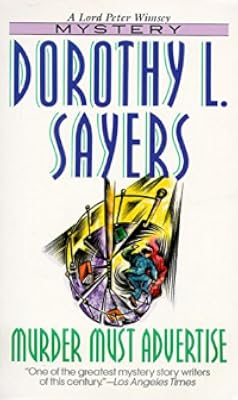
On This Page
Description
The ad men at Pym's can sell anything, even murder. The iron staircase at Pym's Publicity is a deathtrap, and no one in the advertising agency is surprised when Victor Dean tumbles down it, cracking his skull along the way. Dean's replacement arrives just a few days later: a green copywriter named Death Bredon. Though he displays a surprising talent for the business of selling margarine, alarm clocks, and nerve tonics, Bredon is not really there to write copy. In fact, he is really Lord show more Peter Wimsey, and he has come to Pym's in search of the man who pushed Dean. As he tries to navigate the cutthroat world of London advertising, Lord Peter uncovers a mystery that touches on catapults, cocaine, and cricket. But how does one uncover a murderer in a business where it pays to have no soul? Murder Must Advertise is the 10th book in the Lord Peter Wimsey Mysteries, but you may enjoy the series by reading the books in any order. This ebook features an illustrated biography of Dorothy L. Sayers including rare images from the Marion E. Wade Center at Wheaton College. show lessTags
Recommendations
















Member Recommendations

Member Reviews
This is my second favorite LPW behind Gaudy Night, and that's saying something. It's just fantastic in so many ways... and my burning question is simply: how tall is LPW if he's under the regulation height for being a policeman LMAO????
this book is so much beyond just a murder mystery. LPW masquerading as Bredon and the Harlequin and social commentary through an advertisement office and an entire chapter dedicated to cricket (I read all of it and understood absolutely none of it). How does Sayers balance so many different characters with so many different motivations beside the social commentary I am truly fascinated. everyone in this book was so real to me and i unironically learned A Lot about newspaper advertising LMAOO
(the first show more time i read this i remember being down in Bethseda Maryland for my brother's soccer tourney and i recalled none of it rereading it so that was crazy. always good when you don't actually remember the solution to a murder mystery) show less
this book is so much beyond just a murder mystery. LPW masquerading as Bredon and the Harlequin and social commentary through an advertisement office and an entire chapter dedicated to cricket (I read all of it and understood absolutely none of it). How does Sayers balance so many different characters with so many different motivations beside the social commentary I am truly fascinated. everyone in this book was so real to me and i unironically learned A Lot about newspaper advertising LMAOO
(the first show more time i read this i remember being down in Bethseda Maryland for my brother's soccer tourney and i recalled none of it rereading it so that was crazy. always good when you don't actually remember the solution to a murder mystery) show less
Murder Must Advertise by Dorothy L Sayers
This is the second Lord Peter Wimsey novel I have read and, as with the first, I find myself delighted with the writing of Dorothy L Sayers. There is a lot happening in [Murder Must Advertise] and the murder mystery and sleuthing around to identify the culprit are almost incidental.
I knew nothing about Dorothy L. Sayers before I read [The Nine Tailors] and from that book and the bits of background research I carried out I learned she was a fan of Gothic stories and in particular the stories of M.R. James, Josephs Sheridan Le Fanu, and Wilkie Collins. Having had that experience I approached Murder Must Advertise with heightened awareness for more than just a story. Sayers’s “Author’s show more Note” at the start of the book added to my anticipation as she made such an issue of pointing out that while this book was set in an advertising agency she was not implying that anything like the goings on that happen in the book actually happened in any particular, or indeed any, advertising agency. I felt the lady didst protest too much. I learnt from friends that Sayers had actually worked in an advertising agency and had been responsible for several well known campaigns. Also, she was responsible for The Mustard Club, the Tucan in the Guinness advertisements and the Guinness phrase, “Guinness is good for you!”, all details that get referenced in the novel.
I will say nothing of the murder mystery or its solution but will mention a few things that delighted me and that mean I will be reading more Dorothy L Sayers books.
Firstly, Sayers used her obvious professional knowledge of the workings of an advertising agency to inform the reader of the workings of such an establishment. She also added in the petty jealousies, idiosyncrasies and internal politics that exist in any business, but especially a small to medium sized enterprise. Her characters ring true and I know I have come across many of them in my visits to different organisations.
At the start of Chapter 11, Sayers describes advertising from the view of Lord Peter Wimsey and presents his viewpoint as being independent of advertising as his being a rich person means he just buys something when he wants it and is not influenced by advertisements which he concludes are for the poorer people. He describes how the “comparatively poor” are influenced by advertisements that push them to acquired goods and services that will give them a fleeting experience of being well off, the feeling that people who are actually rich have all the time. In this two page socio-economic commentary on advertising, Sayers shows how, that if it were not for advertising, the comparatively poor would not spend the little money they have to buy goods and consequently drive the economy and keep people working and earning money. These two pages are filled with wonderful words and ideas but the essence of her comments are presented in the reaction of Lord Peter Wimsey to his thoughts on the matter.
”He had never before paid any attention to advertisements. He had never realised the enormous commercial importance of the comparatively poor. Not on the wealthy, who buy only what they want when they want it, was the vast superstructure of industry built up, but on those who, aching for a luxury beyond their reach and for a leisure for ever denied them, could be bullied or wheedled into spending their few hardly won shillings on whatever might give them, if only for moment, a leisured and luxurious illusion.”
The amorality of advertising is presented in a discussion between Wimsey and the two principals of the agency when they are discussing how they will devise a campaign that will boost their cigarette manufacturing client’s sales. The principals are talking about boosting cigarette smoking amongst the populace and describe how they have to make smoking appeal to women more and how to get them off the milder cigarettes and on to the stronger ones. This discussion would be wildly anachronistic today, but was probably very real for the time setting of the story.
”No, but really. Suppose you push up the smoking of every man and woman in the Empire till they must either stop or die of nicotine poisoning?”
“We’re a long way off that,” replied Mr Pym seriously…
…This scheme should carry a strong appeal to women…We want to get women down to serious smoking. Too many of them play about with it. Take them off scented stuff and put them on the straightforward Virginia cigarette.”
I also found little axioms that are as true today as they were when this novel was written, e.g.
”Directors are the last people to hear anything about the staff. Otherwise,” said Miss Meteyard, “they wouldn’t be able to stand on their hind legs at the Staff Dinner and shoot off the speeches about co-operation, and all being one happy family.”
When describing how another firm paid its staff well to keep them from feeling the need to have a union, Sayers states of the firm’s management,
“They had merely discovered that comfortable and well-fed people are constitutionally disinclined for united action of any sort – a fact which explains the asinine meekness of the income-tax payer.”
I found Sayers’s commentary on the tendency of one character’s trousers and shirt to part company very amusing.
”…while Mr Tallboy, irreproachable in other respects, had an unfortunate tendency to come apart at the waist, for which his tailor and his shirt-maker were, no doubt, jointly responsible.”
All in all, a very entertaining book filled with good writing, wit and some intelligent presentation of ideas and considerations. As I said at the beginning of this piece, this is more than just a murder mystery. show less
This is the second Lord Peter Wimsey novel I have read and, as with the first, I find myself delighted with the writing of Dorothy L Sayers. There is a lot happening in [Murder Must Advertise] and the murder mystery and sleuthing around to identify the culprit are almost incidental.
I knew nothing about Dorothy L. Sayers before I read [The Nine Tailors] and from that book and the bits of background research I carried out I learned she was a fan of Gothic stories and in particular the stories of M.R. James, Josephs Sheridan Le Fanu, and Wilkie Collins. Having had that experience I approached Murder Must Advertise with heightened awareness for more than just a story. Sayers’s “Author’s show more Note” at the start of the book added to my anticipation as she made such an issue of pointing out that while this book was set in an advertising agency she was not implying that anything like the goings on that happen in the book actually happened in any particular, or indeed any, advertising agency. I felt the lady didst protest too much. I learnt from friends that Sayers had actually worked in an advertising agency and had been responsible for several well known campaigns. Also, she was responsible for The Mustard Club, the Tucan in the Guinness advertisements and the Guinness phrase, “Guinness is good for you!”, all details that get referenced in the novel.
I will say nothing of the murder mystery or its solution but will mention a few things that delighted me and that mean I will be reading more Dorothy L Sayers books.
Firstly, Sayers used her obvious professional knowledge of the workings of an advertising agency to inform the reader of the workings of such an establishment. She also added in the petty jealousies, idiosyncrasies and internal politics that exist in any business, but especially a small to medium sized enterprise. Her characters ring true and I know I have come across many of them in my visits to different organisations.
At the start of Chapter 11, Sayers describes advertising from the view of Lord Peter Wimsey and presents his viewpoint as being independent of advertising as his being a rich person means he just buys something when he wants it and is not influenced by advertisements which he concludes are for the poorer people. He describes how the “comparatively poor” are influenced by advertisements that push them to acquired goods and services that will give them a fleeting experience of being well off, the feeling that people who are actually rich have all the time. In this two page socio-economic commentary on advertising, Sayers shows how, that if it were not for advertising, the comparatively poor would not spend the little money they have to buy goods and consequently drive the economy and keep people working and earning money. These two pages are filled with wonderful words and ideas but the essence of her comments are presented in the reaction of Lord Peter Wimsey to his thoughts on the matter.
”He had never before paid any attention to advertisements. He had never realised the enormous commercial importance of the comparatively poor. Not on the wealthy, who buy only what they want when they want it, was the vast superstructure of industry built up, but on those who, aching for a luxury beyond their reach and for a leisure for ever denied them, could be bullied or wheedled into spending their few hardly won shillings on whatever might give them, if only for moment, a leisured and luxurious illusion.”
The amorality of advertising is presented in a discussion between Wimsey and the two principals of the agency when they are discussing how they will devise a campaign that will boost their cigarette manufacturing client’s sales. The principals are talking about boosting cigarette smoking amongst the populace and describe how they have to make smoking appeal to women more and how to get them off the milder cigarettes and on to the stronger ones. This discussion would be wildly anachronistic today, but was probably very real for the time setting of the story.
”No, but really. Suppose you push up the smoking of every man and woman in the Empire till they must either stop or die of nicotine poisoning?”
“We’re a long way off that,” replied Mr Pym seriously…
…This scheme should carry a strong appeal to women…We want to get women down to serious smoking. Too many of them play about with it. Take them off scented stuff and put them on the straightforward Virginia cigarette.”
I also found little axioms that are as true today as they were when this novel was written, e.g.
”Directors are the last people to hear anything about the staff. Otherwise,” said Miss Meteyard, “they wouldn’t be able to stand on their hind legs at the Staff Dinner and shoot off the speeches about co-operation, and all being one happy family.”
When describing how another firm paid its staff well to keep them from feeling the need to have a union, Sayers states of the firm’s management,
“They had merely discovered that comfortable and well-fed people are constitutionally disinclined for united action of any sort – a fact which explains the asinine meekness of the income-tax payer.”
I found Sayers’s commentary on the tendency of one character’s trousers and shirt to part company very amusing.
”…while Mr Tallboy, irreproachable in other respects, had an unfortunate tendency to come apart at the waist, for which his tailor and his shirt-maker were, no doubt, jointly responsible.”
All in all, a very entertaining book filled with good writing, wit and some intelligent presentation of ideas and considerations. As I said at the beginning of this piece, this is more than just a murder mystery. show less
Wimsey Undercover
Review of the Hodder & Stoughton paperback (2016) reissue of the Victor Gollancz "Murder Must Advertise" (1933) original
There is a lot of fun to be had in this 1930's Golden Age mystery set in an advertising agency. Dorothy Sayers had the full background experience to write this as she herself had worked as an advertising copywriter for many years and builds an office full of quirky character types from it.
She puts her amateur detective character Lord Peter Wimsey into the mix playing his own invented cousin Death (pronounced as two syllables: De-ath) Bredon who joins the firm as a fledgling copywriter while secretly working to solve the mystery behind the death of his predecessor. On the way there are office secrets & show more politics, the charming recruitment of an office delivery boy as junior detective, some experimental stream of consciousness writing, an wild party orgy, a drugs gang, several more murders, a cricket match and more advertising jingles than you could ever imagine. show less
Review of the Hodder & Stoughton paperback (2016) reissue of the Victor Gollancz "Murder Must Advertise" (1933) original
There is a lot of fun to be had in this 1930's Golden Age mystery set in an advertising agency. Dorothy Sayers had the full background experience to write this as she herself had worked as an advertising copywriter for many years and builds an office full of quirky character types from it.
She puts her amateur detective character Lord Peter Wimsey into the mix playing his own invented cousin Death (pronounced as two syllables: De-ath) Bredon who joins the firm as a fledgling copywriter while secretly working to solve the mystery behind the death of his predecessor. On the way there are office secrets & show more politics, the charming recruitment of an office delivery boy as junior detective, some experimental stream of consciousness writing, an wild party orgy, a drugs gang, several more murders, a cricket match and more advertising jingles than you could ever imagine. show less
When a young advertising copywriter tumbles down a steep flight of stairs, the coroner deems his death an unfortunate accident. Mr. Pym, of Pym’s Publicity, suspects otherwise, and calls in Lord Peter Wimsey to investigate the case undercover as his badly-behaved “cousin,” Mr. Death Bredon. It turns out that the death of the copywriter is only a small part of the mystery, as Wimsey finds himself embroiled in the complicated machinations of a cocaine smuggling ring. What does Pym’s Publicity have to do with it all?
Dorothy Sayers worked as a copywriter at an advertising agency from 1921-1933, helped create the Guinness ads that are sometime seen today, and is credited with inventing the slogan, “it pays to advertise.” So show more Sayers knew her stuff, and it shows (she even goes into detail about what copy is acceptable and unacceptable in terms of legal repercussions).
There are quite a few characters to keep track of, and it’s nearly impossible for the reader to figure out who’s behind it all. There’s a lot more to this book than advertising and cocaine, though—there’s also a few wanton women and some blackmail to spice things up a bit. The characters are witty, varied, and memorable, and the plot doesn’t overwhelm. Definitely a great place to start reading Sayers’s work if you haven’t read her work before. show less
Dorothy Sayers worked as a copywriter at an advertising agency from 1921-1933, helped create the Guinness ads that are sometime seen today, and is credited with inventing the slogan, “it pays to advertise.” So show more Sayers knew her stuff, and it shows (she even goes into detail about what copy is acceptable and unacceptable in terms of legal repercussions).
There are quite a few characters to keep track of, and it’s nearly impossible for the reader to figure out who’s behind it all. There’s a lot more to this book than advertising and cocaine, though—there’s also a few wanton women and some blackmail to spice things up a bit. The characters are witty, varied, and memorable, and the plot doesn’t overwhelm. Definitely a great place to start reading Sayers’s work if you haven’t read her work before. show less
Two casual snipes at Chinese in passing for absolutely no reason. Also distressing: Our Hero comes up with a new advertising campaign to gamify cigarette purchases and is terribly proud of putting it into practice. This is 1933 so I guess he and the author didn't know how much ill health and death this will cause? Though someone does mention nicotine poisoning so they can't be entirely ignorant. It's deeply ironic when the author spends much of the book being absolutely biting about the role of advertising in society, and Peter's brother-in-law waxes passionate on the subject of drug-runners killing many more people by getting them addicted to noxious substances than your petty axe-murderer.
Also once again Peter encourages the murderer show more to save everyone the bother of a trial, which is, as the murderer notes, a very public-school kind of morality. Times have changed I guess -- apart from advertising. show less
Also once again Peter encourages the murderer show more to save everyone the bother of a trial, which is, as the murderer notes, a very public-school kind of morality. Times have changed I guess -- apart from advertising. show less
Lord Peter goes undercover at an advertising agency to investigate an irregular death, but he also discovers a drug ring in the process. He nearly slips up with his cover a few times. The office staff provides interesting characters. I just don't like the series that much. Although this is one of the better installments, Bunter is largely absent, and I really enjoy his character.
There's 2 levels to this - as a murder mystery and as a depiction of life in the advertising industry. The setting here is given much more prominence than it is in other murder mysteries and obviously reflects Sayers' own experience in it.
As a murder mystery it's *fine*. Something I noticed here that's also in Strong Poison and Have His Carcase is there's a surprisingly limited pool of suspects and barely any attempt to set up red herrings. Here there's *technically* lots of characters introduced who could have done it but there's only 2 that are developed to have any suspicion or motive attached to them, really.
The advertising setting though... the actual key contrast in the book is between the evils of the cocaine trade and the show more slightly less evil but still pretty grubby world of the advertising industry. It's clear that Sayers is a bit vague on the drug stuff but the advertising industry is clearly deeply personal to her. A small but important subplot isLord Peter coming up with a highly successful advertising campaign for a brand of cigarettes that gets people smoking more and gets new people into smoking The precise health effects of cigarette smoking were I assume not widely known but it's still clearly taken as read that they're not great (mention is made of the risks of people being struck down by nicotine poisoning). The parallel is extremely obvious, although it's not really tackled - the detective got rid of one murderer and helped break up a drug gang but at the same time promoted a major takeup of drugs, the only difference being it was perfectly legal. Especially knowing what we know today it's hard not to see him as morally culpable for tens of thousands of deaths show less
As a murder mystery it's *fine*. Something I noticed here that's also in Strong Poison and Have His Carcase is there's a surprisingly limited pool of suspects and barely any attempt to set up red herrings. Here there's *technically* lots of characters introduced who could have done it but there's only 2 that are developed to have any suspicion or motive attached to them, really.
The advertising setting though... the actual key contrast in the book is between the evils of the cocaine trade and the show more slightly less evil but still pretty grubby world of the advertising industry. It's clear that Sayers is a bit vague on the drug stuff but the advertising industry is clearly deeply personal to her. A small but important subplot is
Members
- Recently Added By
Lists

The Guardian's 1000 Novels Everyone Must Read
1,005 works; 551 members

1001 Books You Must Read Before You Die
1,448 works; 1,134 members

Best Crime Fiction
262 works; 39 members

Top Cops (Detectives in Fiction)
86 works; 24 members
Best of British Literature
226 works; 41 members

Golden Age of Detection
35 works; 10 members

The Top 100 Crime Novels of All Time
100 works; 15 members

Top-Rated Books on LibraryThing
272 works; 117 members

Crime and Mysteries to Read
746 works; 31 members
Top 100 Mystery Novels of All Time
98 works; 9 members

Read the book and saw the movie
1,170 works; 195 members

Books I've Read More Than Once
602 works; 49 members

British Mystery
469 works; 14 members
Best Books Set in London
157 works; 42 members

Survey of Mysteries and Crime Fiction
96 works; 17 members

In or About the 1930s
198 works; 27 members

Murder Mysteries
57 works; 11 members

Books With Characters I'd Like to Date
18 works; 9 members
Survey of Classic Crime
39 works; 7 members

Books Set in Great Britain
191 works; 13 members
501 Must-Read Books
529 works; 72 members

Books About Murder
313 works; 7 members

cricket in fiction
14 works; 2 members
Detective Stories
343 works; 5 members

Books mentioned in Julian Symons’ Bloody Murder
438 works; 6 members

1,001 BYMRBYD Concensus
723 works; 27 members

Read in 2006
140 works; 1 member
Our Favorite Comfort Reads
334 works; 200 members
Top Ten Escapist Crime Reads (Martin Edwards)
10 works; 1 member
Must Read Detective Stories (Nick Fuller)
278 works; 2 members

Books Read in 2006
423 works; 8 members

Books With the Most Memorable Titles
478 works; 158 members

1930s
262 works; 5 members

To Read
29 works; 2 members

Shelf 101
60 works; 1 member
Read These Too
458 works; 9 members

Books Read in 2018
4,360 works; 110 members

Best Workplace Fiction
47 works; 18 members

stories at work
43 works; 7 members

Alphabetical Books
211 works; 3 members

Books With Complete Sentence Titles
501 works; 17 members

Books Set in London
49 works; 3 members
Folio Society
831 works; 49 members
20th Century Literature
1,161 works; 55 members

Classics you know you should have read but probably haven't
421 works; 409 members

Books Read in 2014
2,343 works; 89 members

Urban Fiction
74 works; 7 members
Favourite Books
1,820 works; 316 members
Author Information

281+ Works 70,949 Members
Dorothy Sayers's impressive reputation as a contemporary master of the classic detective story is eclipsed only by Agatha Christie's. Sayers was born in Oxford and attended Somerville College, where she received a B.A. in 1915 and an M.A. in 1920. During that period, Sayers worked as an instructor of modern languages at Hull High School for Girls show more in Yorkshire and as a reader for a publisher in Oxford. Her early literary work was in poetry; she published several volumes and served as an editor for the journal Oxford Poetry from 1917 to 1919. Sayers also worked as a copywriter for a major advertising firm in London. She was president of the Modern Language Association from 1939 to 1945 and of the Detection Club in the 1950s. Around 1920 Sayers developed the idea for her detective hero Lord Peter Wimsey, and she soon published her first mystery, Whose Body? (1923), in which Lord Peter is introduced. For the next dozen or so years, Sayers wrote prolifically about Wimsey, creating in the process what many critics of the genre consider to be the finest detective novels in the English language. Perhaps her most famous Wimsey mystery was The Nine Tailors (1934). Although Sayers essentially followed the classic form in her detective fiction---a formula in which the plot assumes a greater importance than do the characters---Sayers maintained that a detective hero's greatness depended on how effectively the character was portrayed. All but one of Sayers's mysteries feature Lord Peter Wimsey. By the late 1930s, Sayers had apparently tired of writing detective fiction. She stated in 1947 that she would write no more mysteries, that she wrote detective fiction only when she was young and in need of money. Thus saying, Sayers turned her attention to her early loves, medieval and religious literature, spending her remaining years lecturing on and translating Dante (see Vol. 2). (Bowker Author Biography) show less
Some Editions
Awards and Honors
Notable Lists
Schecks Bücher (63)
Series

Belongs to Publisher Series
Four Square Books (176)
Zephyr Books (10)
Pocket Books (21)
Work Relationships
Is contained in
Strong Poison | Have His Carcass | Murder Must Advertise | The Nine Tailors | Gaudy Night by Dorothy L. Sayers
Clouds of Witness / Murder Must Advertise / Strong Poison / Unnatural Death / Busman's Honeymoon by Dorothy L. Sayers
Clouds of Witness - The Unpleasantness at the Bellona Club - Strong Poison - Hangman's Holiday - Murder Must Advertise by Dorothy L. Sayers
Has the adaptation
Common Knowledge
- Canonical title
- Murder Must Advertise
- Original title
- Murder Must Advertise
- Alternate titles*
- Verraad op de ijzeren trap; Een moordenaar adverteert
- Original publication date
- 1933-02-06
- People/Characters
- Peter Death Bredon Wimsey (Lord Peter Wimsey); Mary Wimsey; Mr. Pym; Mr. Armstrong; Mr. Brotherhood; Miss Rossiter (show all 19); Mr. Copley; Victor Dean; Pamela Dean; Dian de Momerie; Mr. Hankin; Mr. Ingleby; Miss Meteyard; Major Todd Milligan; Charles Parker (Inspector); Jim Tallboy; Alec Willis; Hector Puncheon; Ginger Joe Potts
- Important places
- London, England, UK; England, UK
- Related movies
- Murder Must Advertise (1973 | IMDb)
- First words
- "And by the way," said Mr. Hankin, arresting Miss Rossiter as she rose to go, "there is a new copy-writer coming in today."
[Author's Note] I do not suppose that there is a more harmless and law-abiding set of people in the world than the Advertising Experts of Great Britain.
[Afterword] The year 1920 is the generally accepted dawn of the Golden Age of detective fiction. - Quotations
- The interview with the cat had been particularly full of appeal. The animal was, it seemed, an illustrious rat-catcher, with many famous deeds to her credit. Not only that, but she had been the first to notice the smell of fi... (show all)re and had, by her anguished and intelligent mewings, attracted the attention of night-watchman number one, who had been in the act of brewing himself a cup of tea when the outbreak took place.
“How do you do?”
“How do you do?” echoed Mr. Ingleby.
They gazed at one another with the faint resentment of two cats at their first meeting.
Mr. Hankin smiled kindly at them both. - Last words
- (Click to show. Warning: May contain spoilers.)Advertise, or go under.
(Click to show. Warning: May contain spoilers.)[Author's Note] If, in the course of this fantasy, I have unintentionally used a name or slogan suggestive of any existing person, firm or commodity, it is by sheer accident, and is not intended to cast the slightest reflection upon any actual commodity, firm or person.
(Click to show. Warning: May contain spoilers.)[Afterword] Although her career as a detective novelist spanned a mere fourteen years--from 'Whose Body?' (1923) to 'Busman's Honeymoon (1937)--she continued until her premature death to contribute to the promotion and acceptance of the literary from with which her name is forever linked. - Original language
- English
- Canonical DDC/MDS
- 823.912
- Disambiguation notice
- This is the main work for Murder Must Advertise; it should not be combined with any adaptation, abridgement, etc.
ISBN 0450001008 is for The Nine Tailors
*Some information comes from Common Knowledge in other languages. Click "Edit" for more information.
Classifications
Statistics
- Members
- 4,134
- Popularity
- 3,741
- Reviews
- 113
- Rating
- (4.15)
- Languages
- 18 — Czech, Danish, Dutch, English, Finnish, French, German, Hebrew, Italian, Japanese, Norwegian, Polish, Russian, Croatian, Spanish, Swedish, Portuguese (Portugal), Chinese, simplified
- Media
- Paper, Audiobook, Ebook
- ISBNs
- 72
- UPCs
- 2
- ASINs
- 79