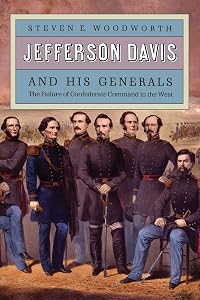
Jefferson Davis and His Generals: The Failure of Confederate Command in the West
by Steven E. Woodworth
Modern War Studies (1990)
On This Page
Description
Examines the relationship of the Confederate generals with Jefferson Davis and each other, on and off the battlefield.Tags
Recommendations














Member Reviews
History is not an either/or proposition.
The idea of this book is interesting: How Jefferson Davis made decisions and managed the generals who fought the American Civil War in the area between the Appalachians and the Mississippi River. Author Steven Woodworth's verdict is mixed: Davis made decisions good and bad, but on the whole his decisions grew worse as the war went along. Woodworth suggests that this is due to a lack of self-confidence on the part of Davis, but that's not essential to the content of the book.
What is essential is accurately assessing the abilities of those generals. It would seem obvious that supporting good generals is the right choice, and firing bad ones is a bad choice, right? But this depends on knowing which show more generals are good and bad.
And it is here that I simply don't agree with Woodworth. Part of the problem is his tendency to treat all generals as either good or bad, with nothing in between. As if anyone was either a perfect paragon or a perfect disaster! Two examples should suffice to prove this point. One is Patrick Cleburne. Cleburne was a brilliant division commander; I don't think anyone questions that. But Woodworth thinks, therefore, that Cleburne should have been promoted faster and eventually become commander of the Army of Tennessee. And yet, the man who eventually got that job, John Bell Hood, proved that being a brilliant division commander did not make one competent to command an army. Or even a corps. The move from division to corps command is one of the hardest there is -- ask Robert E. Lee, who never had much trouble finding division commanders for his army, but after Stonewall Jackson was killed, tried corps commander after corps commander without finding any who were really satisfactory. Cleburne, even as a divisional commander, had shown some political deafness. Could he really command a whole army full of narcissistic people who thought they should have his job?
And speaking of Lee's corps commanders, Woodworth is really down on James Longstreet -- almost as much as southerners after the War, when they hated him as a Republican. He regards Longstreet as insubordinate, which he sometimes was, but Woodworth ignores both Longstreet's record of being correct (about Pickett's charge, e.g.) and Longstreet's incredible tactical successes (at Second Bull Run, Chickamauga, and The Wilderness. No other corps commander in the war -- not even Jackson -- commanded more battle-winning attacks).
And it's this they're-either-good-or-bad attitude that affects Woodsworth's evaluation of the three most important generals involved in this work: Albert Sidney Johnston, Braxton Bragg, and Joseph E. Johnston. For Johnston #1, he ignores all his major errors (sending just the wrong number of men to Fort Donelson: More than he could afford to lose, but not enough to win the battle; also, fighting the battle of Shiloh with P. G. T. Beauregard's ridiculous dispositions). For Johnston #2, he correctly points out that Johnston was cautious, but ignores the fact that he didn't get his army destroyed by superior forces.
But it's Braxton Bragg who demonstrates what I see as the defect of Woodsworth's approach. He correctly assesses Bragg as a good administrator, and generally as a good strategist, although I think he soft-pedals the fact that Bragg had a certain tendency to chicken out at the last moment. And he correctly assesses that Bragg's biggest problem was that he couldn't get his subordinates to do what he needed them to do.
Why? Well, if you believe Woodworth, his subordinates were all a bunch of sneaky jerks who took out their problems on Bragg. But this makes no sense. If one subordinate dislikes a superior officer, it's on the subordinate. If every subordinate dislikes the superior officer, it's on the superior officer.
Take, as a non-Civil War example, Dwight D. Eisenhower. There is no real evidence that Eisenhower was a good strategist. The campaigns he commanded were often pretty disastrous at a tactical level, too. But he won World War II in western Europe -- and he did it despite subordinates, such as Bernard Law Montgomery, Mark W. Clark, and George Patton, who probably would have destroyed each other if you locked them in a room together. Eisenhower's greatness -- and it was greatness -- was that he managed to get these almost-unmanageable officers to function together well enough to win the war. This was one of Robert E. Lee's special gifts, too: Yes, he was a good strategic and tactical commander, but he also kept his fractious subordinates working together.
Bragg failed at this. Totally. Everybody hated him. That's on Bragg, and Woodworth should recognize it, as Jefferson Davis should have recognized it. You can't stick with a general who is hated by his subordinates.
And Woodworth, with his binary world view, just doesn't see it. This book has a lot of interesting information, and I learned some interesting things from it (e.g. about John Pemberton, another one of Davis's failures). But Woodworth's conclusions are simply not reliable, because he won't use the data he has gathered.
[Revised 4/9/2026 to correct two typos: "Johnson" for "Johnston" and a singular/plural mismatch] show less
The idea of this book is interesting: How Jefferson Davis made decisions and managed the generals who fought the American Civil War in the area between the Appalachians and the Mississippi River. Author Steven Woodworth's verdict is mixed: Davis made decisions good and bad, but on the whole his decisions grew worse as the war went along. Woodworth suggests that this is due to a lack of self-confidence on the part of Davis, but that's not essential to the content of the book.
What is essential is accurately assessing the abilities of those generals. It would seem obvious that supporting good generals is the right choice, and firing bad ones is a bad choice, right? But this depends on knowing which show more generals are good and bad.
And it is here that I simply don't agree with Woodworth. Part of the problem is his tendency to treat all generals as either good or bad, with nothing in between. As if anyone was either a perfect paragon or a perfect disaster! Two examples should suffice to prove this point. One is Patrick Cleburne. Cleburne was a brilliant division commander; I don't think anyone questions that. But Woodworth thinks, therefore, that Cleburne should have been promoted faster and eventually become commander of the Army of Tennessee. And yet, the man who eventually got that job, John Bell Hood, proved that being a brilliant division commander did not make one competent to command an army. Or even a corps. The move from division to corps command is one of the hardest there is -- ask Robert E. Lee, who never had much trouble finding division commanders for his army, but after Stonewall Jackson was killed, tried corps commander after corps commander without finding any who were really satisfactory. Cleburne, even as a divisional commander, had shown some political deafness. Could he really command a whole army full of narcissistic people who thought they should have his job?
And speaking of Lee's corps commanders, Woodworth is really down on James Longstreet -- almost as much as southerners after the War, when they hated him as a Republican. He regards Longstreet as insubordinate, which he sometimes was, but Woodworth ignores both Longstreet's record of being correct (about Pickett's charge, e.g.) and Longstreet's incredible tactical successes (at Second Bull Run, Chickamauga, and The Wilderness. No other corps commander in the war -- not even Jackson -- commanded more battle-winning attacks).
And it's this they're-either-good-or-bad attitude that affects Woodsworth's evaluation of the three most important generals involved in this work: Albert Sidney Johnston, Braxton Bragg, and Joseph E. Johnston. For Johnston #1, he ignores all his major errors (sending just the wrong number of men to Fort Donelson: More than he could afford to lose, but not enough to win the battle; also, fighting the battle of Shiloh with P. G. T. Beauregard's ridiculous dispositions). For Johnston #2, he correctly points out that Johnston was cautious, but ignores the fact that he didn't get his army destroyed by superior forces.
But it's Braxton Bragg who demonstrates what I see as the defect of Woodsworth's approach. He correctly assesses Bragg as a good administrator, and generally as a good strategist, although I think he soft-pedals the fact that Bragg had a certain tendency to chicken out at the last moment. And he correctly assesses that Bragg's biggest problem was that he couldn't get his subordinates to do what he needed them to do.
Why? Well, if you believe Woodworth, his subordinates were all a bunch of sneaky jerks who took out their problems on Bragg. But this makes no sense. If one subordinate dislikes a superior officer, it's on the subordinate. If every subordinate dislikes the superior officer, it's on the superior officer.
Take, as a non-Civil War example, Dwight D. Eisenhower. There is no real evidence that Eisenhower was a good strategist. The campaigns he commanded were often pretty disastrous at a tactical level, too. But he won World War II in western Europe -- and he did it despite subordinates, such as Bernard Law Montgomery, Mark W. Clark, and George Patton, who probably would have destroyed each other if you locked them in a room together. Eisenhower's greatness -- and it was greatness -- was that he managed to get these almost-unmanageable officers to function together well enough to win the war. This was one of Robert E. Lee's special gifts, too: Yes, he was a good strategic and tactical commander, but he also kept his fractious subordinates working together.
Bragg failed at this. Totally. Everybody hated him. That's on Bragg, and Woodworth should recognize it, as Jefferson Davis should have recognized it. You can't stick with a general who is hated by his subordinates.
And Woodworth, with his binary world view, just doesn't see it. This book has a lot of interesting information, and I learned some interesting things from it (e.g. about John Pemberton, another one of Davis's failures). But Woodworth's conclusions are simply not reliable, because he won't use the data he has gathered.
[Revised 4/9/2026 to correct two typos: "Johnson" for "Johnston" and a singular/plural mismatch] show less
Woodworth examines the generals in the western theater. He is a huge fan of Albert Sidney Johnston. However with his death at Shiloh, Woodworth claims that Jefferson Davis took too great a role in managing affairs in the West. He did not trust his generals, especially Joe Johnston, and instead hung his star on Braxton Bragg who was not competent for independent command. More meddling led to greater disaster.
Ratings
Members
- Recently Added By
Author Information

42+ Works 1,962 Members
Steven E. Woodworth was born on January 28, 1961. He received a B.A. in history from Southern Illinois University in 1982 and a Ph.D. from Rice University in 1987. He is a professor of history at Texas Christian University and an expert on the Civil War. He has written a number of books on the topic including Jefferson Davis and His Generals: The show more Failure of Confederate Command in the West, While God Is Marching On: The Religious World of Civil War Soldiers, Nothing but Victory: The Army of the Tennessee 1861-1865, Manifest Destinies: Westward Expansion and the Civil War, and This Great Struggle: America's Civil War. (Bowker Author Biography) show less
Awards and Honors
Awards
Series

Common Knowledge
- Canonical title
- Jefferson Davis and His Generals: The Failure of Confederate Command in the West
- Original publication date
- 1990
- People/Characters
- Jefferson Davis; Braxton Bragg; Simon Bolivar Buckner; Leonidas Polk; Samuel Cooper; Albert Sidney Johnston (show all 24); Gideon J. Pillow (as Gideon Pillow); Felix Zollicoffer; George Crittenden; P. G. T. Beauregard (Pierre Gustave Toutant Beauregard); John B. Floyd; Earl Van Dorn; Patrick Ronayne Cleburne; Edmund Kirby Smith; William J. Hardee; John Cabell Breckinridge; Nathan Bedford Forrest; Sterling Price; John C. Pemberton; Joseph E. Johnston; Benjamin Franklin Cheatham; Daniel Harvey Hill; James Longstreet; John Bell Hood
- Important places
- Richmond, Virginia, USA; Columbus, Kentucky, USA; Mill Springs, Kentucky, USA; Fort Donelson, Tennessee, USA; Pittsburg Landing, Tennessee, USA; Corinth, Mississippi, USA (show all 11); Vicksburg, Mississippi, USA; Perryville, Kentucky, USA; Chattanooga, Tennessee, USA; Atlanta, Georgia, USA; Franklin, Tennessee, USA
- Important events
- American Civil War (1861 | 1865); Battle of Mill Springs (1862-01-19); Battle of Fort Donelson (1862-02-11 | 1862-02-16); Battle of Shiloh (1862-04-06 | 1862-04-07); Battle of Corinth (1862-04-29 | 1862-05-30); Battle of Perryville (1862-10-08) (show all 12); Battle of Chickamauga (1863-09-19 | 1863-09-20); Siege of Vicksburg, Mississippi (1863-05-18 | 1863-07-04); Battle of Lookout Mountain (1863); Battle of Missionary Ridge (1863); Battle of Atlanta (1864); Battle of Franklin (1864)
- Dedication
- For My Mother and Father
- First words
- PREFACE
As civil war approaches in the spring of 1861, comparison of the rival presidents, Abraham Lincoln of the United States and Jefferson Davis of the would-be Confederate States, seemed encouraging to good Southerners... (show all). - Original language
- English
Classifications
Statistics
- Members
- 223
- Popularity
- 146,821
- Reviews
- 2
- Rating
- (3.88)
- Languages
- English
- Media
- Paper
- ISBNs
- 3
- ASINs
- 1