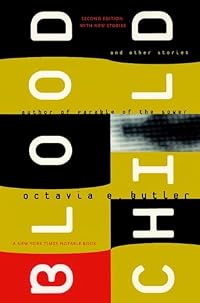
Bloodchild and Other Stories {second edition}
by Octavia E. Butler
On This Page
Description
Six extraordinary stories from the author of Kindred, a master of modern science fiction—including a Hugo and Nebula award–winning novella.Octavia E. Butler's classic "Bloodchild," winner of both the Nebula and Hugo awards, anchors this collection of incomparable stories and essays. "Bloodchild" is set on a distant planet where human children spend their lives preparing to become hosts for the offspring of the alien Tlic. Sometimes the procedure is harmless, but often it is not. Also show more included is the Hugo Award–winning "Speech Sounds," about a near future in which humans must adapt after an apocalyptic event robs them of their ability to speak. "The Evening and the Morning and the Night," another esteemed title in this collection, is a Nebula Award finalist. In these pages, Butler shows us life on Earth and amongst the stars, telling her tales with characteristic imagination and clarity. This ebook features an illustrated biography of Octavia E. Butler including rare images from the author's estate.. show less
Tags
Recommendations



Member Reviews
4.5/5
A stunning collection that shows some of the best writing from Butler that I've read to date. Butler has some of the best prose I know, but it's not the type that would dazzle anyone. It's much more due to her unique precision and economy of language that makes her works approachable, while at the same time letting a more seasoned reader marvel that no word is unnecessary or misplaced. Truly, I believe that Butler could write about a dull and amorphous ball of cells, and not only do so compellingly, but while somehow finding the humanity and emotion within. Several of these stories moved me to the point of tears.
Butler, who herself admits a dislike for writing short stories, is nonetheless more than capable of synthesizing a story show more down to it's most essential parts, stories that could easy be longer, novel-length works. It's impressive to read any collection and have an instinct to wish that the stories were longer.
The standouts in this collection, for me, were the tile story Bloodchild and Speech Sounds, both of which won awards when they were first published. What sets this collection apart though, is that while some of the stories didn't match these two in terms of quality, none of them dragged the collection down. None of them felt like filler, which seems to be an almost legal requirement for half of the stories included in any collection or anthology. show less
A stunning collection that shows some of the best writing from Butler that I've read to date. Butler has some of the best prose I know, but it's not the type that would dazzle anyone. It's much more due to her unique precision and economy of language that makes her works approachable, while at the same time letting a more seasoned reader marvel that no word is unnecessary or misplaced. Truly, I believe that Butler could write about a dull and amorphous ball of cells, and not only do so compellingly, but while somehow finding the humanity and emotion within. Several of these stories moved me to the point of tears.
Butler, who herself admits a dislike for writing short stories, is nonetheless more than capable of synthesizing a story show more down to it's most essential parts, stories that could easy be longer, novel-length works. It's impressive to read any collection and have an instinct to wish that the stories were longer.
The standouts in this collection, for me, were the tile story Bloodchild and Speech Sounds, both of which won awards when they were first published. What sets this collection apart though, is that while some of the stories didn't match these two in terms of quality, none of them dragged the collection down. None of them felt like filler, which seems to be an almost legal requirement for half of the stories included in any collection or anthology. show less
I was very impressed by this dark and intriguing collection from Octavia Estelle Butler. These stories are well written, thought provoking, and challenging. Butler establishes character quickly and sets up some very imaginative settings.
The title story has several layers of symbolism, offering a vision of Male as Mother, and a vision of a human/alien society which is both parasitic and symbiotic. “The Morning and the Evening and the Night,” a powerful story about two young people struggling with the knowledge that they are fated to develop a disease that brings self-loathing, self-mutilation and ultimately suicide, was my favorite in the collection. “Speech Talk,” a story about a survivor of a plague that has destroyed show more mankind’s ability to use language, was also thought provoking, and offered interesting parallels to Matheson’s I Am Legend (which like “Speech Talk” is also set in Los Angeles).
It’s not a book to read if you are depressed and looking for a lift. Except for the male who would be mom from Bloodchild, the other protagonists are all female. The characters are in some cases explicitly, and in other cases, implicitly black, but I wouldn’t categorize these as African American fiction. It is more fiction that offers insight into what it is to be human, viewed through the lens of the African American experience. show less
The title story has several layers of symbolism, offering a vision of Male as Mother, and a vision of a human/alien society which is both parasitic and symbiotic. “The Morning and the Evening and the Night,” a powerful story about two young people struggling with the knowledge that they are fated to develop a disease that brings self-loathing, self-mutilation and ultimately suicide, was my favorite in the collection. “Speech Talk,” a story about a survivor of a plague that has destroyed show more mankind’s ability to use language, was also thought provoking, and offered interesting parallels to Matheson’s I Am Legend (which like “Speech Talk” is also set in Los Angeles).
It’s not a book to read if you are depressed and looking for a lift. Except for the male who would be mom from Bloodchild, the other protagonists are all female. The characters are in some cases explicitly, and in other cases, implicitly black, but I wouldn’t categorize these as African American fiction. It is more fiction that offers insight into what it is to be human, viewed through the lens of the African American experience. show less
“My last night of childhood began with a visit home.”
The short sci-fi/horror-lite story of the title, Bloodchild, opens thus. You know something significant, and probably not good, will happen. But at first, it’s a pleasant enough domestic scene: among the family, sipping a soporific but rejuvenating egg, snuggling against the velvet underside of someone’s (something’s?!) embrace.
The awareness of mysteries and taboos grows slowly, seeded by careful choice of vague but uneasy words: the need for one’s people to be “available”, concern about thinness, “choosing” an infant, living in the Preserve… And then there is a gross-out scene.
That leads to a choice. A dreadful choice, but a newly-informed one. And choice, show more especially about family, is the beating, bleeding, bloody heart of the story. A story of coming of age, adoption, family, sacrifice, symbiosis, improbable love, impregnation, and birth, against a background of enslaved refugees. And it challenges our primeval assumptions about gender.
Search Google images for fan art, and you’ll get more idea of exactly what it’s about. (Clue: it's not about birds or crocodiles. The picture above is a loose analogy.)
There’s an excellent profile of Octavia Butler: HERE. It includes pictures of some of her notes, of which this is my favourite, especially the final exhortation:
Butler certainly made me feel as if I’d touched, tasted, and known, and above all, to feel, feel, feel!
This fully deserves its prestigious Hugo and Nebula awards from 1985 and 1984, respectively. show less
The short sci-fi/horror-lite story of the title, Bloodchild, opens thus. You know something significant, and probably not good, will happen. But at first, it’s a pleasant enough domestic scene: among the family, sipping a soporific but rejuvenating egg, snuggling against the velvet underside of someone’s (something’s?!) embrace.
The awareness of mysteries and taboos grows slowly, seeded by careful choice of vague but uneasy words: the need for one’s people to be “available”, concern about thinness, “choosing” an infant, living in the Preserve… And then there is a gross-out scene.
That leads to a choice. A dreadful choice, but a newly-informed one. And choice, show more especially about family, is the beating, bleeding, bloody heart of the story. A story of coming of age, adoption, family, sacrifice, symbiosis, improbable love, impregnation, and birth, against a background of enslaved refugees. And it challenges our primeval assumptions about gender.
Search Google images for fan art, and you’ll get more idea of exactly what it’s about. (Clue: it's not about birds or crocodiles. The picture above is a loose analogy.)
There’s an excellent profile of Octavia Butler: HERE. It includes pictures of some of her notes, of which this is my favourite, especially the final exhortation:
Butler certainly made me feel as if I’d touched, tasted, and known, and above all, to feel, feel, feel!
This fully deserves its prestigious Hugo and Nebula awards from 1985 and 1984, respectively. show less
I don’t usually gravitate toward short stories, but I found this collection deeply engaging. Butler brings together some fascinating and imaginative concepts, each with its own unique twist, and the accompanying author’s notes add real depth by explaining her ideas and intentions.
What I especially appreciated was the balance between the creativity of the stories themselves and Butler’s candid reflections on her process and purpose. It made the collection feel both intellectually stimulating and personally revealing.
Overall, a powerful introduction to Butler’s shorter works - one that might even win over readers who, like me, tend to prefer longer fiction.
What I especially appreciated was the balance between the creativity of the stories themselves and Butler’s candid reflections on her process and purpose. It made the collection feel both intellectually stimulating and personally revealing.
Overall, a powerful introduction to Butler’s shorter works - one that might even win over readers who, like me, tend to prefer longer fiction.
These stories will burrow into your brain like a grub into an achti carcass.
(Trigger warning for rape and sexual/reproductive exploitation.)
The truth is, I hate short story writing. Trying to do it has taught me much more about frustration and despair than I ever wanted to know.
Yet there is something seductive about writing short stories. It looks so easy. You come up with an idea, then ten, twenty, perhaps thirty pages later, you've got a finished story.
Well, maybe.
Don't let Butler's apparent distaste for short stories fool you; many of the stories collected here are shiny little masterpieces in their own right.
(...although I'd be lying if I said that I wouldn't also love to see several of the stories fleshed out into full-length show more novels; "Bloodchild," "Speech Sounds," and "Amnesty," I'm looking at you!)
The second edition of Bloodchild and Other Stories includes seven short stories (five previously published, two brand spanking new) and two essays (both reprints). While the essays offer advice to aspiring writers as well as insights into Butler's childhood ("Shyness is shit." might be the realest, rawest sentence in the whole damn book), the stories are that wonderfully creepy, complex, unsettling, and ultimately deeply profound brand of SF/F that I've come to associate with Butler: earth-based worlds characterized by rapidly crumbling dystopias, or alien societies in which the human survivors are forced into untenable compromises with their extraterrestrial saviors/overlords. Each piece is followed by a brief (but enlightening) Afterward penned by the author herself.
* Previously Published Stories *
"Bloodchild" - Faced with a dying planet and crumbling society, a group of humans fled earth, only to arrive on a planet already occupied: by the Tlics, an intelligent species of giant, segmented, worm-like creatures. After much warring that proved costly to both sides, the two groups reached a tenuous peace agreement: the humans would be given a home on the Preserve, but in exchange some settlers - men, primarily - would be "adopted" by Tlic families, ultimately required to carry and birth their young in a gruesome and sometimes fatal process. Against this backdrop, a boy named Gan must come to terms with his future servitude to family friend T'Gatoi, the Tlic government official in charge of the Preserve. Inspired by botflies, Butler describes "Bloodchild" as her "pregnant man story." (©1984; first published in Isaac Asimov's Science Fiction Magazine.)
"The Evening and the Morning and the Night" - No miracle drug comes without a cost - at least not in the realm of science fiction. In "The Evening and the Morning and the Night," the downside to curing cancer manifests in the form of Duryea-Gode Disease (DGD), a debilitating and often fatal disorder that, at best, causes its victim to "drift" - dissociate from his or her surroundings, in a sort of fugue state. At worst, it causes aggression, usually in the form of self-harming behaviors. Sufferers may gouge out their own eyes, flay themselves alive, even cannibalize their own body parts.
Lynn witnessed these horrors for herself, when her parents - both afflicted with the illness - took her to a DGD institution as a sort of punishment for going off her strict diet - the only thing known to keep symptoms at bay. Like many DGD kids, Lynn's an overachiever - trying to cram as much into her unexpectedly short life as possible - but when she visits her fiance Alan's mother in an innovate DGD "retreat," she finds that her special strain of hereditary DGD is a gift as well as a curse. (©1987; first published in Omni Magazine.)
"Near of Kin" - In the wake of her estranged mother's death, the MC must come to terms with her unhappy childhood - and unusual parentage. Butler describes it as as "a sympathetic story of incest" inspired by the Bible. ("This was, of course, not exactly what my mother had in mind when she encouraged me to read the Bible.") A more contemporary, earthly tale, "Near of Kin" doesn't quite fit with the other stories, all of which have a SF/F bent. Even so, I found it an engaging read. (©1979; first published in Chrysalis 4.)
"Speech Sounds" - In a future dystopia, a mysterious and devastating illness has robbed many humans of their ability to use and even understand language - written as well as spoken. Nothing more than hairless chimps, humans have been reduced to communicating with grunts, gestures - and violence. On the way to Pasadena to search for her long-lost brother, Valerie Rye has lost everything: not just her husband and children, but her purpose in life as well teaching and writing). She connects with a mysterious stranger in an LAPD uniform - just another vestige of a forgotten past - long enough to lose him; and, in her grief and despair, discovers that her work isn't done quite yet. (©1983; first published in Isaac Asimov's Science Fiction Magazine.)
"Crossover" - A factory worker is haunted by her disfigured jailbird lover. (©1971; first published in Clarion.)
* Previously Published Essays *
"Birth of a Writer" - In fragments and flashbacks, Butler shares her obsession with writing and her development as a (black, female, science fiction) writer. (©1989; first published in Essence.)
"Furor Scribendi" - "A Rage for Writing" offers advice to new and aspiring writers. (©1993; first published in L. Ron Hubbard Presents Writers of the Future Volume IX.)
* New Stories *
"Amnesty" - Twenty years ago, a group of plant-like aliens known as the Communities landed on earth via a one-way shuttle, with no way to leave or return home. They quickly established "bubbles" in dry desert lands - 37 of them worldwide - and, like scientists with lab animals, they set about studying their strange new neighbors: humans. After several waves of abductions, much suffering and death, and a brief but decisive war (we lost), humans and Communities reached an impasse. Though they heralded a global depression, the Communities are exceedingly wealthy, thanks to the resources they're able to extract from deep within the earth's surface. In exchange for a handsome salary, select humans are given fixed-term jobs in the bubbles, teaching the Communities about human culture and allowing themselves to be "enfolded" within their employers - a powerful drug for humans and Communities alike.
Abducted as child and kept for twelve long years, Noah is one of just thirty people who are able to communicate with the Communities; in fact, she helped them develop their shared language. Now working as a Translator, it's her job to find new recruits to work in the bubbles. But with the prevailing mistrust of and outright hostility toward these alien invaders - and, by extension, herself - Noah's work isn't always easy...or even pleasant. Yet communication is vital to ongoing peace, so translate she must.
"The Book of Martha" - God tasks Martha Bes - a black, middle-aged writer of fantasy - with saving the human species from itself. Her answer is the only kind of utopia that Butler could imagine working: your own personal utopia that comes to you in dreams.
While all the stories are both enjoyable and thought-provoking, I preferred those planted firmly in the realm of science fiction; in particular, "Bloodchild," "The Evening and the Morning and the Night," "Speech Sounds," and "Amnesty." The exploitative extraterrestrials in "Bloodchild" and "Amnesty" are reminiscent of the Oankali who populate Lilith's Brood (and Noah begs a comparison to the titular Lilith); and Rye, the protagonist of "Speech Sounds," feels a distant cousin to Lauren Olamina of the Parables duology. This is classic Butler, alright, pared down to short story form. And it is glorious.
A must for Butler fans; those looking to diversify their shelves; and anyone who just plain loves great scifi.
http://www.easyvegan.info/2015/03/04/bloodchild-and-other-stories-by-octavia-but... show less
(Trigger warning for rape and sexual/reproductive exploitation.)
The truth is, I hate short story writing. Trying to do it has taught me much more about frustration and despair than I ever wanted to know.
Yet there is something seductive about writing short stories. It looks so easy. You come up with an idea, then ten, twenty, perhaps thirty pages later, you've got a finished story.
Well, maybe.
Don't let Butler's apparent distaste for short stories fool you; many of the stories collected here are shiny little masterpieces in their own right.
(...although I'd be lying if I said that I wouldn't also love to see several of the stories fleshed out into full-length show more novels; "Bloodchild," "Speech Sounds," and "Amnesty," I'm looking at you!)
The second edition of Bloodchild and Other Stories includes seven short stories (five previously published, two brand spanking new) and two essays (both reprints). While the essays offer advice to aspiring writers as well as insights into Butler's childhood ("Shyness is shit." might be the realest, rawest sentence in the whole damn book), the stories are that wonderfully creepy, complex, unsettling, and ultimately deeply profound brand of SF/F that I've come to associate with Butler: earth-based worlds characterized by rapidly crumbling dystopias, or alien societies in which the human survivors are forced into untenable compromises with their extraterrestrial saviors/overlords. Each piece is followed by a brief (but enlightening) Afterward penned by the author herself.
* Previously Published Stories *
"Bloodchild" - Faced with a dying planet and crumbling society, a group of humans fled earth, only to arrive on a planet already occupied: by the Tlics, an intelligent species of giant, segmented, worm-like creatures. After much warring that proved costly to both sides, the two groups reached a tenuous peace agreement: the humans would be given a home on the Preserve, but in exchange some settlers - men, primarily - would be "adopted" by Tlic families, ultimately required to carry and birth their young in a gruesome and sometimes fatal process. Against this backdrop, a boy named Gan must come to terms with his future servitude to family friend T'Gatoi, the Tlic government official in charge of the Preserve. Inspired by botflies, Butler describes "Bloodchild" as her "pregnant man story." (©1984; first published in Isaac Asimov's Science Fiction Magazine.)
"The Evening and the Morning and the Night" - No miracle drug comes without a cost - at least not in the realm of science fiction. In "The Evening and the Morning and the Night," the downside to curing cancer manifests in the form of Duryea-Gode Disease (DGD), a debilitating and often fatal disorder that, at best, causes its victim to "drift" - dissociate from his or her surroundings, in a sort of fugue state. At worst, it causes aggression, usually in the form of self-harming behaviors. Sufferers may gouge out their own eyes, flay themselves alive, even cannibalize their own body parts.
Lynn witnessed these horrors for herself, when her parents - both afflicted with the illness - took her to a DGD institution as a sort of punishment for going off her strict diet - the only thing known to keep symptoms at bay. Like many DGD kids, Lynn's an overachiever - trying to cram as much into her unexpectedly short life as possible - but when she visits her fiance Alan's mother in an innovate DGD "retreat," she finds that her special strain of hereditary DGD is a gift as well as a curse. (©1987; first published in Omni Magazine.)
"Near of Kin" - In the wake of her estranged mother's death, the MC must come to terms with her unhappy childhood - and unusual parentage. Butler describes it as as "a sympathetic story of incest" inspired by the Bible. ("This was, of course, not exactly what my mother had in mind when she encouraged me to read the Bible.") A more contemporary, earthly tale, "Near of Kin" doesn't quite fit with the other stories, all of which have a SF/F bent. Even so, I found it an engaging read. (©1979; first published in Chrysalis 4.)
"Speech Sounds" - In a future dystopia, a mysterious and devastating illness has robbed many humans of their ability to use and even understand language - written as well as spoken. Nothing more than hairless chimps, humans have been reduced to communicating with grunts, gestures - and violence. On the way to Pasadena to search for her long-lost brother, Valerie Rye has lost everything: not just her husband and children, but her purpose in life as well teaching and writing). She connects with a mysterious stranger in an LAPD uniform - just another vestige of a forgotten past - long enough to lose him; and, in her grief and despair, discovers that her work isn't done quite yet. (©1983; first published in Isaac Asimov's Science Fiction Magazine.)
"Crossover" - A factory worker is haunted by her disfigured jailbird lover. (©1971; first published in Clarion.)
* Previously Published Essays *
"Birth of a Writer" - In fragments and flashbacks, Butler shares her obsession with writing and her development as a (black, female, science fiction) writer. (©1989; first published in Essence.)
"Furor Scribendi" - "A Rage for Writing" offers advice to new and aspiring writers. (©1993; first published in L. Ron Hubbard Presents Writers of the Future Volume IX.)
* New Stories *
"Amnesty" - Twenty years ago, a group of plant-like aliens known as the Communities landed on earth via a one-way shuttle, with no way to leave or return home. They quickly established "bubbles" in dry desert lands - 37 of them worldwide - and, like scientists with lab animals, they set about studying their strange new neighbors: humans. After several waves of abductions, much suffering and death, and a brief but decisive war (we lost), humans and Communities reached an impasse. Though they heralded a global depression, the Communities are exceedingly wealthy, thanks to the resources they're able to extract from deep within the earth's surface. In exchange for a handsome salary, select humans are given fixed-term jobs in the bubbles, teaching the Communities about human culture and allowing themselves to be "enfolded" within their employers - a powerful drug for humans and Communities alike.
Abducted as child and kept for twelve long years, Noah is one of just thirty people who are able to communicate with the Communities; in fact, she helped them develop their shared language. Now working as a Translator, it's her job to find new recruits to work in the bubbles. But with the prevailing mistrust of and outright hostility toward these alien invaders - and, by extension, herself - Noah's work isn't always easy...or even pleasant. Yet communication is vital to ongoing peace, so translate she must.
"The Book of Martha" - God tasks Martha Bes - a black, middle-aged writer of fantasy - with saving the human species from itself. Her answer is the only kind of utopia that Butler could imagine working: your own personal utopia that comes to you in dreams.
While all the stories are both enjoyable and thought-provoking, I preferred those planted firmly in the realm of science fiction; in particular, "Bloodchild," "The Evening and the Morning and the Night," "Speech Sounds," and "Amnesty." The exploitative extraterrestrials in "Bloodchild" and "Amnesty" are reminiscent of the Oankali who populate Lilith's Brood (and Noah begs a comparison to the titular Lilith); and Rye, the protagonist of "Speech Sounds," feels a distant cousin to Lauren Olamina of the Parables duology. This is classic Butler, alright, pared down to short story form. And it is glorious.
A must for Butler fans; those looking to diversify their shelves; and anyone who just plain loves great scifi.
http://www.easyvegan.info/2015/03/04/bloodchild-and-other-stories-by-octavia-but... show less
Bloodchild and Other Stories was my introduction to Butler’s writing, and it reflects a masterful (and masterfully-thoughtful) writer. This collection features every short story — and two essays — that Octavia Butler wrote between 1971 and 2003. At just over 200 pages, that’s not many, and she herself admits to not being a writer or fan of short stories in her comments.
### ‘Bloodchild’ (1984)
I should find the title story, ‘Bloodchild,’ cheesy, with its insect-like aliens and technological magic: It’s steeped in old-fashioned sci-fi cheese without ever getting drowned in the magic and wonder writers like Bradbury relied on.
[N.B. This review features images and formatting specific to my book site, dendrobibliography: show more Check it out here.]
‘Bloodchild’ is about a future where humanity has come under the control and protection of a space-faring species most akin to preying mantises and spiders. They’re benevolent, but still very clearly in charge. Humanity is, coincidentally, an ideal host species for the Tilc’s larva; human families live on vast preserves, and are free to live as long as they supply one child per family as an N’Tilc — a host of Tilc larvae.
This is an uncomfortable story, and infinitely imaginative. Humanity is conflicted about this — it is a sort of slavery, after all. The hosts form close bonds with their Tilc partners, but the host process is violent, painful, gory, and can easily lead to the host’s death if they’re not careful.
‘Bloodchild’ never quite focuses on that, however. This story is all about the bond of human boy and his Tilc partner; in forming a loving relationship despite the requisite pain and suffering.
### ‘The Evening and the Morning and the Night’ (1987)
‘The Evening and the Morning and the Night’ continues the first story’s excellence, introducing a genetic disorder that causes unpredictably violent and suicidal behavior in those affected by it. Society, being how it is, punishes those born with this genetic disorder, pushing them to the outskirts of society much as our culture silently does with special needs individuals (which, of course, exacerbates their condition, turning the violence into a cycle). Like ‘Bloodchild,’ this story is required reading.
### ‘Near of Kin’ (1979), ‘Speech Sounds’ (1983), and ‘Crossover’ (1971)
The original edition of Bloodchild and Other Stories only had three more stories, all shorter and less consistent. ‘Near of Kin’ and ‘Crossover’ aren’t sci-fi, and are brief moments in the lives of fragmenting families: In ‘Near of Kin,’ a young woman goes through her mother’s belongings after she passes away. She reflects on her poor relationship with her mom, and of her better, if timid, relationship with her living uncle — who, it’s suggested, is her dad. ‘Crossover,’ Butler’s first-published story (1971), follows a young, miserable woman struggling with an abusive boyfriend, a miserable job, and thoughts of suicide. These two aren’t bad, but didn’t leave much of an impression.
‘Speech Sounds’ is a fairly standard mid-’80s post-apocalyptic story. The world’s social order has broken down after a virus causes every living person to either lose their ability to speak or read/write. Each group — speakers and readers — is led by jealousy and trouble communicating, leading to a plot straight out of the Road Warrior. This story, about a young woman who makes a fleeting acquaintance with someone not awful, is exciting, yes, but the apocalypse was never believable, and, like the page-count, the characters are in and out of the story too quickly to be memorable.
It’s rare that I can get into short stories as it is, and these three, while good, remind me more of every other short story writer I’ve had trouble getting into despite accolades (Ray Bradbury, Amy Hempel).
### ‘Positive Obsession’ (1989) and ‘Furor Scribendi’ (1993)
The two essays that closed the original ’95 publication of Bloodchild, ‘Positive Obsession’ and ‘Furor Scribendi,’ include stories from Butler’s life as well as advice to aspiring writers. Her writing background is fascinating, publishing sci-fi at a time when Samuel Delany was the only accepted black sci-fi writer. Octavia didn’t have much in the way of role models or family encouragement: Black women shouldn’t write, especially genre fiction.
Her writing advice that accompanies her flash-biography is simple: Keep writing, keep trying — become obsessed. Butler intentionally shuns the garbage of the self-help industry to get her message across: There’s no talent — nothing innate in respected writers — there’s only their obsessions that drive them to try and try again.
These two short essays may be far more valuable than any self-help book or guide for writers.
### ‘Amnesty’ (2003)
Butler’s return to short stories is stunning, with both ‘Amnesty’ and ‘the Book of Martha’ being some of the most intellectually- and emotionally-demanding work in the collection. ‘Amnesty’ is a marriage of classic sci-fi tropes, careful characterization, and damning social commentary.
An alien civilization has landed. Like in Ted Chiang’s ‘Story of Your Life,’ the Communities landed quietly in the world’s deserts, barely interacting with us as we’re studied from a distance. People have been abducted — never with any nefarious intent, though some have suffered simply due to communication issues — and slab cities have been erected around the Communities. The Communities are peaceful, each individual actually a population in itself of plant-like entities, minds working as one.
The story revolves around a former abductee interviewing candidates from outside the Communities to work for the Communities. As the interviewer, she gets a number of questions about why she is working for the species, and her reasoning is the meat of this story, relevant particularly to political events in 2017:
After her abduction, Noah was kidnapped by her own government and tortured for years. They didn’t understand the Communities — rather feared them — and wouldn’t believe that she wasn’t an agent working on the aliens’ behalf to harm mankind. Mankind, embroiled in heated competition with itself, is hardly prepared to handle an alien species which, they assume, must be after the same thing. It’s a cycle of fear and hatred, and Noah felt no choice in escaping persecution. What the Communities offer her is a home: She’s no longer welcome among mankind, tainted by this alien experience.
Octavia Butler’s gleamed more truths about humanity than most of us ever could.
### ‘The Book of Martha’ (2005)
The final story Butler ever wrote, ‘the Book of Martha’ is another bombshell on the reader’s feelings. The idea is simple (and even cliche): God meets with Martha in her dreams. Martha’s an everywoman figure, rising from nothing to moderate success. S/he asks for her help in shaping humanity’s future, in helping dilute anger and hatred and religious persecution in favor of a paradise.
The rest of this story is their conversation, their debates on how her varying ideas would help or harm the vision of an earthly paradise: Who would benefit, who would suffer. The only way to benefit everyone — hopefully — they realize, is through that individual’s dreams.
‘The Book of Martha’ offers an interesting thought experiment, and it’s surprising that a philosophical conversation with the self makes for as entertaining a story as this is.
---
Short stories rarely appeal to me the way novels do, but Bloodchild and Other Stories is an excellent introduction to Butler’s writing. Her ideas are brilliantly creative, her social commentary sharp, the empathy of her characters deep — I can’t wait to move on to her other work. show less
### ‘Bloodchild’ (1984)
I should find the title story, ‘Bloodchild,’ cheesy, with its insect-like aliens and technological magic: It’s steeped in old-fashioned sci-fi cheese without ever getting drowned in the magic and wonder writers like Bradbury relied on.
[N.B. This review features images and formatting specific to my book site, dendrobibliography: show more Check it out here.]
‘Bloodchild’ is about a future where humanity has come under the control and protection of a space-faring species most akin to preying mantises and spiders. They’re benevolent, but still very clearly in charge. Humanity is, coincidentally, an ideal host species for the Tilc’s larva; human families live on vast preserves, and are free to live as long as they supply one child per family as an N’Tilc — a host of Tilc larvae.
This is an uncomfortable story, and infinitely imaginative. Humanity is conflicted about this — it is a sort of slavery, after all. The hosts form close bonds with their Tilc partners, but the host process is violent, painful, gory, and can easily lead to the host’s death if they’re not careful.
‘Bloodchild’ never quite focuses on that, however. This story is all about the bond of human boy and his Tilc partner; in forming a loving relationship despite the requisite pain and suffering.
### ‘The Evening and the Morning and the Night’ (1987)
‘The Evening and the Morning and the Night’ continues the first story’s excellence, introducing a genetic disorder that causes unpredictably violent and suicidal behavior in those affected by it. Society, being how it is, punishes those born with this genetic disorder, pushing them to the outskirts of society much as our culture silently does with special needs individuals (which, of course, exacerbates their condition, turning the violence into a cycle). Like ‘Bloodchild,’ this story is required reading.
### ‘Near of Kin’ (1979), ‘Speech Sounds’ (1983), and ‘Crossover’ (1971)
The original edition of Bloodchild and Other Stories only had three more stories, all shorter and less consistent. ‘Near of Kin’ and ‘Crossover’ aren’t sci-fi, and are brief moments in the lives of fragmenting families: In ‘Near of Kin,’ a young woman goes through her mother’s belongings after she passes away. She reflects on her poor relationship with her mom, and of her better, if timid, relationship with her living uncle — who, it’s suggested, is her dad. ‘Crossover,’ Butler’s first-published story (1971), follows a young, miserable woman struggling with an abusive boyfriend, a miserable job, and thoughts of suicide. These two aren’t bad, but didn’t leave much of an impression.
‘Speech Sounds’ is a fairly standard mid-’80s post-apocalyptic story. The world’s social order has broken down after a virus causes every living person to either lose their ability to speak or read/write. Each group — speakers and readers — is led by jealousy and trouble communicating, leading to a plot straight out of the Road Warrior. This story, about a young woman who makes a fleeting acquaintance with someone not awful, is exciting, yes, but the apocalypse was never believable, and, like the page-count, the characters are in and out of the story too quickly to be memorable.
It’s rare that I can get into short stories as it is, and these three, while good, remind me more of every other short story writer I’ve had trouble getting into despite accolades (Ray Bradbury, Amy Hempel).
### ‘Positive Obsession’ (1989) and ‘Furor Scribendi’ (1993)
The two essays that closed the original ’95 publication of Bloodchild, ‘Positive Obsession’ and ‘Furor Scribendi,’ include stories from Butler’s life as well as advice to aspiring writers. Her writing background is fascinating, publishing sci-fi at a time when Samuel Delany was the only accepted black sci-fi writer. Octavia didn’t have much in the way of role models or family encouragement: Black women shouldn’t write, especially genre fiction.
Her writing advice that accompanies her flash-biography is simple: Keep writing, keep trying — become obsessed. Butler intentionally shuns the garbage of the self-help industry to get her message across: There’s no talent — nothing innate in respected writers — there’s only their obsessions that drive them to try and try again.
These two short essays may be far more valuable than any self-help book or guide for writers.
### ‘Amnesty’ (2003)
Butler’s return to short stories is stunning, with both ‘Amnesty’ and ‘the Book of Martha’ being some of the most intellectually- and emotionally-demanding work in the collection. ‘Amnesty’ is a marriage of classic sci-fi tropes, careful characterization, and damning social commentary.
An alien civilization has landed. Like in Ted Chiang’s ‘Story of Your Life,’ the Communities landed quietly in the world’s deserts, barely interacting with us as we’re studied from a distance. People have been abducted — never with any nefarious intent, though some have suffered simply due to communication issues — and slab cities have been erected around the Communities. The Communities are peaceful, each individual actually a population in itself of plant-like entities, minds working as one.
The story revolves around a former abductee interviewing candidates from outside the Communities to work for the Communities. As the interviewer, she gets a number of questions about why she is working for the species, and her reasoning is the meat of this story, relevant particularly to political events in 2017:
After her abduction, Noah was kidnapped by her own government and tortured for years. They didn’t understand the Communities — rather feared them — and wouldn’t believe that she wasn’t an agent working on the aliens’ behalf to harm mankind. Mankind, embroiled in heated competition with itself, is hardly prepared to handle an alien species which, they assume, must be after the same thing. It’s a cycle of fear and hatred, and Noah felt no choice in escaping persecution. What the Communities offer her is a home: She’s no longer welcome among mankind, tainted by this alien experience.
Octavia Butler’s gleamed more truths about humanity than most of us ever could.
### ‘The Book of Martha’ (2005)
The final story Butler ever wrote, ‘the Book of Martha’ is another bombshell on the reader’s feelings. The idea is simple (and even cliche): God meets with Martha in her dreams. Martha’s an everywoman figure, rising from nothing to moderate success. S/he asks for her help in shaping humanity’s future, in helping dilute anger and hatred and religious persecution in favor of a paradise.
The rest of this story is their conversation, their debates on how her varying ideas would help or harm the vision of an earthly paradise: Who would benefit, who would suffer. The only way to benefit everyone — hopefully — they realize, is through that individual’s dreams.
‘The Book of Martha’ offers an interesting thought experiment, and it’s surprising that a philosophical conversation with the self makes for as entertaining a story as this is.
---
Short stories rarely appeal to me the way novels do, but Bloodchild and Other Stories is an excellent introduction to Butler’s writing. Her ideas are brilliantly creative, her social commentary sharp, the empathy of her characters deep — I can’t wait to move on to her other work. show less
I frequently reference Butler as an influential and beloved author, but have still read such a small fragment of her work! It was high time to work on that. That I ended up giving a collection of short stories (by far not my favorite format) five stars was only a slight surprise.
In addition to the stories themselves, this collection includes a brief commentary from Butler on each -- inspirations for the story, comments on how others have interpreted it, etc. I loved these insights -- especially her recommended reading list after "The Evening and the Morning and the Night" -- one of my favorite stories in the collection.
These stories are just so recognizably and uniquely Butler. The way many of them get you so twisted up you want to show more scream and rage at the injustice -- even as the protagonist is taking some resolute turn toward compassion. I feel like I would be a bette person if I understood them better. I'd better make sure to keep more Butler books on my shelves. show less
In addition to the stories themselves, this collection includes a brief commentary from Butler on each -- inspirations for the story, comments on how others have interpreted it, etc. I loved these insights -- especially her recommended reading list after "The Evening and the Morning and the Night" -- one of my favorite stories in the collection.
These stories are just so recognizably and uniquely Butler. The way many of them get you so twisted up you want to show more scream and rage at the injustice -- even as the protagonist is taking some resolute turn toward compassion. I feel like I would be a bette person if I understood them better. I'd better make sure to keep more Butler books on my shelves. show less
Members
- Recently Added By
Lists

Character-driven SF
59 works; 1 member

Books Read in 2022
5,164 works; 113 members
Author Information

58+ Works 55,835 Members
Science-fiction writer and novelist Octavia Estelle Butler was born in Pasadena, California, on June 22, 1947. She earned as Associate of Arts degree from Pasadena City College in 1968 and later attended California State University and the University of California. Her first novel, Patternmaster, was the first in a series about a society run by a show more group of telepaths who are mentally linked to one another. She explored the topics of race, poverty, politics, religion, and human nature in her works. She won a Hugo Award in 1984 for her short story Speech Sounds and a Hugo Award and Nebula Award in 1985 for her novella Bloodchild. She received a MacArthur Grant from the John D. and Catherine T. MacArthur Foundation. The award pays $295,000 over a five-year period to creative people who push the boundaries of their fields. She died in Lake Forest Park, Washington on February 24, 2006 at the age of 58. (Bowker Author Biography) show less
Some Editions
Work Relationships
Contains
Is an expanded version of
Common Knowledge
- Canonical title
- Bloodchild and Other Stories {second edition}
- Original publication date
- 2005
- First words
- The truth is, I hate short story writing.
- Quotations
- "It's too easy to follow bad but attractive leaders, embrace pleasurable but destructive habits, ignore looming disaster because maybe it won't happen after all -- or maybe it will only happen to other people. That kind of th... (show all)inking is part of what it means to be adolescent."
- Last words
- (Click to show. Warning: May contain spoilers.)So, of course, I have God demand of poor Martha that she come up with a utopia that would work. And where else could it work but in everyone's private, individual dreams?
- Disambiguation notice
- There are two, similarly-titled versions of this anthology. This work is the second collection (2005) containing 7 stories and 2 essays. See contents in the Book description CK below.
The print and e-book editions contain the same stories, essays, and afterwards by Butler and should be combined.
Classifications
Statistics
- Members
- 1,829
- Popularity
- 11,820
- Reviews
- 51
- Rating
- (4.27)
- Languages
- English, Spanish
- Media
- Paper, Audiobook, Ebook
- ISBNs
- 10
- ASINs
- 5