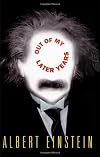
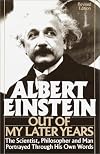
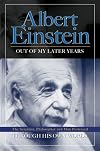
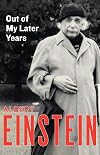
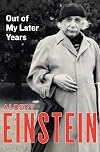
Out of My Later Years
by Albert Einstein
On This Page
Description
An inspiring collection of essays, in which Albert Einstein addresses the topics that fascinated him as a scientist, philosopher, and humanitarian Divided by subject matter--"Science," "Convictions and Beliefs," "Public Affairs," etc.--these essays consider everything from the need for a "supranational" governing body to control war in the atomic age to freedom in research and education to Jewish history and Zionism to explanations of the physics and scientific thought that brought Albert show more Einstein world recognition. Throughout, Einstein's clear, eloquent voice presents an idealist's vision and relays complex theories to the layperson. Einstein's essays share his philosophical beliefs, scientific reasoning, and hopes for a brighter future, and show how one of the greatest minds of all time fully engaged with the changing world around him. This authorized ebook features rare photos and never-before-seen documents from the Albert Einstein Archives at the Hebrew University of Jerusalem. show lessTags
Recommendations











Member Reviews
The chapters on public affairs and my people were so intelligently written and so relevant to today--2017. He was very prescient.
Collected essays by Albert Einstein from 1934 to 1950. Includes addresses, articles, letters, appeals and miscellaneous papers otherwise unpublished.
The world renowned scientist gives his personal credos, his profound convictions on the most urgent questions of modern society: social,religious, educational and racial relationships and the problem of peace."
Ratings
Members
- Recently Added By
Author Information

365+ Works 16,415 Members
Albert Einstein was born on March 14, 1879 in Ulm. He spent his childhood in Munich where his family owned a small machine shop. By the age of twelve, Einstein had taught himself Euclidean Geometry. His family moved to Milan, where he stayed for a year, and he used it as an excuse to drop out of school, which bored him. He finished secondary show more school in Aarau, Switzerland and entered the Swiss Federal Institute of Technology in Zurich. Einstein graduated in 1900, by studying the notes of a classmate since he did not attend his classes out of boredom, again. His teachers did not like him and would not recomend him for a position in the University. For two years, Einstein worked as a substitute teacher and a tutor before getting a job, in 1902, as an examiner for a Swiss patent office in Bern. In 1905, he received his doctorate from the University of Zurich for a theoretical dissertation on the dimension of molecules. Einstein also published three theoretical papers of central importance to the development of 20th Century physics. The first was entitled "Brownian Motion," and the second "Photoelectric Effort," which was a revolutionary way of thinking and contradicted tradition. No one accepted the proposals of the first two papers. Then the third one was published in 1905 and called "On the Electrodynamics of Moving Bodies." Einstein's words became what is known today as the special theory of relativity and said that the physical laws are the same in all inertial reference systems and that the speed of light in a vacuum is a universal constant. Virtually no one understood or supported Einstein's argument. Einstein left the patent office in 1907 and received his first academic appointment at the University of Zurich in 1909. In 1911, he moved to a German speaking university in Prague, but returned to Swiss National Polytechnic in Zurich in 1912. By 1914, Einstein was appointed director of the Kaiser Wilhelm Institute of Physics in Berlin. His chief patron in those early days was German physicist Max Planck and lent much credibility to Einstein's work. Einstein began working on generalizing and extending his theory of relativity, but the full general theory was not published until 1916. In 1919, he predicted that starlight would bend in the vicinity of a massive body, such as the sun. This theory was confirmed during a solar eclipse and cause Einstein to become world renowned after the phenomenon. Einstein received be Nobel Prize in Physics in 1921. With his new fame, Einstein attempted to further his own political and social views. He supported pacifism and Zionism and opposed Germany's involvement in World War I. His support of Zionism earned him attacks from both Anti-Semitic and right wing groups in Germany. Einstein left Germany for the United States when Hitler came into power, taking a position at the Institute for Advanced Study in Princeton, New Jersey. Once there, he renounced his stand on pacifism in the face of Nazi rising power. In 1939 he collaborated with other physicists in writing a letter to President Franklin D. Roosevelt informing him of the possibility that the Nazis may in fact be attempting to create an atomic bomb. The letter bore only Einstein's signature but lent credence to the letter and spurred the U.S. race to create the bomb first. Einstein became an American citizen in 1940. After the war, Einstein was active in international disarmament as well as world government. He was offered the position of President of Israel but turned the honor down. Albert Einstein died on April 18, 1955 in Princeton, New Jersey. (Bowker Author Biography) show less
Series
Belongs to Publisher Series
Work Relationships
Is contained in
Common Knowledge
- Original publication date
- 1950
- People/Characters
- Albert Einstein
Classifications
Statistics
- Members
- 754
- Popularity
- 37,223
- Reviews
- 3
- Rating
- (3.61)
- Languages
- English, German, Italian
- Media
- Paper, Ebook
- ISBNs
- 20
- ASINs
- 30