On This Page
Description
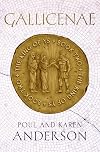
In book two of the King of Ys series, Gratillonius adjusts to his new role as sovereign of Ys as threats from all sides begin closing in As the Roman Empire loses its grip on its far-flung territories, the mystical kingdom of Ys in western Gaul is in great danger of slipping into oblivion. Suffocated for years by the rule of a tyrant king, Ys's last hope arrived in the form of a Roman emissary, Gratillonius, who defeated the sitting king to take the throne himself. Now Gratillonius must show more grapple with the kingdom's political strife and religious tensions while balancing his responsibilities to the Gallicenae, nine wide-ranging witches who have become his wives. Though Rome seeks to spread Christianity, and Gratillonius stands firm in his worship of Mithras, the Ysans hold to an entirely different religion in service of pagan deities who must be obeyed lest grave consequences descend on the fragile kingdom. Gallicenae is the second book in Poul and Karen Anderson's King of Ys series, which continues with Dahut. show lessTags
Recommendations






































Member Reviews
ORIGINALLY POSTED AT Fantasy Literature.
This review is for all four books in this series:
The King of Ys is a historical fantasy -- it is set in our world just before the fall of the Roman Empire and it mixes in the legend of the mythical city of Ys which was built below sea level on the coast of Brittany. Many of the characters in The King of Ys (Roman emperors, Christian saints, etc) are based on legendary and real historical figures and Poul and Karen Anderson include plenty of footnotes which explain the legend of Ys and the culture and religion of the 5th century.
In Roma Mater, we meet Gaius Valerius Gratillonius, a Roman centurion stationed at Hadrian's Wall. Because of his loyalty to would-be-emperor Magnus Clemens Maximus, the show more commander of the Roman troops in Britannia, Maximus assigns him to be Rome's prefect in Ys so that Gratillonius can keep it loyal while Maximus goes for the purple. Ys, though part of the Roman empire, has been left to itself for years because it's spooky. According to rumors, Ys is ruled by nine witches who, among other things, control the weather to keep Ys safe from enemies intending to invade by sea. These nine "witches" are the God-chosen wives of the King of Ys who is a nasty tyrant. His nine wives use their powers to ask the Gods to bring them a deliverer -- someone to challenge the king.
And so Gratillonius and his small troop arrive in Ys and soon he finds himself king. Along with inheriting the crown, Gratillonius gets the nine witch queens, too. As he sets out to reform Ys, which has suffered under the former rule, he has a lot of unfamiliar stuff to deal with: the responsibilities of a king, the different culture, a strange land and people, clashes in religious beliefs (he covertly worships Mithras who has been denounced by the newly Christian Roman Empire, and the Ysans worship three pagan gods), and satisfying nine wives who vary greatly in age, beauty, intelligence, and appreciation for men.
At first, Gratillonius balances all of this mostly successfully, and he begins to restore the prosperity of Ys. He is well-intentioned, but he can't help but occasionally go wrong as his own beliefs conflict with his people's and their gods'. One problem is that the Ysan's believe that their gods will destroy Ys by flood if they are not obeyed. So, there is a conflict between the Ysans' expectations of Gratillonius's duties at their religious rites, his desire to keep alive the worship of Mithras, and his admiration for the Christian leaders he knows. The other big problem is that when one of his wives dies, the gods choose the replacement from the priestesses who are all descendants of the previous kings and queens and the gods don't seem to care too much about age, mental ability, or consanguinity. So, not only are there nine wives, but their family tree looks more like an M.C. Escher drawing than a tree, and this kind of behavior isn't congruent with the worship of either Mithras or Christ. (But it does make for some interesting reading.)
The first two books, Roma Mater and Gallicenae, progress rather slowly and there's not much action -- and this is really my only complaint about The King of Ys. But, by the end of Gallicenae, we've seen the ways Gratillonius has had to struggle to obey the Ysan gods, and we can be rather certain about what they're going to throw at him next ... and we know he's going to defy them this time. And, we've seen some plot threads being developed (warriors preparing overseas) that are presumably being carefully set up for use in the next novel.
In the third novel, Dahut, things really come to a head, and the fallout is spectacular. The reader then realizes and appeciates how carefully the Andersons have planned and crafted this work from page one. Well done! The fourth book, Dog and Wolf, deals with the after-effects of the events in book three, develops the characters further as their lives have drastically changed, and comes to a satisfactory conclusion.
Besides being a fascinating and original tale with real historical feel, The King of Ys is beautifully written:
My favorite parts were Gratillonious's internal thoughts about his wives:
And there is poetry -- even whole chapters of poetry!
Near the end of the story, Gratillonious meets a young soldier who is in nearly the same situation he was in when he left Britain 25 years before. Shocked, he looks back and realizes that he's not the same man he was then -- he would make different choices now. Through love and loss, we learn what's important -- that's a good story.
Read this review in context at Fantasy Literature's Poul Anderson page show less
This review is for all four books in this series:
The King of Ys is a historical fantasy -- it is set in our world just before the fall of the Roman Empire and it mixes in the legend of the mythical city of Ys which was built below sea level on the coast of Brittany. Many of the characters in The King of Ys (Roman emperors, Christian saints, etc) are based on legendary and real historical figures and Poul and Karen Anderson include plenty of footnotes which explain the legend of Ys and the culture and religion of the 5th century.
In Roma Mater, we meet Gaius Valerius Gratillonius, a Roman centurion stationed at Hadrian's Wall. Because of his loyalty to would-be-emperor Magnus Clemens Maximus, the show more commander of the Roman troops in Britannia, Maximus assigns him to be Rome's prefect in Ys so that Gratillonius can keep it loyal while Maximus goes for the purple. Ys, though part of the Roman empire, has been left to itself for years because it's spooky. According to rumors, Ys is ruled by nine witches who, among other things, control the weather to keep Ys safe from enemies intending to invade by sea. These nine "witches" are the God-chosen wives of the King of Ys who is a nasty tyrant. His nine wives use their powers to ask the Gods to bring them a deliverer -- someone to challenge the king.
And so Gratillonius and his small troop arrive in Ys and soon he finds himself king. Along with inheriting the crown, Gratillonius gets the nine witch queens, too. As he sets out to reform Ys, which has suffered under the former rule, he has a lot of unfamiliar stuff to deal with: the responsibilities of a king, the different culture, a strange land and people, clashes in religious beliefs (he covertly worships Mithras who has been denounced by the newly Christian Roman Empire, and the Ysans worship three pagan gods), and satisfying nine wives who vary greatly in age, beauty, intelligence, and appreciation for men.
At first, Gratillonius balances all of this mostly successfully, and he begins to restore the prosperity of Ys. He is well-intentioned, but he can't help but occasionally go wrong as his own beliefs conflict with his people's and their gods'. One problem is that the Ysan's believe that their gods will destroy Ys by flood if they are not obeyed. So, there is a conflict between the Ysans' expectations of Gratillonius's duties at their religious rites, his desire to keep alive the worship of Mithras, and his admiration for the Christian leaders he knows. The other big problem is that when one of his wives dies, the gods choose the replacement from the priestesses who are all descendants of the previous kings and queens and the gods don't seem to care too much about age, mental ability, or consanguinity. So, not only are there nine wives, but their family tree looks more like an M.C. Escher drawing than a tree, and this kind of behavior isn't congruent with the worship of either Mithras or Christ. (But it does make for some interesting reading.)
The first two books, Roma Mater and Gallicenae, progress rather slowly and there's not much action -- and this is really my only complaint about The King of Ys. But, by the end of Gallicenae, we've seen the ways Gratillonius has had to struggle to obey the Ysan gods, and we can be rather certain about what they're going to throw at him next ... and we know he's going to defy them this time. And, we've seen some plot threads being developed (warriors preparing overseas) that are presumably being carefully set up for use in the next novel.
In the third novel, Dahut, things really come to a head, and the fallout is spectacular. The reader then realizes and appeciates how carefully the Andersons have planned and crafted this work from page one. Well done! The fourth book, Dog and Wolf, deals with the after-effects of the events in book three, develops the characters further as their lives have drastically changed, and comes to a satisfactory conclusion.
Besides being a fascinating and original tale with real historical feel, The King of Ys is beautifully written:
The armies met south of the River Ruirthech. That was a day when clouds blew like smoke, low above the valley, underneath a sky the hue of lead. Rainshowers rushed out of them, drenched men, washed their wounds and their dead, passed away on the keening wind. All colors were dulled except those of blood and gold. Shouts, horn calls, hoofbeats, footfalls, clamorous wheels, clash and rattle of weapons, were somehow muffled. But blows fell as heavy and sharp as always.
My favorite parts were Gratillonious's internal thoughts about his wives:
He gazed back. Over the years she had added flesh to flesh, though her frame was quite large enough that as yet she did not appear quite gross. Her features remained good in their heavy fashion and her hair was still a burnished red-brown. It was untidily piled on her head, like the raiment on her body. He had grown used to that....Well, she had her rights, and she was by no means a bad person, and a man ought to shoulder his burdens without whining about them.
And there is poetry -- even whole chapters of poetry!
Would you know the dog from the wolf? You may look at his paw,
Comparing the claw and the pad; you may measure his stride;
You may handle his coat and his ears; you may study his jaw;
And yet what you seek is not found in his bones or his hide,
For between the Dog and the Wolf there is only the Law.
Near the end of the story, Gratillonious meets a young soldier who is in nearly the same situation he was in when he left Britain 25 years before. Shocked, he looks back and realizes that he's not the same man he was then -- he would make different choices now. Through love and loss, we learn what's important -- that's a good story.
Read this review in context at Fantasy Literature's Poul Anderson page show less
All four volumes in this series are equally good. The city of Ys with its ingenious sea defences seems real.
Roman king of Ys continues to consolidate position
Devenu contre son gré souverain d'Ys au terme d'un duel fomenté par les Neuf Reines sorcières de la mythique cité, le Romain Gratillonius s'est peu à peu habitué à l'étrange coutume voulant qu'il partage successivement sa couche avec chacune d'elles. Dahilis, sa favorite, a péri en lui donnant une fille, Dahut, promise à un exceptionnel destin. Acceptant désormais sa charge, Gratillonius devra apprendre à distinguer ce qui est bon pour Rome, et ce qu'il convient d'accomplir pour garantir la sécurité du peuple ysan, son peuple à présent, face à l'Age de Ténèbres qui s'annonce...
Sep 17, 2010 (Edited)French
Ratings
Members
- Recently Added By
Author Information

Poul Anderson, November 25, 1926 - July 31, 2001 Poul Anderson was born on November 25, 1926 in Bristol, Pennsylvania to parents Anton and Astrid. After his father's death, Poul's mother took them first to Denmark and then to Maryland and Minnesota. He earned his degree in Physics from the University of Minnesota, but chose instead to write show more stories for science fiction magazines, such as "Astounding." Anderson is considered a "hard science fiction" writer, meaning that his books have a basis in scientific fact. To attain this high level of scientific realism, Anderson spent many hours researching his topics with scientists and professors. He liked to write about individual liberty and free will, which was a well known theme in many of his books. He also liked to incorporate his love of Norse mythology into his stories, sometimes causing his modern day characters to find themselves in fantastical worlds, such as in "Three Hearts and Three Lions," published in 1961. Anderson has written over a hundred books, his last novel, "Genesis" won the John W. Campbell Award, one of the three major science fiction awards. He is a former president of the Science Fiction and Fantasy Writers of America and won three Nebula awards and nine Hugo Awards. In 1997, Anderson was named a Grandmaster by the Science Fiction and Fantasy Writers of America and was also inducted into the Science Fiction Fantasy Hall of Fame. Poul Anderson died on July 31, 2001 at the age of 74. (Bowker Author Biography) show less

Some Editions
Series

Work Relationships
Is contained in
Common Knowledge
- Canonical title
- The King of Ys: Gallicenae
- Original publication date
- 1987
- Important places
- Ys
Classifications
Statistics
- Members
- 208
- Popularity
- 157,316
- Reviews
- 4
- Rating
- (3.29)
- Languages
- English, French
- Media
- Paper, Ebook
- ISBNs
- 7
- ASINs
- 4