Sister Age
by M. F. K. Fisher 
On This Page
Description
In these fifteen remarkable stories, M.F.K. Fisher, one of the most admired writers of our time, embraces the coming of old age. With a saint to guide us, she writes, perhaps we can accept in a loving way "the inevitable visits of a possibly nagging harpy like Sister Age" But in the stories, it is the human strength in the unavoidable encounter with the end of life that Fisher dramatizes so powerfully. Other themes--the importance of witnessing death, the marvelous resilience of the old, the show more passing of vanity--are all explored with insight, sympathy and, often, a sly wit. show lessTags
Recommendations































Member Reviews
What an odd collection of stories this is -- memoir pieces, short stories, ghost stories, travelogues, philosophy dips -- all bundled into the myriad of thoughts on Aging by the singular MFK Fisher.
Fisher's writing is sublime. You want to be her friend. You want her to invite you for a meal. You want her to knowingly wink at you across the table during coffee. I took my time with this book, reading only a story a day. I wanted her voice, her astute observations, and the scent of her company to linger in the air with me.
She addresses stages of aging, from the indignities, senility and fears, to the loss of social acceptability, secrets unwittingly revealed, and, of course, she addresses death too. Sometimes, beyond death. This seeming show more hodgepodge collection makes for a fifteen course meal and along with each course is wonderment. I don't think it's usual for us to think of old people or aging with wonderment. But Fisher does and she illustrates it beautifully to us.
There was one particular story I read twice, back to back, and then again next day. The story is about a woman preparing for a visit from a long absent daughter and grandson. It brought to mind my grandmother who had a passel of grown children, grandchildren and even great grandchildren who regularly visited her. As she aged and found preparing large meals in real time more difficult, she kept a stand-alone freezer filled with her homemade goodness at the ready. Not only did she live through the Depression as a farmer's wife in Oklahoma, but in her retirement was living on Social Security only. Thus, she was rightfully frugal. But that didn't mean frugality of taste. Rather, it meant she had on hand things like jars of apple butter made from the best of the season apples bought at their best price. It meant she had a special tin of saved bacon fat, that flavorful ingredient now anathema to many. And, of course, like any Grandmother worth her salt in those days, she could whip up fresh hot biscuits and gravy in 15 minutes flat. When a rare, young picky eater appeared in the genetic pool, she would sincerely offer a peanut butter and jelly sandwich, asking which direction the grandchild thought it should be halved. Oh, and cut the crusts, too? She would be only too happy to please them, worried about their hunger, not insulted.
But that was the 1960s and 70s. I think that eating at Grandma's is now less common for most of us and for so very many reasons. Does she still live in her home with her own kitchen? Can she expect a visit from those living far away more than every five or ten years? What about the Vegans? The Gluten-free? Lactose intolerant? Those with nut/soy/egg allergies? Or was there a family rift that won't heal? It is all so complicated.
In "A Kitchen Allegory," the piece I read three times, it is complicated too. Fisher's take, only a few pages long, is done with devastating compassion and accepting pathos.
The whole of Sister Age is like that. Even the pieces that I found odd, they add to Fisher's wide observations about aging and the aged. Together they are an exploration, an inquiry, a testament, or maybe a kind of education as she mentions in the Afterword. I wouldn't take a single story out.
I'm on a campaign to thin my bookshelves. This one is staying to be read again. God willing I myself live to even further old age. show less
Fisher's writing is sublime. You want to be her friend. You want her to invite you for a meal. You want her to knowingly wink at you across the table during coffee. I took my time with this book, reading only a story a day. I wanted her voice, her astute observations, and the scent of her company to linger in the air with me.
She addresses stages of aging, from the indignities, senility and fears, to the loss of social acceptability, secrets unwittingly revealed, and, of course, she addresses death too. Sometimes, beyond death. This seeming show more hodgepodge collection makes for a fifteen course meal and along with each course is wonderment. I don't think it's usual for us to think of old people or aging with wonderment. But Fisher does and she illustrates it beautifully to us.
There was one particular story I read twice, back to back, and then again next day. The story is about a woman preparing for a visit from a long absent daughter and grandson. It brought to mind my grandmother who had a passel of grown children, grandchildren and even great grandchildren who regularly visited her. As she aged and found preparing large meals in real time more difficult, she kept a stand-alone freezer filled with her homemade goodness at the ready. Not only did she live through the Depression as a farmer's wife in Oklahoma, but in her retirement was living on Social Security only. Thus, she was rightfully frugal. But that didn't mean frugality of taste. Rather, it meant she had on hand things like jars of apple butter made from the best of the season apples bought at their best price. It meant she had a special tin of saved bacon fat, that flavorful ingredient now anathema to many. And, of course, like any Grandmother worth her salt in those days, she could whip up fresh hot biscuits and gravy in 15 minutes flat. When a rare, young picky eater appeared in the genetic pool, she would sincerely offer a peanut butter and jelly sandwich, asking which direction the grandchild thought it should be halved. Oh, and cut the crusts, too? She would be only too happy to please them, worried about their hunger, not insulted.
But that was the 1960s and 70s. I think that eating at Grandma's is now less common for most of us and for so very many reasons. Does she still live in her home with her own kitchen? Can she expect a visit from those living far away more than every five or ten years? What about the Vegans? The Gluten-free? Lactose intolerant? Those with nut/soy/egg allergies? Or was there a family rift that won't heal? It is all so complicated.
In "A Kitchen Allegory," the piece I read three times, it is complicated too. Fisher's take, only a few pages long, is done with devastating compassion and accepting pathos.
The whole of Sister Age is like that. Even the pieces that I found odd, they add to Fisher's wide observations about aging and the aged. Together they are an exploration, an inquiry, a testament, or maybe a kind of education as she mentions in the Afterword. I wouldn't take a single story out.
I'm on a campaign to thin my bookshelves. This one is staying to be read again. God willing I myself live to even further old age. show less
I enjoyed this short story collection tremendously. Or are they essays? I'm not sure of the technical term, but they made for good reading. It felt like nonfiction, but the stories were fictional. The theme was aging, but it is not an advice book. It is more like a kaleidoscope to help us look at aging through different lenses and make us think. That's a terrible description, and yet I can do no better because Fisher doesn't hit us upside the head with her viewpoint, she makes you dig for your own.
The stories have a sort of progression from aging seen through the eyes of a child, to a woman in her prime, onto those at the end of their lives. In amongst them you will find a couple of ghost stories. The forward and the afterward tell us show more why she wrote these stories; why the art of aging has been on the author's mind from the time she was young until she was nearly finished writing as an aged adult. The prose is pure Fisher. Beautiful to read, poignant, and thought-provoking. I enjoyed this book very much. show less
The stories have a sort of progression from aging seen through the eyes of a child, to a woman in her prime, onto those at the end of their lives. In amongst them you will find a couple of ghost stories. The forward and the afterward tell us show more why she wrote these stories; why the art of aging has been on the author's mind from the time she was young until she was nearly finished writing as an aged adult. The prose is pure Fisher. Beautiful to read, poignant, and thought-provoking. I enjoyed this book very much. show less
Fisher is exploring aging, not from the standpoint of one who is facing it, but from the view of a woman in her 70s. This collection of stories is a mix of fact and fiction, short stories and short essays from her personal experience. Having read about but not having read any of Fisher's previous books, I looked forward to this reading. Her original metaphors tickle my writer's fancy: "her firm, rounded old face as impassive as a postcard of Krishna" and "as untroubled as a dot of plankton." In 1936 in Zurich Fisher bought an old oil painting of a woman she dubbed Sister Age. "I was going to write about growing old. . . . I was going to learn from the picture. . . . I planned to think and study about the art of aging for several years, show more and then tell how to learn and practice it." This volume, written when she was in her 70s, is the only effort she ever made to fulfill that ambition. She makes no direct statement about aging except in her Afterword, and there the valiantly borne disappointment is clearly stated: "Our housing is to blame," she said from her loneliness and separation from her children and grandchildren, blaming high-rises, cost of large homes, and the socioeconomic events that caused these phenomena for old people living alone, not being touched, not basking in the daily light of children's smiles. Fisher's stories delight and baffle from time to time, and her view of old age as a lonely time when one has to halfheartedly figure out what to do with one's time and search for ways to spend one's resources travel from page to lonely page. It was rather like a black comedy without a punch line. show less
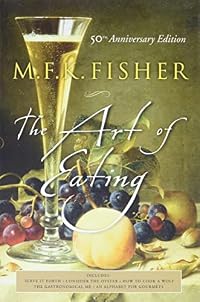
M.F.K. Fisher is best known for her splendid food memoirs - The Art of Eating, The Gastronomical Me, Two Towns in Provence, How to Cook a Wolf, Consider the Oyster... and more. They are all delightful -- smart and funny and thought-provoking and about far more than food. Far more. 'When I write of hunger,' she explained in a foreword to 'The Gastronomical Me,' 'I am really writing about love and the hunger for it.' A moral writer, she is full of philosophy, history and sly wit.
And so it was with great interest that I picked up her book about aging, and I wasn't disappointed. These are stories, with a couple of memoir essays, about how to get old, and what it means to get old, and what one experiences in that country. She's a show more fascinating writer, in that her fiction reads like memoir and her memoir like fiction. An early genre-bender, if you will.
But of course, Fisher being Fisher, it is about age, yes, but so much more. Memory. Place. Death. Wonder. France. War. Suffering. And rats (I'll let you discover them for yourself).
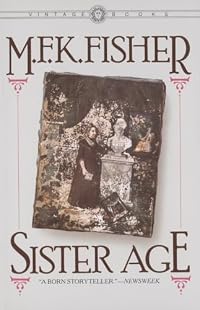
She says here, 'I have spent my life in a painstaking effort to tell about things as they are to me, so that they will not sound like autobiography but simply like notes, like factual reports.' A photo she found in a second-hand store of an old and "monkey-ugly" become the talisman she hangs over her writing desk, her companion into the exploration. It's intriguing and deeply human.
The book is not perfect -- a couple of the stories seem light-weight and some purists might not like her more fantastical stories, although I did, very much. In their imagery she reaches out to understand, and to express, what is essentially mysterious, and I felt the rustle of recognition on a deep level, which is a testament to her art.
Loneliness and regret touch many of the characters, and Fisher seems to be wrestling with how we make peace with the things we have done and the things we have left undone. From the vantage point of age, we remain ourselves, still hungry for love. The difference might be, however, where we find it. show less
And so it was with great interest that I picked up her book about aging, and I wasn't disappointed. These are stories, with a couple of memoir essays, about how to get old, and what it means to get old, and what one experiences in that country. She's a show more fascinating writer, in that her fiction reads like memoir and her memoir like fiction. An early genre-bender, if you will.
But of course, Fisher being Fisher, it is about age, yes, but so much more. Memory. Place. Death. Wonder. France. War. Suffering. And rats (I'll let you discover them for yourself).
She says here, 'I have spent my life in a painstaking effort to tell about things as they are to me, so that they will not sound like autobiography but simply like notes, like factual reports.' A photo she found in a second-hand store of an old and "monkey-ugly" become the talisman she hangs over her writing desk, her companion into the exploration. It's intriguing and deeply human.
The book is not perfect -- a couple of the stories seem light-weight and some purists might not like her more fantastical stories, although I did, very much. In their imagery she reaches out to understand, and to express, what is essentially mysterious, and I felt the rustle of recognition on a deep level, which is a testament to her art.
Loneliness and regret touch many of the characters, and Fisher seems to be wrestling with how we make peace with the things we have done and the things we have left undone. From the vantage point of age, we remain ourselves, still hungry for love. The difference might be, however, where we find it. show less
In these fifteen remarkable stories, M.F.K. Fisher, one of the most admired writers of our time, embraces the coming of old age. With a saint to guide us, she writes, perhaps we can accept in a loving way "the inevitable visits of a possibly nagging harpy like Sister Age" But in the stories, it is the human strength in the unavoidable encounter with the end of life that Fisher dramatizes so powerfully. Other themes—the importance of witnessing death, the marvelous resilience of the old, the passing of vanity—are all explored with insight, sympathy and, often, a sly wit. - from publisher
This is a curious mix of short stories. I had assumed, from the title, that it would reflect an acceptance of ageing especially for women. It seems, instead, Fisher gathered together 15 stories, purportedly which reflect her thoughts on growing older. Perhaps she didn't have quite enough to flesh out a book--towards the end the tales have more to do with the survival of the spirit after death, and delve into ghostly actions.
Her forward and afterward give her justification for the collection, the source of the title, and expands a bit more on her own views of growing older. It was my first book by this author. When I picked up the book I thought I knew her but had confused her name with that of M C Richards. Obviously a sign of my own show more ageing and memory slips.
Not bad, just not what I expected, and not enough depth for reflection to make me want to keep the book for re-reading. show less
Her forward and afterward give her justification for the collection, the source of the title, and expands a bit more on her own views of growing older. It was my first book by this author. When I picked up the book I thought I knew her but had confused her name with that of M C Richards. Obviously a sign of my own show more ageing and memory slips.
Not bad, just not what I expected, and not enough depth for reflection to make me want to keep the book for re-reading. show less
Sister Age is an anthology of short stories, most previously published in the 1960's in "literary" magazines, that deal with the subject of aging. The stories reflect an era, and a social dynamic, that has disappeared from the American scene but Fisher's thoughts and examination of the aging process remain insightful 40 years later.
Members
- Recently Added By
Lists

500 Great Books by Women
507 works; 60 members
Author Information

272+ Works 9,374 Members
Born July 3, 1908, in Albion, Michigan, M.F.K Fisher was raised primarily in Whittier, California, where she enjoyed cooking meals for her family. Encouraged in literary pursuits by her parents, she combined her favorite pastimes-cooking and writing-and began writing about cooking as early as 1929 when she moved to Dijon, France, with her first show more husband, Alfred Fisher. Fisher was educated at Illinois College, Occidental College, the University of California at Los Angeles, and the University of Dijon. She has written under the names Mary Frances Parrish, Victoria Bern, and Victoria Berne. A prolific author, her work is primarily autobiography and memoir. Her long list of publications includes Dubious Honors (1988) and Stay Me, Oh Comfort Me: Journals and Stories, 1933-1945, (1993). She also contributed articles to widely known magazines, including the New Yorker, Vanity Fair, and Gourmet. Fisher died of Parkinson's disease on June 22, 1992, in Glen Ellen, California. (Bowker Author Biography) show less
M. F. K. Fisher has a Legacy Library. Legacy libraries are the personal libraries of famous readers, entered by LibraryThing members from the Legacy Libraries group.
Awards and Honors
Notable Lists
Common Knowledge
- People/Characters
- M. F. K. Fisher
- First words
- Foreword: St. Francis sang gently of his family: his brother the Sun, his sister the Moon.
Tears do come occasionally into one's eyes, and they are more often than not a good thing.
Afterword: Of course it was strange to send away some forty years of accumulated clippings and notes and even lengthy writings that I had kept since my first meeting with Ursula von Ott, Sister Age, in Zurich. - Last words
- (Click to show. Warning: May contain spoilers.)But Sister Age still looks far past us all (Grandmother, little sister Anne, Mrs. Tolbert, her own spoiled brat called something like Johann Wilhelm Sebastian von Ott...), and her monkey sad eyes are brighter than ever, and the letter of information remains open but unread in her bony hand.
Classifications
- Genre
- Biography & Memoir
- DDC/MDS
- 305.26 — Social sciences Social sciences, sociology & anthropology Groups of people Age groups Older people (60+)
- LCC
- HQ1061 .F54 — Social sciences The family. Marriage, Women and Sexuality The Family. Marriage. Women The family. Marriage. Home Aged. Gerontology (Social aspects).
- BISAC
Statistics
- Members
- 385
- Popularity
- 80,774
- Reviews
- 10
- Rating
- (3.72)
- Languages
- English
- Media
- Paper, Ebook
- ISBNs
- 7
- ASINs
- 2