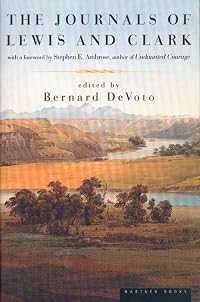
The Journals of Lewis and Clark {abridged, 1953}
by Meriwether Lewis (Author), William Clark
On This Page
Description
In 1804, President Jefferson asked two Virginians-Meriwether Lewis and William Clark-to lead an expedition into the unexplored wilderness of North America. The journals of these explorers are both a priceless piece of national history and a great adventure story. With descriptions of Native American tribes and life-and-death struggles against the elements, this book will transport you to the early days of American exploration.Tags
Recommendations













Member Recommendations
Member Reviews
A sometimes interesting but often tedious abridged account. The most interesting aspects for me were the relative ignorance and reliance of the members of the expedition on indigenous peoples for food, shelter and navigation.
Excellent book. One of my few "five stars." The Journals of Lewis and Clark was a journal by explorers who were new to the land, its flora and fauna, and its people. The journey was an epic struggle through heat, blizzards, insects, wolves, grizzly bears and Native Americans. Lewis and Clark tried to "put their arms around" a huge country that is so vast, so diverse that no one can really know it.
They were part of the dream that kindled America and that keeps burning.
They were part of the dream that kindled America and that keeps burning.
I can only imagine what it must have been like for Meriwether Lewis and William Clark as they set out to explore the territory of the Louisiana Purchase. The journals were fascinating in some areas and, as would be expected, very slow in others. There are portions that I know I will reread in the future.
If you love America and want to read an epic story, look no further than this book. I read this book after a cross country drive and thought it was one of the best stories I have ever read. The lamguage and spelling take a little time getting used too, but the story and description from Lewis and Clark make up for it. A must read for any budding historian interested in the formation of the United States.
This handy little abridgement is all you really need as it includes some of the most important journal entries. It's also inexpensive, so that when you're camping on the Lewis and Clark trail you can sit around the campfire and read from the journals.
Every American should read this book. OMG what a story. This edit is truly the best of the lot.
NOT A REVIEW: This book has a front matter page count of xxv (25). That is followed by one (1) unnumbered page before the numbered pages start. Most of the time the numbered pages then start at one (1) but, not with this book. This book the pages start right where the front matter left off (adding the unnumbered page in as well)... So the book starts on page twenty-seven (27). The bottom line? To accomplish the proper pagination you now have to do math. LoL
Members
- Recently Added By
Lists

100 Books to Read in a Lifetime (That Are Older Than 200 Years)
415 works; 175 members

Set in the Pacific Northwest
136 works; 7 members

25 Greatest Science Books of All Time
33 works; 6 members

Best 19th and 20th Century Travel
22 works; 4 members

Mississippi River in Books
20 works; 3 members

el
1,139 works; 1 member
Author Information

The Lewis and Clark expedition was one of the earliest crossings of the United States. Eager to expand the country, President Thomas Jefferson appointed Lewis, formerly his private secretary, to seek a Northwest passage to the Orient. Lewis and his partner, William Clark, were both seasoned soldiers, expert woodsmen, and boatmen. They both kept show more journals and so did 4 sergeants and 1 private in the party of 43 men. They started from St. Louis in 1804, heading up to the Missouri River, across the Rockies, and down to the Pacific coast at the mouth of the Columbia River. The Indian woman Sacajawea ("Bird Woman") gave them valuable help on the hazardous journey, which lasted 2 years, 4 months, and 10 days, and cost the U.S. government a total of $38,722.25. Lewis was the better educated of the two captains, and his account has more force, but Clark was a superb observer who wrote in an ingenious phonetic spelling of his own invention. The official edition of the Journals did not appear until 1814, when they were edited in two volumes by Nicholas Biddle and Paul Allen. This text, a paraphrase of the journals, was used in various editions until 1904, when Reuben G. Thwaites edited an eight-volume edition, published in 1904--05. Many recent editions have followed the original text, making the journals available in all of their original freshness. Early in 1960 it was announced in the New York Times that 67 notes written by Clark had been given by Frederick W. Beinecke of New York to the Yale University Library. "The documents, finger-smudged, blotted and blurred with cross-outs, list personal observations previously unknown to historians. . . . The documents, consisting of old letters, envelopes and scraps of paper, were the subject of an unusual legal fight. After the Clark notes were found in an attic in St. Paul, Minnesota, in 1952, the United States moved to obtain them. The Government contended the documents were part of the official records of Clark while he served the United States. The Federal Court of Appeals in St. Louis dismissed the suit on Jan. 23, 1958. The court test was closely watched by libraries, museums and the American Philosophical Society. Had the Government been upheld, the custody of similar historical documents would have been jeopardized. . . ." Shortly after the end of the expedition, Lewis was appointed governor of the Territory of Upper Louisiana. When he at last took up his post, he was mysteriously killed---or took his own life---in the lonely wilderness. (Bowker Author Biography) show less

40 Works 3,903 Members
Eager to expand the country in the early 1800s, President Thomas Jefferson appointed Meriwether Lewis, formerly his private secretary, to seek a Northwest passage to the Orient. Lewis and his partner, William Clark, were seasoned soldiers, expert woodsmen, and boatmen. They both kept journals and so did four sergeants and a private in the party of show more 43 men. They started from St. Louis, Missouri, in 1804, heading up to the Missouri River, across the Rockies, and down to the Pacific coast at the mouth of the Columbia River. The Indian woman Sacajawea (Bird Woman) gave them valuable help on the hazardous journey, which lasted 2 years, 4 months, and 10 days, and cost the U.S. government a total of $38,722.25. Lewis was the better educated of the two captains, and his account of the expedition has more force, but Clark was a superb observer who wrote in an ingenious phonetic spelling of his own invention. The official edition of the Journals did not appear until 1814, after they had been edited in two volumes by Nicholas Biddle and Paul Allen. This text, a paraphrase of the journals, was used in various editions until 1904, when Reuben G. Thwaites edited an eight-volume edition, published in 1904-1905. Many recent editions have followed the original text, making the journals available in all of their original freshness. Early in 1960 the New York Times announced that Frederick W. Beinecke of New York had given 67 notes written by Clark to the Yale University Library. The finger-smudged documents blotted and blurred with cross-outs consisted of personal observations previously unknown to historians. The documents became the subject of an unusual legal fight. After the Clark notes were found in an attic in St. Paul, Minnesota, in 1952, the United States moved to obtain them. The government stated that the documents were part of the official records of Clark while he served the United States. On January 23, 1958, the Federal Court of Appeals in St. Louis dismissed the suit. Libraries, museums and the American Philosophical Society had closely watched the court test. Had the U.S. government been upheld, the custody of similar historical documents would have been jeopardized. Shortly after the end of the expedition, Lewis was appointed governor of the Territory of Upper Louisiana. When he at last took up his post, he was mysteriously killed or took his own life in the lonely wilderness. (Bowker Author Biography) show less
All Editions
Some Editions
Awards and Honors
Distinctions
Notable Lists
Series
Belongs to Publisher Series
Work Relationships
Is an abridged version of
Common Knowledge
- Canonical title
- The Journals of Lewis and Clark {abridged, 1953}
- Original publication date
- 1953
- People/Characters
- William Clark; Meriwether Lewis; Sacajawea
- Important places
- Montana, USA
- Important events
- Lewis and Clark Expedition (1804 | 1806)
- Publisher's editor
- Thwaites, Reuben Gold
- Blurbers
- Ambrose, Stephen E.
- Disambiguation notice
- Please distinguish between this 1953 abridgement of The Journals of Lewis and Clark, edited by Bernard DeVoto, and other similar abridgements of the complete Work. Thank you.
Classifications
- Genres
- Nonfiction, History, Travel, General Nonfiction, Biography & Memoir
- DDC/MDS
- 917.8042 — History & geography Geography & travel Geography of and travel in North America Western U.S. Travel 19th Century
- LCC
- F592.41997 — Local History of the United States, Canada and Latin America United States local history
- BISAC
Statistics
- Members
- 1,274
- Popularity
- 19,165
- Reviews
- 7
- Rating
- (4.00)
- Languages
- English
- Media
- Paper, Audiobook, Ebook
- ISBNs
- 26
- UPCs
- 3
- ASINs
- 28