
James P. Ronda
Author of Lewis and Clark among the Indians
About the Author
James P. Ronda is H. G. Barnard Professor of Western American History at the University of Tulsa and past president of the Western History Association
Image credit: via C-SPAN
Works by James P. Ronda
Revealing America: Image & Imagination in the Exploration of North America (Sources in Modern History) (1996) 11 copies
Indian missions: A critical bibliography (Bibliographical series - The Newberry Library, Center for the History of the American Indian) (1978) 7 copies
Visions of the Tallgrass: Prairie Photographs by Harvey Payne (The Charles M. Russell Center Series on Art and Photography of the American West) (2018) 3 copies
Associated Works
Thomas Jefferson and the Stony Mountains: Exploring the West from Monticello (1981) — Foreword, some editions — 44 copies
Journal of the Early Republic: Winter 1999 Vol.19, No.4 — Contributor — 1 copy
Tagged
Common Knowledge
- Canonical name
- Ronda, James P.
- Birthdate
- 1943-05-30
- Gender
- male
- Education
- University of Nebraska-Lincoln (Ph.D | History)
Hope College (BA | History)
University of Nebraska-Lincoln (MA | History) - Occupations
- H. G. Barnard Chair of Western American History, University of Tulsa (1989-2008)
Professor of History, Youngstown State University (1969-1988) - Organizations
- Western History Association
Organization of American Historians - Nationality
- USA
- Places of residence
- Chicago, Illinois, USA
- Associated Place (for map)
- Illinois, USA
Members
Reviews
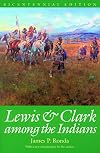
Author James Ronda describes Lewis and Clark as good ethnographers but not good ethnologists; they did well describing the various Native American tribes they encountered on the way west, but not as well comparing native customs with Europeans or other natives. For example, they never figured out the complicated trade relations between native groups; in particular the possibility that a particular native might be part of a war party intent on plunder and scalps one day, but a valued trading show more partner the next. Their efforts to make “peace” between tribes that were at “war” foundered as a result. Ronda also has some interesting observations about native sexuality; the members of the Corps of Discovery generally picked up sex partners every time they stayed with a tribe for more than a few days. Clark tended to blame this on the “promiscuity” of native women. In later, more politically correct times, things turned around and the explorers were seen as sexually aggressive men taking advantage of naïve native women. Ronda notes the reality is nuanced; many of the tribes contacted – particular the Mandans, where the expedition overwintered – saw sex as a way of contacting the spirit world. The men of the Corps of Discover, with their pale skin and fascinating equipment, were seen as “spirit people” and sexual relations with them were considered beneficial – to the extent that there were cases where native husbands stood guard while their wives did their spiritual exercises.
Ronda also has some interesting comments on Sacagawea (he considers that the correct spelling, with the Hidatsa meaning of “bird woman”). Sacagawea is the subject of a lot of mythologizing; she appears in art and literature as a “guide” for the expedition. Ronda notes that although she was able to point out some landmarks, she didn’t choose the expedition’s route. However, Clark acknowledged her value as a translator and Ronda suggests her presence with the expedition helped to convince natives that the Corps of Discovery didn’t have hostile intent – nobody would bring a young woman along on a war party.
Well written and an easy read, despite considerable depth of scholarship. Some good maps; a few pertinent illustrations. Good bibliography, index, and endnotes. For more on the expedition, see Undaunted Courage. show less
Ronda also has some interesting comments on Sacagawea (he considers that the correct spelling, with the Hidatsa meaning of “bird woman”). Sacagawea is the subject of a lot of mythologizing; she appears in art and literature as a “guide” for the expedition. Ronda notes that although she was able to point out some landmarks, she didn’t choose the expedition’s route. However, Clark acknowledged her value as a translator and Ronda suggests her presence with the expedition helped to convince natives that the Corps of Discovery didn’t have hostile intent – nobody would bring a young woman along on a war party.
Well written and an easy read, despite considerable depth of scholarship. Some good maps; a few pertinent illustrations. Good bibliography, index, and endnotes. For more on the expedition, see Undaunted Courage. show less
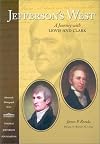
This book is a snapshot of current conceptions of Jefferson's view of the West. Ronda's view is that Jefferson was always drawn to the west as an engine of continued peaceful progress in the new republic, and that it was vital that Americans have a true picture of that geography. Yet, Jefferson's understanding of the west was rooted in his own limited knowledge of eastern geography. When he authorized the Lewis and Clark expedition, the "geography of the mind" came into conflict with the show more "geography of reality." The single line of mountains (the Blue Ridge) was not the same as the ranks of mountains that formed the Rockies, Bitteroots and Cascades. The east traversed by easily navigable rivers (Potomac, Ohio, Mississippi, did not have a western equivalent. The myths that Jefferson hoped to establish in fact--Welsh speaking Indians, mastodons and a land of volcanoes also were untrue. Even Jefferson's conception of Indians as lower on the social evolutionary chain, who would respect the authority and power of the Great Father, was not correct.
Ronda lays out a firm foundation in current scholarship about the west. This small volume (72 pages) is nicely illustrated and though rooted in scholarly thinking is very accessible. show less
Ronda lays out a firm foundation in current scholarship about the west. This small volume (72 pages) is nicely illustrated and though rooted in scholarly thinking is very accessible. show less
Ronda is one of the most thought-provoking and interesting of the revisionist Lewis and Clark historians. While still respectful of the expedition, Ronda is constantly searching for the missing narrative, the hidden perspective. Lewis and Clark Among the Indians is still his most important work.
Finding the West: Explorations With Lewis and Clark (Histories of the American Frontier) by James P. Ronda
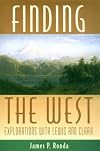
James Ronda is one of those Lewis and Clark historians that take an expansive view of the expedition. His concern is not so much the expedition itself, but those that came before, those it touched, and the voices we do not hear in the journals. Ronda always manages to question our long-held assumptions in a respectful manner. He broadens our understanding of the land and people the Captains saw and came into contact with.
The seven essays in the book focus on a variety of topics including, show more American relations with Spain, the legacy of Lewis and Clark on the Clatsop Indians, illusions versus the reality of the West. show less
The seven essays in the book focus on a variety of topics including, show more American relations with Spain, the legacy of Lewis and Clark on the Clatsop Indians, illusions versus the reality of the West. show less
You May Also Like


Associated Authors
Statistics
- Works
- 19
- Also by
- 6
- Members
- 481
- Popularity
- #51,316
- Rating
- 4.0
- Reviews
- 6
- ISBNs
- 22
- Languages
- 1