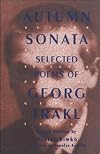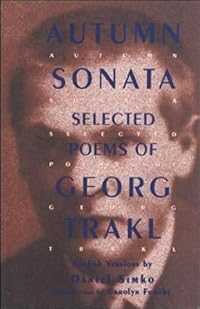
Autumn Sonata
by Georg Trakl
98 Members (4.55)
On This Page
Description
Georg Trakl's poems are considered some of the most difficult for any translator to tackle; his German is dense and sometimes almost impenetrable. Daniel Simko's collection Autumn Sonata, has been lauded for the 'simplicity and directness' of its translations, accomplished with out sacrificing the drama of Trakl's rich imagery.Suffering from manic depressive episodes and haunted by his experiences tending the wounded and dying during World War One, Trakl's poems reflect a sense of lostness: show more nightmare visions and disembodied voices provide an often eccentric perspective of reality. Though he yearns for deliverance, there poems do not anticipate it. Instead, they map the interior landscape of a brilliant, though troubled, spirit. show lessTags
Recommendations

















Member Reviews
Members
- Recently Added By
Author Information

155+ Works 1,090 Members
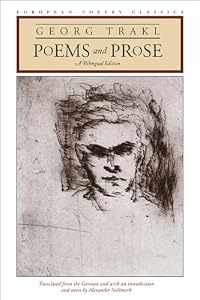
Georg Trakl was born to a family of wealthy industrialists in Salzburg. He proved a poor student and was unable to embark on the professional career his family intended for him. As a young man he grew increasingly morose, indulging heavily in hallucinogenic drugs and alcohol. He apprenticed himself to a pharmacist, a trade that guaranteed him easy show more access to drugs. In 1912 he received the patronage of Ludwig Flicker, which enabled him to devote much of his time to poetry. Trakl went on to publish two small collections of poems, Gedichte (Poems) (1913) and Sebastian im Traum (Sebastian in a Dream) (1914). In 1914 he joined the army. After the battle of Grodek, for which his last and most famous poem is named, Trakl was assigned to look after 90 badly wounded soldiers. Unable to help them, he experienced a mental breakdown. A short while later, he died of an overdose of cocaine, possibly deliberately. Trakl's poetry is narrow in range, though intense. His verse consists almost entirely of elegies and laments, in which mythic images are held together by slow yet pronounced rhythms. Trakl himself described poetry as an "imperfect penance" for "unabsolved guilt."Rilke wrote in a letter to Erhard Buschbeck, "In the history of the poem Trakl's books are important contributions to the liberation of the poetic image. They seem to have mapped out a new dimension of the spirit and to have disproved that prejudice which judges all poetry only in terms of feeling and content, as if in the direction of lament there were only lament---but here too there is world again." (Bowker Author Biography) show less
All Editions
Common Knowledge
- Original publication date
- 1998 (collection) (collection)
Classifications
Statistics
- Members
- 98
- Popularity
- 327,980
- Rating
- (4.55)
- Languages
- English
- Media
- Paper
- ISBNs
- 3
- ASINs
- 1