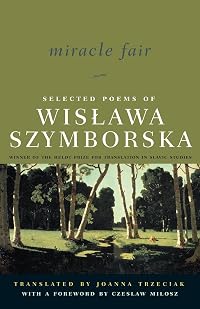
Miracle Fair: Selected Poems of Wislawa Szymborska
by Wislawa Szymborska
On This Page
Description
This long-awaited translation of the works of the Nobel Prize-winning poet includes an introduction by Czeslaw Milosz. 5 woodcuts.Tags
Recommendations
Member Reviews
I've always enjoyed Szymborska's work when I've come across it, so I'm somewhat surprised that I didn't enjoy this collection more. It isn't bad particularly, but it's also not up to the expectations I had from reading her work previously. Partly because of this, I'm tempted to blame it at least partly on the translator. I can't particularly say if this is fair since I haven't read the poems in their original form, but at the same time, I have read much of Szymborska's work previously, and from other translators. In the translator's note in the beginning, she writes that "a substantial number of these poems have never appeared in English translation before. Indeed several had been deemed untranslatable." Some things simply don't lend show more themselves to translations, and perhaps many of these poems were rightly in that category until being explored for this collection. The language and ideas are elegant, but many of them simply don't fully come across in meaning, even after repeated readings. I've never seen this with Szymborska's work before, and it was frustrating here--again, perhaps this is not the case in the originals and necessary nuances were left out for whatever reason. There are some gems here that I'll come back to, but frighteningly few for having come from this author.
In conclusion, I would highly recommend Wislawa Szymborska's work to anyone who enjoys poetry and/or beautiful and elegant writing and ideas; however, I would recommend work by a translator other than Joanna Trzeciak. This may be an unfair comment, but based on my experience and on some of the sentiments in the Translator's note, as well as the vast difference in the level of communication presented by various poems (some easily understood, some nearly impossible), it is the only conclusion I can reach to explain the collection and my reaction. Particularly taking into consideration that she "re-translated" poems already translated into English (she gives no further comment as to why they required further work), I have to assume that she is shaping these in some way that ends up changing the level of emotion and readability. show less
In conclusion, I would highly recommend Wislawa Szymborska's work to anyone who enjoys poetry and/or beautiful and elegant writing and ideas; however, I would recommend work by a translator other than Joanna Trzeciak. This may be an unfair comment, but based on my experience and on some of the sentiments in the Translator's note, as well as the vast difference in the level of communication presented by various poems (some easily understood, some nearly impossible), it is the only conclusion I can reach to explain the collection and my reaction. Particularly taking into consideration that she "re-translated" poems already translated into English (she gives no further comment as to why they required further work), I have to assume that she is shaping these in some way that ends up changing the level of emotion and readability. show less
Ratings
Members
- Recently Added By
Lists

Poetry Corner
187 works; 15 members
Author Information

134+ Works 4,988 Members
Wislawa Szymborska was born in Bnin, Poland on July 2, 1923. After the Nazis invaded Poland in September 1939, she found work as a railway clerk to avoid deportation to Germany as a forced laborer. In her free time, she studied at illegal underground universities. After World War II, she resumed her formal studies in Polish literature and show more sociology at Jagiellonian University, but never earned a degree. In 1945, she published her first poem, I Am Looking for a Word, in a weekly supplement to the local newspaper. Her first book of poetry was published in 1952. Her other volumes of poetry include View with a Grain of Sand, People on a Bridge, Sounds, Feelings, Thoughts: Seventy Poems, and Here. In 1991 she won the Goethe Prize and in 1995 she was awarded the Herder Prize. She won the Nobel Prize for Poetry in 1996 and was awarded The Order of the White Eagle in recognition of her contribution to her country's culture in 2011. From 1953 to 1981, she worked as a poetry editor and columnist for the literary weekly Literary Life, where she wrote a column called Non-Required Reading. She died of lung cancer on February 1, 2012 at the age of 88. (Bowker Author Biography) show less
Classifications
- Genres
- Poetry, Fiction and Literature
- DDC/MDS
- 891.8 — Literature & rhetoric Literatures of other languages East Indo-European and Celtic literatures West and South Slavic languages (Bulgarian, Slovene, Polish, Czech, Slovak, Serbo-Croatian, and Macedonian)
- LCC
- PG7178 .Z9 .A28 — Language and Literature Slavic languages and literatures. Baltic languages. Albanian language Slavic. Baltic. Albanian Slavic Polish
- BISAC
Statistics
- Members
- 171
- Popularity
- 191,966
- Reviews
- 1
- Rating
- (4.48)
- Languages
- English, Hungarian
- Media
- Paper
- ISBNs
- 3
- ASINs
- 2