On This Page
Description
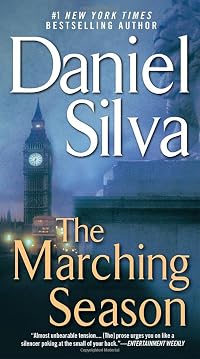
The #1 New York Times bestselling author of the Gabriel Allon series presents the second thriller featuring former CIA Agent Michael Osbourne, following The Mark of the Assassin.When the Good Friday peace accords are shattered with three savage acts of terrorism, Northern Ireland is blown back into the depths of conflict. And after his father-in-law is nominated to become the new American ambassador to London, retired CIA agent Michael Osbourne is drawn back into the game. He soon show more discovers that his father-in-law is marked for execution. And that he himself is once again in the crosshairs of a killer known only as October, one of the most merciless assassins the world has ever known... show less
Tags
Recommendations














Member Reviews
The Marching Season picks up where Daniel Silva's The Mark of the Assassin leaves off. Michael Osbourne has recovered from his wounds received in his encounter with the assassin, Jean-Paul Delaroche, code named October, and is now bored and yearning for activity. Delaroche's hand wound received from his encounter with Osbourne has healed but has left "an ugly, puckered scar ... which he could do nothing about ... except to conceal it." The Society for International Development and Cooperation has thrived and has paid Delaroche for another assassination, that of the leader of Hamas, Ahmed Hussein. In killing Hussein, Delaroche has changed his modus operandi and has avoided his customary three shots to the face. Hussein's assassination is show more another successful venture for the Society which seeks "to promote constant, controlled global tension through covert operations." The group also is moving to subvert the treaty by assisting a newly formed Protestant terrorist cell, "the Ulster Freedom Brigade" (UFB) which has already committed one assassination and two violent bombings.
When Senator Douglas Cannon, Osbourne's father-in-law is appointed as President Beckwith's ambassador to the Court of James, the UFB is thwarted in an assassination plot against him. The group is erased except for its head of intelligence, Rebecca Wells. The society arranges for her to team up with Delaroche who now has had his appearance change drastically by plastic surgery. The society fears for interference from Osbourne and decides to eliminate him. Monica Tyler, head of the CIA and a member of the Society, agrees.
This novel is somewhat over-the-top in its denouement, but it is a good read. show less
When Senator Douglas Cannon, Osbourne's father-in-law is appointed as President Beckwith's ambassador to the Court of James, the UFB is thwarted in an assassination plot against him. The group is erased except for its head of intelligence, Rebecca Wells. The society arranges for her to team up with Delaroche who now has had his appearance change drastically by plastic surgery. The society fears for interference from Osbourne and decides to eliminate him. Monica Tyler, head of the CIA and a member of the Society, agrees.
This novel is somewhat over-the-top in its denouement, but it is a good read. show less
I feel a little bad about rating this 2-1/2 stars, but I just didn't feel like it measured up to average. It was a very "vanilla" thriller, or a not very original story. You had all the basic ingredients: the spies, the good guys, the bad guys, the guys you couldn't really tell whether they were good or bad, and the all-pervasive secret society ("The Pentaverate"... the 1993 Pentaverate, not the remake).
I really like Daniel Silva's Gabriel Allon series, but this wasn't nearly as good. None of the characters drew me in with the possible exception of the assassin Delaroche. There was also a ton going on in this book, but at the end most of it was never wrapped up. Like this was going to be part of a series, and then all the loose threads show more would be put back in play. I liked the ending, but it left more questions than answers so in a lot of respects there was no conclusion that came with the ending (if that makes any sense).
Also, quite strangely, I wasn't sure if this was a Gabriel Allon book or not when I started reading it because Jean-Paul Delaroche sounded like the same character. And part of "The Pentaverate" in this book is also a central character in the Allon series.
I finished, but I was not all that thrilled reading it. show less
I really like Daniel Silva's Gabriel Allon series, but this wasn't nearly as good. None of the characters drew me in with the possible exception of the assassin Delaroche. There was also a ton going on in this book, but at the end most of it was never wrapped up. Like this was going to be part of a series, and then all the loose threads show more would be put back in play. I liked the ending, but it left more questions than answers so in a lot of respects there was no conclusion that came with the ending (if that makes any sense).
Also, quite strangely, I wasn't sure if this was a Gabriel Allon book or not when I started reading it because Jean-Paul Delaroche sounded like the same character. And part of "The Pentaverate" in this book is also a central character in the Allon series.
I finished, but I was not all that thrilled reading it. show less
This was a pretty typical spy thriller, nothing too special (although I did appreciate that the 'villains' of the piece weren't Arabs for once), but gets the job done. Silva does make an effort to give his main character and main antagonists an interior life, but I'm not sure how successful he really is in that effort. Ultimately, I was only mildly disappointed to find Michael Osbourne doesn't appear in a third book.
I guess if Mark of the Assassin was three stars, this one was probably three and a half, or maybe three and a quarter. Good but not great, but I did like Michael a lot more in this book. The plot again was high quality, but Silva still indulges in way to much detail, including places that need minimal to no detail, and that always throws a book off for me. Interesting twist at the end, with Michael and Delaroche, which I didn't see coming, which was nice. Tied up a few loose ends nicely too.
One thing I wonder about the book is how Silva talks about people in code names, as if you don't know who they are (Picasso) and then had a big reveal later, when in reality you know who that person is the whole time. Do people really need that big show more reveal to figure what is going on, or was it just some weak literary trick that I missed or something?
Eh, the books are ok, not bad for a quick, lazy summer read or something, but there are a lot of others I'd probably pick up first. show less
One thing I wonder about the book is how Silva talks about people in code names, as if you don't know who they are (Picasso) and then had a big reveal later, when in reality you know who that person is the whole time. Do people really need that big show more reveal to figure what is going on, or was it just some weak literary trick that I missed or something?
Eh, the books are ok, not bad for a quick, lazy summer read or something, but there are a lot of others I'd probably pick up first. show less
This 1999 work is Daniel Silva's third book, and the 2nd in his Michael Osbourne series. I read it in abridged form (compliments of Reader's Digest) and found it somewhat wanting. The plot is as follows. Peace is about to break out in Northern Island, but a secret organization seeks to disrupt the process by assassinating the new US Ambassador to that country. This organization -- the Society of International Development and Cooperation -- has no political agenda; they simply seek to foment conflict to advance their own shadowy economic interests. The hired assassin is Jean-Paul Delaroche (nicknamed "October"), a KGB trained agent who is an old enemy of the CIA's own assassin, Osbourne. Last time the duo met, October's lady-love wound show more up dead, killed by bow and arrow by Osbourne's own lady.
So with this history behind them, Osbourne and October match efforts and wits; October seeks to kill the ambassador, who (in a strategically stupid move -- since they know he's been targeted) is brought to the house where Osbourne's wife and children are staying. Towards the end,once Osbourne has disarmed and wounded October, he grants the latter his life in return for information on who the highly placed turncoat is in the CIA. A terrorist assassin like October may murder hundreds without compunction and simply for the money, but under his high code of morality, when he makes a promise (i.e., utters a few verbalizations) he keeps it. And of course Osbourne doesn't take the opportunity to kill October, to save his future victims. . So Osbourne finds out the identity of the CIA double agent, and October and Osbourne both live to kill again.
In my opinion, there are too many characters, too much implausibility, and too many scenes obviously constructed for effect. In addition, the work didn't lend itself well to abridgement, since the characters flew by too fast to become familiar. show less
So with this history behind them, Osbourne and October match efforts and wits; October seeks to kill the ambassador, who (in a strategically stupid move -- since they know he's been targeted) is brought to the house where Osbourne's wife and children are staying. Towards the end,
In my opinion, there are too many characters, too much implausibility, and too many scenes obviously constructed for effect. In addition, the work didn't lend itself well to abridgement, since the characters flew by too fast to become familiar. show less
I have come to enjoy the Gabriel Allon series of spy stories from Daniel Silva. The Marching Season is not exactly part of that canon, but it does share some characters and has another character who could have served as an extended character study for Gabriel.
This book and the Allon series are connected through the story of Adrian Carter, a CIA operative who becomes head of the CIA, a role continued in later books. Also present is Ari Shamron, Gabriel Allon’s boss at the Mosad. In Marching Season, he is a minor character, still in charge of Mosad Operations, and a character of dubious moral fiber. The third thread that connects the two is a mysterious assassin, known primarily by his cover name, October. Like Allon, he is an artist, show more as well as an accomplished assassin, has a physique like a cyclist and can pass for different nationalities.
The Marching Season stands on its own merits, and stands very well indeed, but these similarities were too noticeable not to comment on. Silva’s writing style is as fluid as his more recent works. Despite his penchant for detail, I found it annoying from a technical point that he constant used “clip” in place of “magazine” for the device that holds bullets in an automatic weapon. This technicality did not bring down the rating, however.
The plot is well constructed and plausible, but there were not enough twists to really elevate this story beyond four stars. If you are a fan of Gabriel Allon, this will fill in some of the backgrounds of the characters in that series. If you like old school spy novels, this is a good addition to your bookshelf: very little in the way of gadgets but lots of stalking, intelligence gathering and trying to outguess the other guy. show less
This book and the Allon series are connected through the story of Adrian Carter, a CIA operative who becomes head of the CIA, a role continued in later books. Also present is Ari Shamron, Gabriel Allon’s boss at the Mosad. In Marching Season, he is a minor character, still in charge of Mosad Operations, and a character of dubious moral fiber. The third thread that connects the two is a mysterious assassin, known primarily by his cover name, October. Like Allon, he is an artist, show more as well as an accomplished assassin, has a physique like a cyclist and can pass for different nationalities.
The Marching Season stands on its own merits, and stands very well indeed, but these similarities were too noticeable not to comment on. Silva’s writing style is as fluid as his more recent works. Despite his penchant for detail, I found it annoying from a technical point that he constant used “clip” in place of “magazine” for the device that holds bullets in an automatic weapon. This technicality did not bring down the rating, however.
The plot is well constructed and plausible, but there were not enough twists to really elevate this story beyond four stars. If you are a fan of Gabriel Allon, this will fill in some of the backgrounds of the characters in that series. If you like old school spy novels, this is a good addition to your bookshelf: very little in the way of gadgets but lots of stalking, intelligence gathering and trying to outguess the other guy. show less
This was the second book of the series; it was a continuation of the first book, and really should be considered a two-book story.
I enjoyed the books, although it was a little strange in the way the full story was "solved", and I was a little disappointed in the loose ends. Hopefully, there will be another book to continue the story. I'll definitely keep my eye out for one.
I enjoyed the books, although it was a little strange in the way the full story was "solved", and I was a little disappointed in the loose ends. Hopefully, there will be another book to continue the story. I'll definitely keep my eye out for one.
Members
- Recently Added By
Published Reviews
*** SPOILERS! *** SPOILERS! *** SPOILERS! ***
I am afraid I found "The Marching Season" rather sloppy,
meaning that the scenario was not always convincing
and in some aspects it contradicted the previous book
("The Mark of the Assassin"), for a number of reasons
(in no particular order):
1) Obsourne appears to have forgotten that it knows the
identity of the killer, referring to him only as October, show more and
not mentioning his real name at all, even though he has
read his file and knows who he is (in fact, he expoilted this
knowledge at the end of the previous book to unerve the
assasin).
2) In the previous book, the Director orders the elimination
of October, to cover up all tracks to his organization. October
manages to escape, pressumably eliminating in the process
his would be killers. However, in "The Marching Season" there
is no information on how October managed to escape. Even
more strange, there is no explanation as to why October
chooses to work again for the guy who set him up. In fact,
the Director is having face to face meetings with October,
without being afraid that the latter will kill him, even though
October has killed for less.
3) In "The Mark of the Assassin", October is about to quit,
having enough money. Even though the loss of his girlfriend
may have made him having second thoughts, it does not
appear that he was so desperate to get back to business,
being forced also to ruin a handsome face. Furthermore,
he goes and kills the plastic surgeant without even trying
to make it look like an accident (the guy was drank and alone
so it would have been relatively easy to do so), thus alerting
the authorities.
4) October continues to use the boat house in Amsterdam
that belonged to his killed girlfirend. I can't believe that he
does so so easily, without being afraid that the authorities
will be able to track it down and put it under observation.
5) The way the organization meets and after each meeting
destroys a villa, is the best way to attract attention. First
of all, it is rather difficult for people who are having senior
positions in intelligence agencies or private/public organizations
to disappear of the face of the earth for 2-3 days, at least
3-4 times a yeat to attend such meetings. Second, the blowing
up of the meeting place is bound to eventually attract attention.
Even if you can get away with it in a remote part of some desert
or jungle, you cannot expect not to raise interest when you
do it in Mykonos, probably the most famous Greek island.
Especially, with the members of the organization having to stay
in different hotels in Chora (the village was too small to house them),
and then trying to find a not that small number of Range Rovers
with dark windows (how many of those can you find in a Greek
island?), march as a convoy to the villa, have the meeting and
then just after departure blow the villa up. I mean, the Greek
police and intelligence services are not top class but their
people are not mentally retarted either.
6) I cannot understand why the people watching the house
with the guns in N. Ireland were still there when the terrorists
went to kill them. By that time, MI5 and CIA knew what the terrorists
would do and therefore they should have removed their
people from around the house, in case they attract attention.
7) Everybody knows that you don't use the famous Downing
Street no. 10 door to get into the PM's house. This is only
used for official visits. There are many other entries to the
house, and much less conspicuous ways to get in. I cannot
imagine a MI5 or CIA person using that door at 3am! A
reporter hanging around would make a story the next day.
8) I find difficult to believe that the Queen knows by heart
the code names of secret operatives. Furthermore, handing
Osbourne his knighthood in a face to face meeting with only
the two around, as if it is a London souvenir, also is not plausible.
I am sure her Majestry in her long career has awarded knighthoods
to a number of secret agents and there must be some formal
procedure about it.
9) Finally, overall I found the story rather boring, just a single
thread of action going on, with mostly predictable turns.
Certainly, not the best moments of Daniel Silva. I wonder if
it is a mere coincidence that Osbourne disapperead after
this second adventure of his to be replace by Gabriel Allon.
Having said the above, I have thoroughly enjoyed the rest of
Daniel Silva's books and I remain a great fun of them.
George show less
I am afraid I found "The Marching Season" rather sloppy,
meaning that the scenario was not always convincing
and in some aspects it contradicted the previous book
("The Mark of the Assassin"), for a number of reasons
(in no particular order):
1) Obsourne appears to have forgotten that it knows the
identity of the killer, referring to him only as October, show more and
not mentioning his real name at all, even though he has
read his file and knows who he is (in fact, he expoilted this
knowledge at the end of the previous book to unerve the
assasin).
2) In the previous book, the Director orders the elimination
of October, to cover up all tracks to his organization. October
manages to escape, pressumably eliminating in the process
his would be killers. However, in "The Marching Season" there
is no information on how October managed to escape. Even
more strange, there is no explanation as to why October
chooses to work again for the guy who set him up. In fact,
the Director is having face to face meetings with October,
without being afraid that the latter will kill him, even though
October has killed for less.
3) In "The Mark of the Assassin", October is about to quit,
having enough money. Even though the loss of his girlfriend
may have made him having second thoughts, it does not
appear that he was so desperate to get back to business,
being forced also to ruin a handsome face. Furthermore,
he goes and kills the plastic surgeant without even trying
to make it look like an accident (the guy was drank and alone
so it would have been relatively easy to do so), thus alerting
the authorities.
4) October continues to use the boat house in Amsterdam
that belonged to his killed girlfirend. I can't believe that he
does so so easily, without being afraid that the authorities
will be able to track it down and put it under observation.
5) The way the organization meets and after each meeting
destroys a villa, is the best way to attract attention. First
of all, it is rather difficult for people who are having senior
positions in intelligence agencies or private/public organizations
to disappear of the face of the earth for 2-3 days, at least
3-4 times a yeat to attend such meetings. Second, the blowing
up of the meeting place is bound to eventually attract attention.
Even if you can get away with it in a remote part of some desert
or jungle, you cannot expect not to raise interest when you
do it in Mykonos, probably the most famous Greek island.
Especially, with the members of the organization having to stay
in different hotels in Chora (the village was too small to house them),
and then trying to find a not that small number of Range Rovers
with dark windows (how many of those can you find in a Greek
island?), march as a convoy to the villa, have the meeting and
then just after departure blow the villa up. I mean, the Greek
police and intelligence services are not top class but their
people are not mentally retarted either.
6) I cannot understand why the people watching the house
with the guns in N. Ireland were still there when the terrorists
went to kill them. By that time, MI5 and CIA knew what the terrorists
would do and therefore they should have removed their
people from around the house, in case they attract attention.
7) Everybody knows that you don't use the famous Downing
Street no. 10 door to get into the PM's house. This is only
used for official visits. There are many other entries to the
house, and much less conspicuous ways to get in. I cannot
imagine a MI5 or CIA person using that door at 3am! A
reporter hanging around would make a story the next day.
8) I find difficult to believe that the Queen knows by heart
the code names of secret operatives. Furthermore, handing
Osbourne his knighthood in a face to face meeting with only
the two around, as if it is a London souvenir, also is not plausible.
I am sure her Majestry in her long career has awarded knighthoods
to a number of secret agents and there must be some formal
procedure about it.
9) Finally, overall I found the story rather boring, just a single
thread of action going on, with mostly predictable turns.
Certainly, not the best moments of Daniel Silva. I wonder if
it is a mere coincidence that Osbourne disapperead after
this second adventure of his to be replace by Gabriel Allon.
Having said the above, I have thoroughly enjoyed the rest of
Daniel Silva's books and I remain a great fun of them.
George show less
added by GeorgeAngelos
Author Information

48+ Works 44,663 Members
Daniel Silva was born in Michigan in 1960. While pursuing a master's degree in international relations, he received a temporary job with United Press International to help cover the 1984 Democratic National Convention. Soon after, he left his graduate program to work full-time for United Press International. He worked in San Francisco and show more Washington, D. C. and as a Middle East correspondent in Cairo and the Persian Gulf. He was working at CNN when his first novel, The Unlikely Spy, was published. In 1997. He then left CNN to become a full-time author. His novels include The Fallen Angel, The English Girl, The Other Woman, and other titles in the Gabriel Allon series. He won the Barry Award for Best Thriller for The Messenger in 2006. In 2014 he made The New York Times Best Seller List with The Heist and The English Spy made the list in 2015. The Black Widow is his latest bestseller. (Bowker Author Biography) show less
Series

Work Relationships
Is contained in
Is abridged in
Reader's Digest: Najlepšie Svetové čítanie / Rukojemníci / Sezóna Pochodov / Choď za Svojimi Hviezdam i by Reader's Digest
Reader's Digest Select Editions 1999 v05 #245: The Marching Season / We'll Meet Again / Miss Julia Speaks Her Mind / 8.4 by Reader's Digest
Common Knowledge
- Canonical title*
- Il bersaglio
- Original title
- The Marching Season
*Some information comes from Common Knowledge in other languages. Click "Edit" for more information.
Classifications
Statistics
- Members
- 1,084
- Popularity
- 23,593
- Reviews
- 18
- Rating
- (3.73)
- Languages
- 9 — Czech, Danish, Dutch, English, German, Greek, Italian, Portuguese, Spanish
- Media
- Paper, Audiobook, Ebook
- ISBNs
- 35
- UPCs
- 1
- ASINs
- 10