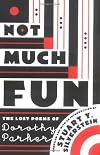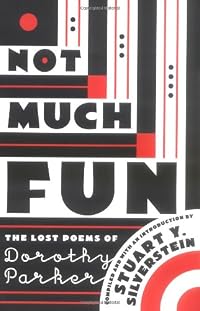
Not Much Fun: The Lost Poems of Dorothy Parker
by Stuart Y. Silverstein (Introduction), Dorothy Parker
On This Page
Description
Dorothy Parker wrote more than three hundred poems and verses for a variety of popular magazines and newspapers during the early years of her literary career. She collected most of these pieces in three volumes of poetry, Enough Rope, Sunset Gun and Death and Taxes. It is the remaining poems and verses, the ones that she failed to collect and whose very existence has been unknown to most of the general public for more than half a century, that comprise this volume. Eclectic and exuberant, show more the 122 forgotten poems and verses display the raw talent and dexterity of America's most renowned cynic. Some are topical, providing gimlet-eyed commentary on urban life from the First World War through the mid-twenties. With incomparable wit, Parker dissects contemporary fads and, in the raucous "Hate Verses," gleefully maligns most facets of humanity and popular culture, from husbands and wives to bohemians, slackers, summer resorts and movies. Some of the pieces are rare examples of Parker's experimentation with structured poetic forms. Others are more personal, celebrating her love of animals or scrutinizing the perils of passion. Notoriously - and irrationally - critical of her own work, Parker chose not to include this poetry in her previous collections. Nonetheless, many of the lost poems compare with her best, and nearly all display the distinctive wit, irony and precision that continue to attract succeeding generations of readers. In an authoritative and immensely entertaining introduction, Stuart Y. Silverstein recounts Parker's celebrated career. show lessTags
Recommendations











Member Reviews
Half biography and half poetry.
It's a sad portrait of what seems to be a very clever, very sad woman. We're cautioned not to believe that everything attributed to Dorothy Parker was actually said by her.
But there are bits of her poetry that are still wickedly sharp and funny.
It's a sad portrait of what seems to be a very clever, very sad woman. We're cautioned not to believe that everything attributed to Dorothy Parker was actually said by her.
But there are bits of her poetry that are still wickedly sharp and funny.
I've always been a fan of her well-turned phrases - but from the bio sketch here, she comes across as a rather nasty piece of work.
Ratings
Members
- Recently Added By
Author Information

147+ Works 10,284 Members
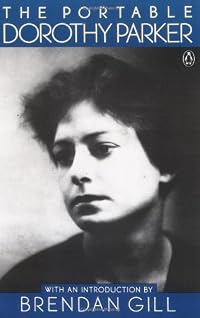
Poet and short story writer Dorothy Parker was born in New Jersey on August 22, 1893. When she was 5, her mother died and her father, a clothes salesman, remarried. Parker had a great antipathy toward her stepmother and refused to speak to her. She attended parochial school and Miss Dana's school in Morristown, New Jersey, for a brief time before show more dropping out at age 14. A voracious reader, she decided to pursue a career in literature. She began her career by writing verse as well as captions for a fashion magazine. During the years of her greatest fame, Dorothy Parker was known primarily as a writer of light verse, an essential member of the Algonquin Round Table, and a caustic and witty critic of literature and society. She is remembered now as an almost legendary figure of the 1920s and 1930s. Her reviews and staff contributions to three of the most sophisticated magazines of this century, Vanity Fair, the New Yorker, and Esquire, were notable for their put-downs. For all her highbrow wit, however, Dorothy Parker was liberal, even radical, in her political views, and the hard veneer of brittle toughness that she showed to the world was often a shield for frustrated idealism and soft sensibilities. The best of her fiction is marked by a balance of ironic detachment and sympathetic compassion, as in "Big Blonde," which won the O. Henry Award for 1929 and is still her best-remembered and most frequently anthologized story. The best of Dorothy Parker is readily and compactly accessible in The Portable Dorothy Parker. Her own selection of stories and verse for the original edition of that compilation, published in 1944, remains intact in the revised edition, but included also are additional stories, reviews, and articles. Parker died of a heart attack at the age of 73 in 1967. In her will, she bequeathed her estate to the Dr. Martin Luther King, Jr. foundation. Following King's death, her estate was passed on to the NAACP. (Bowker Author Biography) show less
Common Knowledge
- Original publication date
- 1996
- People/Characters
- Dorothy Parker
- Important events
- Jazz Age
- First words
- How do we cut for the deal?
- Last words
- (Click to show. Warning: May contain spoilers.)I hate College Boys; They get under my feet.
Classifications
Statistics
- Members
- 269
- Popularity
- 119,696
- Reviews
- 2
- Rating
- (3.87)
- Languages
- English
- Media
- Paper
- ISBNs
- 5
- ASINs
- 1