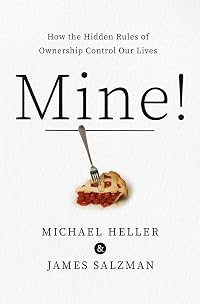
Mine! How the Hidden Rules of Ownership Control Our Lives
by Michael A. Heller, James Salzman
On This Page
Description
"A hidden set of rules governs who owns what--explaining everything from whether you can recline your airplane seat to why HBO lets you borrow a password illegally--and in this lively and entertaining guide, two acclaimed law professors reveal how things become "mine.""--Tags
Recommendations










Member Reviews
Who knows what we own?
The key thesis of this book is that our core ownership stories are wrong. They contend the each of us uses some version of six ownership stories:
1. First come, first served;
2. Possession is nine-tenths of the law;
3. You reap what you sow—we own the fruits of our labors;
4. My home is my castle—I own what is attached to me;
5. Our bodies, our selves, and
6. The meek shall inherit the earth—family property stays in the family.
The authors are law professors, and they use a series of engaging real-life legal disputes to demonstrate that each of these rules are open to broad and conflicting interpretations. One key flaw in our simplistic ownership stories is that they are based on a binary view of ownership—either show more my story is correct, and I deserve full ownership of the property, or yours is correct and you deserve full ownership. The authors advocate thinking in terms of gradations of ownership (which they model with a light dimmer) rather than full ownership models (which they model with an on/off switch).
They offer a few broad principles that can be used to reduce conflict and resolve ownership disputes. These include considering:
• What ownership decision serves to best advance the collective well-being,
• Reframing the problem using design tool alternatives including
o ex post or ex ante considerations,
o rules or standards,
o exclusion or governance,
o setting baselines, and
o liberal commons.
They end with the statement “If there is one lesson from this book, it’s that mine reflects a choice among competing stories.”
This is a well written, entertaining, informative, well researched, thought provoking, and important book. show less
The key thesis of this book is that our core ownership stories are wrong. They contend the each of us uses some version of six ownership stories:
1. First come, first served;
2. Possession is nine-tenths of the law;
3. You reap what you sow—we own the fruits of our labors;
4. My home is my castle—I own what is attached to me;
5. Our bodies, our selves, and
6. The meek shall inherit the earth—family property stays in the family.
The authors are law professors, and they use a series of engaging real-life legal disputes to demonstrate that each of these rules are open to broad and conflicting interpretations. One key flaw in our simplistic ownership stories is that they are based on a binary view of ownership—either show more my story is correct, and I deserve full ownership of the property, or yours is correct and you deserve full ownership. The authors advocate thinking in terms of gradations of ownership (which they model with a light dimmer) rather than full ownership models (which they model with an on/off switch).
They offer a few broad principles that can be used to reduce conflict and resolve ownership disputes. These include considering:
• What ownership decision serves to best advance the collective well-being,
• Reframing the problem using design tool alternatives including
o ex post or ex ante considerations,
o rules or standards,
o exclusion or governance,
o setting baselines, and
o liberal commons.
They end with the statement “If there is one lesson from this book, it’s that mine reflects a choice among competing stories.”
This is a well written, entertaining, informative, well researched, thought provoking, and important book. show less
A really good popular book about property law; I’d recommend it for law students and for people who are just interested in learning more about property. It sets out various frameworks for establishing property rights (such as attachment to an existing right, first-in-time, and possession) and shows how they’re always contested and partial. The opening example, about the Knee Defender (a device that an airplane passenger can deploy to prevent the seat in front of them from reclining) depends on competing accounts of “whose” space that is, and on the airlines’ own strategic silence on this—they could make explicit rules, but they’d rather have passengers mad at each other. Other topics in this far-ranging book include water show more rights, kidney sales, Black land loss, South Dakota’s special role in protecting the assets of wealthy people against legitimate creditors, the “sharing” economy that might just be the oligopoly economy, and more. show less
Here and there it stretches the conceit a bit too far (not everything is a question of ownership). But it definitely gave me a lot of insight into the unconscious ways that we all think about ownership, and the incredibly long tendrils of ownership issues throughout our lives.
An interesting analysis of how we think about property. Very America centric. Less interesting are the author's ideas on how to fix society. The only way property laws will change now is after a civil war or if we start from scratch on Mars.
A couple of snarky opinionated law professors write about the legal concepts of ownership, where they come from, and how they compare/contrast with more common sense ideas about property. This is a really vast subject, if you go back in history and also consider traditions from around the world. So this book is really a quick summary of the last few hundred years of European practice I guess. But it was entertaining and a bit educational.
A good compendium about different facets of ownership. The problem for me was that I had already heard of all but one or two of the examples. I would rather it had gone a little more in depth.
> Among the states that recognize publicity rights, there’s wide variation on whether they survive death and for how long. In Tennessee, rights last ten years after death; in Virginia, twenty years; in California, seventy; and in Indiana, one hundred. New York terminates them when the owner dies. So when Marilyn Monroe died as a New York resident, her heirs could not cash in. Why such variation? California has many notable dead celebrities whose heirs succeeded in pushing the state for lengthy ownership. … In the plastic King bust case, the show more Georgia Supreme Court neglected to specify an end date for the posthumous right of publicity it created. Nor did it craft a “fair use” exception, as in copyright law, that allows for educational uses, criticism, or parody without payment to, or permission from, the copyright owner. The court created a flawed, overly expansive ownership form—with national consequences. King Inc. keeps suing everyone who uses King’s likeness, though he’s been dead more than fifty years.
> Texas is the only oil-producing state not to require compulsory unitization—surface owners can voluntarily create a unit, but only if they all unanimously agree, and that’s hard to achieve. Instead, Texas adopted and has stuck with a more collectivist ownership form to address the commons tragedy—an odd choice for a state that prizes individual autonomy. Since the late 1930s, the Texas Railroad Commission (by a quirk of politics) has controlled oil production through “proration” rules: the state agency sets production caps for individual owners each month and it enforces well-spacing rules.
> One hundred forty-two countries, including well-off ones like Japan and Chile, say underground natural resources belong to the state as part of the common wealth—flowing oil, gas, and water are like the air we breathe or the oceans we fish. Landownership means you control certain rights on the surface and close to it, but attachment does not reach much below ground.
> American law makes everything about managing co-owned property difficult, not just repairs. It can be impossible to get a loan with just a partial ownership interest, so the land remains undeveloped. Often you can’t get disaster relief either. Following Hurricane Katrina, up to $165 million of recovery funds went unclaimed because of difficulty in proving ownership of heir property. As a result, heir property often remains run-down and unimproved
> In practice and often in law, courts usually prefer to order the land partitioned by auction sale, especially if there are many heirs. Money is easier to split. But this administrative ease comes at a cost. According to one analyst, the purchasers at these sales “ are almost always white persons, frequently local lawyers or relatives of local officials, who make it their business to keep abreast of what properties are going to auction and who attend the auctions prepared to buy.” The U.S. Department of Agriculture says such sales are “the leading cause of black involuntary land loss.” As a recent magazine feature on this practice explains, in one North Carolina county, “forty-two per cent of the [heir property] cases involved black families, despite the fact that only six per cent of Carteret’s population is black.”
> What can be done to prevent future loss of heir property farms? Ownership design, which created the problem, is the key to solving it. Many European countries have social policies and laws that help keep family farms intact. German law requires immediate reimbursement when one co-owner makes essential repairs, in sharp contrast with the American rule that reimbursement comes after partition.
> Primogeniture was a powerful tool for aristocrats aiming to avoid fractionation among heirs, the outcome inflicted on Black and Native American owners—and on the Irish. Fractionation was in part responsible for the Irish Potato Famine and the resulting wave of immigration to the United States. Following the Popery Act of 1703, England did not allow primogeniture for Catholics in Ireland, so their farms fractured as generations passed. Plots shrank to the point that planting a diversified range of crops became impossible. Eventually, potatoes were the only viable, nutrient-dense food that could be farmed.
> That’s why, to this day, you probably mail your credit card payment to a South Dakota P.O. box (or maybe to Nevada or Delaware, which gutted their usury laws to compete with South Dakota).
> Community property includes most of the assets a couple acquires in the state, during their marriage. It protects spouses from disinheritance by automatically making them both present and equal owners, no matter whose name is on the deed or account. On divorce or death, each spouse simply gets half. Today if you happen to live in one of the nine community property states, you are automatically enrolled in America’s most egalitarian marital ownership regime. … California—also a community property state
> Because of a glitch in the federal tax system, if you own a large, highly appreciated stock portfolio, it’s better to die with those assets governed by community property law than by common law. Your surviving spouse and later beneficiaries avoid certain capital gains taxes. Alaska lets you retitle precisely the assets that maximize tax avoidance—and you don’t have to be married in Alaska or even bother visiting the state
> Allow couples to check either a community property or common law box when they get their marriage licenses, like the choices couples make when they click through pro-or-con screens regarding options for tax deductions. No lawyers, no bankers, no fees. The marriage menu could perhaps extend further. Maybe let couples choose their preferred rule on increased earning capacity and other key aspects of marriage. Maybe let couples amend their selections after major life events. A well-crafted menu would allow all marrying couples—not just the wealthy—meaningful choices in writing their own marital story.
> The first trial in Alaska began in 1995 in the halibut fishery. Derby fishing had gotten so bad that there were only three twenty-four-hour windows of halibut fishing allowed per year. It wasn’t much better for Alaskan king crabs, but crab boat owners resisted ownership innovation. Grudgingly, after waves of bankruptcies and deaths, the fleet accepted the catch share strategy in 2005, just six months after Deadliest Catch went on the air. The results have been remarkable. No more frantic free-for-all on the Bering Sea. The crab season lengthened from three days in 2004 to three months in 2006. … catch shares have been adopted in forty countries and already account for about one-fifth of the global catch. It’s no surprise the strategy has been called “the greatest unknown policy success of our time.”
> Just one HFC-23 molecule causes as much global warming as 11,700 molecules of carbon dioxide. The manufacturers spotted an opportunity with CERs. Five years into the trading program, it emerged that these companies had doubled their output and had earned roughly half the world’s total CERs. The market for refrigerants had not grown, though, so why had they ramped up production? These companies had changed their business model. Their profit no longer came from producing and selling refrigerant. What they now cared about was producing and destroying the HFC-23 by-product. They duly incinerated every pound of HFC-23 they created. And for every pound of super greenhouse gas they destroyed, the companies were awarded CERs—which they then sold to polluting countries and companies in Europe and Japan. show less
> Among the states that recognize publicity rights, there’s wide variation on whether they survive death and for how long. In Tennessee, rights last ten years after death; in Virginia, twenty years; in California, seventy; and in Indiana, one hundred. New York terminates them when the owner dies. So when Marilyn Monroe died as a New York resident, her heirs could not cash in. Why such variation? California has many notable dead celebrities whose heirs succeeded in pushing the state for lengthy ownership. … In the plastic King bust case, the show more Georgia Supreme Court neglected to specify an end date for the posthumous right of publicity it created. Nor did it craft a “fair use” exception, as in copyright law, that allows for educational uses, criticism, or parody without payment to, or permission from, the copyright owner. The court created a flawed, overly expansive ownership form—with national consequences. King Inc. keeps suing everyone who uses King’s likeness, though he’s been dead more than fifty years.
> Texas is the only oil-producing state not to require compulsory unitization—surface owners can voluntarily create a unit, but only if they all unanimously agree, and that’s hard to achieve. Instead, Texas adopted and has stuck with a more collectivist ownership form to address the commons tragedy—an odd choice for a state that prizes individual autonomy. Since the late 1930s, the Texas Railroad Commission (by a quirk of politics) has controlled oil production through “proration” rules: the state agency sets production caps for individual owners each month and it enforces well-spacing rules.
> One hundred forty-two countries, including well-off ones like Japan and Chile, say underground natural resources belong to the state as part of the common wealth—flowing oil, gas, and water are like the air we breathe or the oceans we fish. Landownership means you control certain rights on the surface and close to it, but attachment does not reach much below ground.
> American law makes everything about managing co-owned property difficult, not just repairs. It can be impossible to get a loan with just a partial ownership interest, so the land remains undeveloped. Often you can’t get disaster relief either. Following Hurricane Katrina, up to $165 million of recovery funds went unclaimed because of difficulty in proving ownership of heir property. As a result, heir property often remains run-down and unimproved
> In practice and often in law, courts usually prefer to order the land partitioned by auction sale, especially if there are many heirs. Money is easier to split. But this administrative ease comes at a cost. According to one analyst, the purchasers at these sales “ are almost always white persons, frequently local lawyers or relatives of local officials, who make it their business to keep abreast of what properties are going to auction and who attend the auctions prepared to buy.” The U.S. Department of Agriculture says such sales are “the leading cause of black involuntary land loss.” As a recent magazine feature on this practice explains, in one North Carolina county, “forty-two per cent of the [heir property] cases involved black families, despite the fact that only six per cent of Carteret’s population is black.”
> What can be done to prevent future loss of heir property farms? Ownership design, which created the problem, is the key to solving it. Many European countries have social policies and laws that help keep family farms intact. German law requires immediate reimbursement when one co-owner makes essential repairs, in sharp contrast with the American rule that reimbursement comes after partition.
> Primogeniture was a powerful tool for aristocrats aiming to avoid fractionation among heirs, the outcome inflicted on Black and Native American owners—and on the Irish. Fractionation was in part responsible for the Irish Potato Famine and the resulting wave of immigration to the United States. Following the Popery Act of 1703, England did not allow primogeniture for Catholics in Ireland, so their farms fractured as generations passed. Plots shrank to the point that planting a diversified range of crops became impossible. Eventually, potatoes were the only viable, nutrient-dense food that could be farmed.
> That’s why, to this day, you probably mail your credit card payment to a South Dakota P.O. box (or maybe to Nevada or Delaware, which gutted their usury laws to compete with South Dakota).
> Community property includes most of the assets a couple acquires in the state, during their marriage. It protects spouses from disinheritance by automatically making them both present and equal owners, no matter whose name is on the deed or account. On divorce or death, each spouse simply gets half. Today if you happen to live in one of the nine community property states, you are automatically enrolled in America’s most egalitarian marital ownership regime. … California—also a community property state
> Because of a glitch in the federal tax system, if you own a large, highly appreciated stock portfolio, it’s better to die with those assets governed by community property law than by common law. Your surviving spouse and later beneficiaries avoid certain capital gains taxes. Alaska lets you retitle precisely the assets that maximize tax avoidance—and you don’t have to be married in Alaska or even bother visiting the state
> Allow couples to check either a community property or common law box when they get their marriage licenses, like the choices couples make when they click through pro-or-con screens regarding options for tax deductions. No lawyers, no bankers, no fees. The marriage menu could perhaps extend further. Maybe let couples choose their preferred rule on increased earning capacity and other key aspects of marriage. Maybe let couples amend their selections after major life events. A well-crafted menu would allow all marrying couples—not just the wealthy—meaningful choices in writing their own marital story.
> The first trial in Alaska began in 1995 in the halibut fishery. Derby fishing had gotten so bad that there were only three twenty-four-hour windows of halibut fishing allowed per year. It wasn’t much better for Alaskan king crabs, but crab boat owners resisted ownership innovation. Grudgingly, after waves of bankruptcies and deaths, the fleet accepted the catch share strategy in 2005, just six months after Deadliest Catch went on the air. The results have been remarkable. No more frantic free-for-all on the Bering Sea. The crab season lengthened from three days in 2004 to three months in 2006. … catch shares have been adopted in forty countries and already account for about one-fifth of the global catch. It’s no surprise the strategy has been called “the greatest unknown policy success of our time.”
> Just one HFC-23 molecule causes as much global warming as 11,700 molecules of carbon dioxide. The manufacturers spotted an opportunity with CERs. Five years into the trading program, it emerged that these companies had doubled their output and had earned roughly half the world’s total CERs. The market for refrigerants had not grown, though, so why had they ramped up production? These companies had changed their business model. Their profit no longer came from producing and selling refrigerant. What they now cared about was producing and destroying the HFC-23 by-product. They duly incinerated every pound of HFC-23 they created. And for every pound of super greenhouse gas they destroyed, the companies were awarded CERs—which they then sold to polluting countries and companies in Europe and Japan. show less
Tried too hard to be Malcolm Gladwell, Freakonomics-esque. Would have been nice if the book had dealt with the subject with a bit more seriousness.
Members
- Recently Added By
Lists

How it can be.
14 works; 2 members

Books I've Read More Than Once
602 works; 49 members
Author Information

3 Works 298 Members

6 Works 372 Members
James Salzman is the Samuel Fox Mordecai Professor of Law and the Nicholas Institute Professor of Environmental Policy at Duke University. He lives in Durham, North Carolina.
Some Editions
Common Knowledge
- Canonical title
- Mine! How the Hidden Rules of Ownership Control Our Lives
- Alternate titles
- Mine! From Personal Space to Big Data, How Ownership Shapes Our Lives
Classifications
- Genres
- Politics and Government, Economics, Nonfiction, General Nonfiction
- DDC/MDS
- 346.7304 — Society, government, & culture Law Private Law North America United States Topics of private law Property Law
- LCC
- KF561 .H45 — Law Law of the United States Law of the United States (Federal) Property General. Ownership
- BISAC
Statistics
- Members
- 169
- Popularity
- 194,283
- Reviews
- 7
- Rating
- (3.68)
- Languages
- English
- Media
- Paper, Audiobook, Ebook
- ISBNs
- 11
- ASINs
- 5