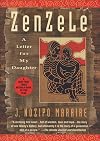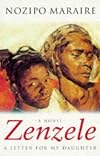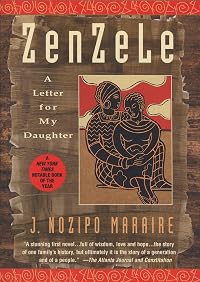
Zenzele: A Letter for My Daughter
by J. Nozipo Maraire
On This Page
Description
Written as an extended letter from a black Zimbabwean mother to her daughter leaving for a university place in America, this first novel draws back a veil to reveal life in Africa today.Tags
Recommendations







Member Reviews
An exquisite book, written as a series of letters by a mother in Zimbabwe to her daughter who is leaving to go to college in America. The book is full of African stories, histories, and cultural values.
J. Nozipo Maraire was born in Rhodesia in 1964, as the violence began that eventually led to the establishment of the independent nation of Zimbabwe. Like Zenzele, she came to the United States for college and has become a neurosurgeon. With precision and beauty, her words express her loyalty to traditional Africa and her effort to sustain her heritage in a very different world.
This book is written, not in Maraire’s voice, but that of her mother, Shiri, known traditionally as “Amai Zenzele” (the mother of Zenzele). Shiri is an show more impressive woman, no flat character naming specific traditions which must be observed. Instead, she is a woman who has lived a full life and is aware of aware of its frequent contradictions. She herself embodies both the old and the new. Growing up in a traditional village, she now lives in a city as the educated, well-traveled wife of a successful lawyer. Regular return visits to her village are part of how she balances her own life. She urges her daughter to work out her own version of living between”the old and new, urban and rural.” Sharing the stories of how she has developed her own balance is part of her responsibility as a mother.
Respecting and being loyal to her African roots is a major value that Shiri seeks to instill in
Zenzele.
READ MORE: http://wp.me/p24OK2-1do show less
J. Nozipo Maraire was born in Rhodesia in 1964, as the violence began that eventually led to the establishment of the independent nation of Zimbabwe. Like Zenzele, she came to the United States for college and has become a neurosurgeon. With precision and beauty, her words express her loyalty to traditional Africa and her effort to sustain her heritage in a very different world.
This book is written, not in Maraire’s voice, but that of her mother, Shiri, known traditionally as “Amai Zenzele” (the mother of Zenzele). Shiri is an show more impressive woman, no flat character naming specific traditions which must be observed. Instead, she is a woman who has lived a full life and is aware of aware of its frequent contradictions. She herself embodies both the old and the new. Growing up in a traditional village, she now lives in a city as the educated, well-traveled wife of a successful lawyer. Regular return visits to her village are part of how she balances her own life. She urges her daughter to work out her own version of living between”the old and new, urban and rural.” Sharing the stories of how she has developed her own balance is part of her responsibility as a mother.
Respecting and being loyal to her African roots is a major value that Shiri seeks to instill in
Zenzele.
READ MORE: http://wp.me/p24OK2-1do show less
As Zenzele embarks on an exciting life-changing journey to leave Africa and attend Harvard, her mother chronicles thoughts and feelings in the form of an open letter.
Proud of both her daughter and her country, her mother eloquently encourages her daughter to remember her rich heritage. Citing others who have left, never to return, or who returned changed forever by a culture that provided different values, Zenele's mother beautifully writes of a wonderful heritage, rich in culture, in depth of caring for each other and of a mighty, proud nation.
Saddened by a younger generation who seeks to race ahead to embrace cultures that seem tainted by the accumulation of objects and money, Zelene's mother reinforces what is true, good and strong show more about non-material lifestyles and the important of a collective group vs a self seeking mode of living.
The writing is beautiful and image filled. While the story focuses on the politics that shaped Zimbabwe and the heritage of that nation, the letter to Zenzele is universal and many of the messages contained can be written by all parents to their children, reminding them to hold fast to what is important, to strive for the good of all instead of the good of one, to know that education is important, but not at the steep price of ignorantly hurting others.
Highly recommended. show less
Proud of both her daughter and her country, her mother eloquently encourages her daughter to remember her rich heritage. Citing others who have left, never to return, or who returned changed forever by a culture that provided different values, Zenele's mother beautifully writes of a wonderful heritage, rich in culture, in depth of caring for each other and of a mighty, proud nation.
Saddened by a younger generation who seeks to race ahead to embrace cultures that seem tainted by the accumulation of objects and money, Zelene's mother reinforces what is true, good and strong show more about non-material lifestyles and the important of a collective group vs a self seeking mode of living.
The writing is beautiful and image filled. While the story focuses on the politics that shaped Zimbabwe and the heritage of that nation, the letter to Zenzele is universal and many of the messages contained can be written by all parents to their children, reminding them to hold fast to what is important, to strive for the good of all instead of the good of one, to know that education is important, but not at the steep price of ignorantly hurting others.
Highly recommended. show less
There are one or two points when Nozipo Maraire's use of rhetoric is a little overblown for my tastes, and I still wonder if this would have been better framed as a monologue or a fictional memoir than as an epistolary novel. But those are relatively minor quibbles with what is otherwise a beautifully-written novella. It's an incisive look at what it means to be a woman in Africa; what it means to be an African in the midst of Western colonialism, cultural hegemony and racism; what it is to be an immigrant caught between two cultures. Nozipo Maraire's prose is rich and persuasive, drawing on the vibrant African oral tradition to give extra power to her tale; and there is, I think, an extra poignancy to the story knowing that the show more emerging Zimbabwe of which the narrator is so proud would soon be brought into such decline by Mugabe. Well worth the read. show less
Such a calm strength in the narrator. I feel as if she is sharing thoughts she has stored up for years, carefully pondering and seeking clarity on what it's like to be herself, a woman, a mother, a Zimbabwean. Although the format is a series of letters she writes, sitting at the kitchen table, to her daughter who has just gone to the US for university, we have no response from the daughter, just this one woman's perspective. It is plenty.
All the love a mother has for her daughter is contained in this thin novel. It is written by a woman in Zimbabwe as a letter to her daughter who is about to embark on a trip abroad to continue her studies. The mother shares the history of her family and her Shona culture, going back to stories of the struggle for independence during the time that her country was controlled by white men and known by the name of Rhodesia.
What warmth this book contains! The story helped define for me exactly what the country of Zimbabwe is and how its people have come to believe in themselves. Its discussion of empowerment through education is a universal theme relevant to any group of people. I also loved the feeling I had from the mother as she described show more pride in her people and in her roots, most importantly her land. I didn’t realize how important what the mom had to tell her daughter was until the end of the book. There it all fit together. show less
What warmth this book contains! The story helped define for me exactly what the country of Zimbabwe is and how its people have come to believe in themselves. Its discussion of empowerment through education is a universal theme relevant to any group of people. I also loved the feeling I had from the mother as she described show more pride in her people and in her roots, most importantly her land. I didn’t realize how important what the mom had to tell her daughter was until the end of the book. There it all fit together. show less
Zenzele is a series of letters from a Zimbabwean mother to her daughter going away to Harvard. The mother has witnessed the village sending off their best and brightest to be educated at European and American schools with the hope of them returning to utilize what they have learned for the betterment of their community. Instead, once the young have finished their education and experienced Western culture, they only return for infrequent visits and express contempt for what they have left behind.
This book really resonated with me as I felt this mother’s concerns are not only unique to Africans but to African-Americans. Through her letters, Zenzele’s mother shares a rich cultural heritage hoping to counteract the lure of a show more materialistic lifestyle. Beautifully written and highly recommended, the book was a New York Times Notable Book of the Year. show less
This book really resonated with me as I felt this mother’s concerns are not only unique to Africans but to African-Americans. Through her letters, Zenzele’s mother shares a rich cultural heritage hoping to counteract the lure of a show more materialistic lifestyle. Beautifully written and highly recommended, the book was a New York Times Notable Book of the Year. show less
This is a lovely, absorbing reflection on what it means to be an African woman. This book is written as an open letter from a Zimbabwean mother to her highly spirited, passionate daughter as she travels to America to study at Harvard. She addresses age-old issues of how to embrace modern comforts and opportunities while not abandoning ancient rhythms and traditions. I was fascinated by the descriptions of village life and family bonds, and heartbroken by the struggle for self-determination against the patronizing oppression of colonizing Europeans. All in all an terrific read.
Members
- Recently Added By
Lists

Epistolary Books
105 works; 27 members
Author Information
4 Works 380 Members
Some Editions
Awards and Honors
Awards
Common Knowledge
- Original publication date
- 1996
- People/Characters
- Zenzele; Mbuya; Amai Zenzele; Sekuru Isaac; Joy; Linda (show all 25); Petranella Makororo; Florence Makororo; Tendai; Farai; Bright Malawi; Tete Murielle; Mukoma Bryon Makon; Eleanor Makon; Chipo; Madiaw Ndiaye; Mary William Smith; Keki Thahane; Tinawo Muti; Reverend Chigare; Commander Pelladay; Mrs. Pelladay; Victory; Mr. Thorn; Rudo
- Important places
- Chakowa, Zimbabwe; Harare, Zimbabwe; Geneva, Geneva, Switzerland; Warsaw, Poland
- Dedication
- This novel is dedicated to the memory of my father, the late Dr. Nkosana Arthur Maraire, whose love, laughter, and lore kindled my spirit and gave me the courage to pursue my dreams.
This novel is dedicated to the memory of my father,
the late Dr. Nkosana Arthur Mataire,
whose love, laughter, and lore kindles my spirit
and gave me the courage to pursue my dreams. - First words
- Today is the first day of winter, I believe.
- Quotations
- If we could only learn from nature; it is our classroom. The trees bear fruit; the fruit contains seed; the flower bears the pollen. The earth regenerates itself; it sows, then reaps. We must develop a cultural ecosystem--som... (show all)e eternal cycle of African regeneration--planting our roots firmly, spreading and growing as the tubers and rhizomes, deep in the earth and sowing our children (the fruits) the seeds to reap another harvest. Each time one of us, like Mukoma Byron, is lost to the West, it is worse than losing a fruit; we also lose the seeds therein.
He so strongly believed that education was the key to our freedom.
He dares to change reality because for him the present construct is simply the realization of someone else’s vision.
I could not forsake our determination to expose you to our culture. If in the end you rejected it, that was fine, but we had fulfilled our responsibility as African parents; the rest was up to you.
Freedom is something you all take for granted.
...we are close to the soil. That is where the African foundation is. We are still standing on the ground of our ancestors; we are rooted, where others were scattered. (p.93)
Your own life is a story yet to be told, and wisdom, when it comes, is simply to understand at last, the beginning of the word and the story of our birth, death, and rebirth.
Racism...is like a thick mist that obscures the vision and judgement of even great minds....To her color-blinded mind's eye, your three dimensions are black by black by black. ..You are beyond her microsphere of credibility..... (show all)..If you begin to doubt yourself then the battle is lost....The true reflection of you lies within. (p.85-6)
Be prepared to meet many who still see Africa as one large amorphous mass: the Dark Continent, a primeval swamp, misty and steaming, inhabited by Neanderthal creatures and cheerful but primitive natives who engage in sordid r... (show all)itualistic ceremonies, deep into the night, to the rhythm of drums. - Last words
- (Click to show. Warning: May contain spoilers.)Be strong.
Your friend,
Mama - Publisher's editor
- Taylor, Carol
- Blurbers
- Brown, Rita Mae
Classifications
Statistics
- Members
- 375
- Popularity
- 83,955
- Reviews
- 23
- Rating
- (4.16)
- Languages
- 9 — Danish, English, Finnish, German, Hungarian, Italian, Norwegian, Spanish, Swedish
- Media
- Paper
- ISBNs
- 15