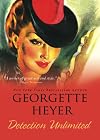
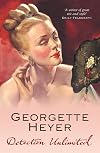
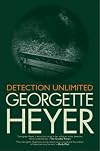
Detection Unlimited
by Georgette Heyer
Inspectors Hannasyde and Hemingway (8), Country House Mysteries (12)
On This Page
Description
Slumped on a seat under an oak tree is old Sampson Warrenby, with a bullet through his head. Everybody in the village is ready to tell Chief Inspector Hemingway who did it. Could the murderer have been the dead man's niece? Or perhaps it was the other town solicitor? The couple at the farm had a guilty secret-what was it? And why is it someone else actually wants to be the prime suspect? Add to this the fact that Warrenby was blackmailing someone, and Hemingway has his work cut out for him.Tags
Recommendations






















Member Reviews
Chief Inspector Hemingway of Scotland Yard is called in to the elite village of Thornden when Sampson Warrenby, a lawyer and newcomer to the village, is murdered in his own garden. The trouble is that there are simply too many suspects, almost all of them without an alibi for the relevant time: there’s rival lawyer Thaddeus Drybeck upon whose clientele Warrenby had been poaching; there’s Mrs. Midgeholme, who breeds pekingese dogs, one of which the deceased had recently kicked; there’s Mavis, the murdered man’s niece and heir; there are the Lindales, who seem terribly secretive; there’s Gavin Plenmeller, a crippled young man who doesn’t seem to have anything against Warrenby in particular but who likes to maliciously insult show more people in general; and many more! Hemingway certainly has his work cut out for him here…. This is the fourth and final “country home” murder series featuring Hemingway, published in 1953 and featuring Ms. Heyer’s usual well-drawn cast of characters, particularly Hemingway himself, who is very sharp, quite funny at times and constantly referring to himself as having “flair,” whatever that means! One need not have read the other books in the series, as only Hemingway and his assistant carry on from one book to the next, and each book works quite well as a stand-alone. Amusing and light; recommended, especially as summer reading! show less
No one in sleepy little Thornden cares much for the pushy new lawyer Sampson Warrenby — but who has enough reason to murder him? Georgette Heyer delights readers again in Detection Unlimited, so titled because when murder happens in a small village, everyone becomes a detective with theories and suspects and motives. And each is wilder than the last.
Chief Inspector Hemingway is brightly intelligent, witty, nervy, and equal to the daunting task at hand (though he rails at his own dullness when he finally cracks the case). The murderer is ingenious, planning the murder to be discovered when most of the principal citizens would lack an alibi. But the motive is the thing, and despite the general dislike of Warrenby, it takes more than show more animosity to make a murder.
Heyer's gift for characterization never flags. She is also just downright funny. Hemingway's setdowns of Harbottle, descriptions of Biggleswade, the Pekes, Hemingway's being bowled over by the Ditchlings, and Miss Patterdale's comment on overhearing her niece being proposed to ("Well, if that's a proposal I'm glad I never received one!") are all very amusing amidst a slightly grim setting. I'd reread this one. show less
Chief Inspector Hemingway is brightly intelligent, witty, nervy, and equal to the daunting task at hand (though he rails at his own dullness when he finally cracks the case). The murderer is ingenious, planning the murder to be discovered when most of the principal citizens would lack an alibi. But the motive is the thing, and despite the general dislike of Warrenby, it takes more than show more animosity to make a murder.
Heyer's gift for characterization never flags. She is also just downright funny. Hemingway's setdowns of Harbottle, descriptions of Biggleswade, the Pekes, Hemingway's being bowled over by the Ditchlings, and Miss Patterdale's comment on overhearing her niece being proposed to ("Well, if that's a proposal I'm glad I never received one!") are all very amusing amidst a slightly grim setting. I'd reread this one. show less
I've read and enjoyed quite a few of Heyer's Regency romances, and was curious to try one of her mysteries. Detection Unlimited is actually the fourth in a series featuring Inspector Hemingway, but I didn't feel that not starting at the beginning of the series detracted from my enjoyment of the story. The interest in the book was not really in the character of Hemingway (classic bright Scotland Yard detective sent down to solve a tricky village murder) but in the characters of the village residents, nearly all of whom are suspects in the case - and - strangely - in their dogs, who seem to feature large in this entertaining portrayal of the clashes of large personalities in a small arena.
We are introduced in the first chapter to Mrs show more Midgeholme who breeds Pekes, all of whom have names beginning with 'U'. The more sensible such names having long since been used on earlier generations, her current pack of tiny bulging-eyed creatures rejoice in such names as Umberto, Umbrella, Untidy, Ullapool and Uppish. A little later we meet Rex, the 'elderly and stout' black labrador who 'advances ponderously' to greet visitors to sensible Miss Patterdale's cottage and appreciates being 'thumped with hearty goodwill'. And there's the Squire's young, untrained Irish setter who effusively welcomes the Inspector, requiring much removal of dog hair from his clothes. These canine characters helped bring the whole setting more fully to life, as well as fleshing out the character of their respective owners.
Another lovely detail was the description of the Sun Inn, where Inspector Hemmingway and his sidekick Harbottle were lodged - 'perhaps the oldest but by no means the most fashionable' pub in the village. The story is set in the post-WWII period when rationing was still in force in England, and the austerity and financial challenges of those post-war years are part of the background of the story - but the Sun appears never to have got round to reading the Rationing Orders, and serves 'high tea reminiscent of an almost forgotten age of plenty':
Meals were not served with elegance, or dignified by menu-cards, but the food itself was excellent, and prepared by a large-minded person. An order for tea was understood by this person to include a plate piled with bacon, eggs, sausages, tomatoes, and chips, three or four kinds of jam, scones, a heavy fruit cake, a loaf of bread, a dish of stewed fruit, and one of radishes.
Altogether a light and entertaining read, more enjoyable for the well-realised setting and the above kinds of details than for the mystery itself. show less
We are introduced in the first chapter to Mrs show more Midgeholme who breeds Pekes, all of whom have names beginning with 'U'. The more sensible such names having long since been used on earlier generations, her current pack of tiny bulging-eyed creatures rejoice in such names as Umberto, Umbrella, Untidy, Ullapool and Uppish. A little later we meet Rex, the 'elderly and stout' black labrador who 'advances ponderously' to greet visitors to sensible Miss Patterdale's cottage and appreciates being 'thumped with hearty goodwill'. And there's the Squire's young, untrained Irish setter who effusively welcomes the Inspector, requiring much removal of dog hair from his clothes. These canine characters helped bring the whole setting more fully to life, as well as fleshing out the character of their respective owners.
Another lovely detail was the description of the Sun Inn, where Inspector Hemmingway and his sidekick Harbottle were lodged - 'perhaps the oldest but by no means the most fashionable' pub in the village. The story is set in the post-WWII period when rationing was still in force in England, and the austerity and financial challenges of those post-war years are part of the background of the story - but the Sun appears never to have got round to reading the Rationing Orders, and serves 'high tea reminiscent of an almost forgotten age of plenty':
Meals were not served with elegance, or dignified by menu-cards, but the food itself was excellent, and prepared by a large-minded person. An order for tea was understood by this person to include a plate piled with bacon, eggs, sausages, tomatoes, and chips, three or four kinds of jam, scones, a heavy fruit cake, a loaf of bread, a dish of stewed fruit, and one of radishes.
Altogether a light and entertaining read, more enjoyable for the well-realised setting and the above kinds of details than for the mystery itself. show less
A tennis party, a disreuptable attorney, and a small town with too many secrets are the backdrop for this mystery. Add to all that an impish mystery author and Detective Hemingway has alot to deal with. Still he proves himself worthy of the task in this fun mystery. Heyer has such fun with her language that she makes the plot a bit fuzzy and I would have appherated a map of the town, but I still found this a fun read.
One thing I like about Heyer's mysteries is the way her characters are believable, yet unrealistic. I think 'theatrical' is the best way to describe them. The characters walk in and take over - very few ordinary people make their way into Heyer's world. It's delightful.
It's your basic whodunnit set-up, not dissimilar to something by Agatha Christie. Murder happens, and the reader suspects one character after another, all of them with their own secrets, relationships and personalities. I knew who did it all along, from the last time I read it, but discovering the murderer's identity is not why I read a Heyer mystery.
It's your basic whodunnit set-up, not dissimilar to something by Agatha Christie. Murder happens, and the reader suspects one character after another, all of them with their own secrets, relationships and personalities. I knew who did it all along, from the last time I read it, but discovering the murderer's identity is not why I read a Heyer mystery.
Didn't like this one as much as Duplicate Death. The beginning was kind of boring but the mystery was good, the characters interesting, and the solution pretty well done. Heyer fleshes out her characters so that you can really picture them, even when she is writing about types, e.g., the old gadger.
An unpopular lawyer is murdered while several people are in the neighbourhood. Scotland Yard is called in, and Chief Inspector Hemmingway interviews suspects in his inimitable way. There's dry humour in places, and good characterisation.
After fourteen years I had totally forgotten the plot and 'whodunit', and enjoyed it all over again. And again another seven years later. It's not as cleverly plotted as an Agatha Christie, though written in similar genre. But the characters are much more three dimensional.
Recommended if you enjoy light mid-20th century crime fiction.
Latest longer review: https://suesbookreviews.blogspot.com/2024/09/detection-unlimited-by-georgette-he...
After fourteen years I had totally forgotten the plot and 'whodunit', and enjoyed it all over again. And again another seven years later. It's not as cleverly plotted as an Agatha Christie, though written in similar genre. But the characters are much more three dimensional.
Recommended if you enjoy light mid-20th century crime fiction.
Latest longer review: https://suesbookreviews.blogspot.com/2024/09/detection-unlimited-by-georgette-he...
Members
- Recently Added By
Lists

Favorite Georgette Heyer Novels, Ranked
49 works; 29 members

British Mystery
469 works; 14 members

Audiobooks to read next
4 works; 1 member

Books Read in 2010
631 works; 10 members

Books Read in 2023
5,547 works; 145 members

Books With Our Favorite First Lines
168 works; 104 members
Author Information

125+ Works 78,055 Members
Georgette Heyer was born on August 16, 1902 at Wimbledon, London. She wrote The Black Moth as a story for her brother Boris. Her father, impressed with his daughter's imagination, suggested that she prepare it to be published, which it was by Constable in 1921. Having scored an instant success with The Black Moth at the age of nineteen under her show more own name, Georgette Heyer, she experimented with a pseudonym, Stella Martin, for her third book, published by Mills & Boon. She continued writing and in 1925 she married Ronald Rougier, a mining engineer. After reasonable but not spectacular sales from her first few books the instant success of These Old Shades in 1926 brought her a solid source of income which was very necessary at the time since the family relied to a large extent on the income from Georgette Heyer's writing. She wrote over fifty books during her lifetime and created the Regency England genre of romance novels. She died on July 4, 1974 at the age of 71. (Bowker Author Biography) show less
Some Editions
Series


Belongs to Publisher Series
rororo (1752)
Work Relationships
Is contained in
Common Knowledge
- Canonical title*
- Enquête difficile
- Original title
- Detection Unlimited
- Alternate titles*
- Pékinois, policiers et polars
- Original publication date
- 1953
- People/Characters
- Hemingway (Chief Inspector); Sampson Warrenby; Mavis Warrenby; Thaddeus Drybeck; Ladislas Zamagoryski; Gavin Plenmeller (show all 18); Miriam Patterdale; Abigail Dearham; Henry Haswell; Charles Haswell; Major Midgholme; Flora Midegholme; Kenelm Lindale; Delia Lindale; Bernard Ainstable, Squire; Rosamund Ainstable; Rev. Cliburn; Edith Cliburn
- Important places
- England
- Dedication
- To all such persons as may imagine that they recognize themselves in it, with the author's assurance that they are mistaken.
- First words
- Mr Thaddeus Drybeck, stepping from the neat gravel drive leading from his house on to the road, found his further progress challenged, and, indeed, impeded, by the sudden onrush of Pekinese dogs, who bounced and barked asthma... (show all)tically about his feet.
- Last words
- (Click to show. Warning: May contain spoilers.)I had to force the pace!
- Blurbers
- Sayers, Dorothy L.
- Original language
- English
*Some information comes from Common Knowledge in other languages. Click "Edit" for more information.
Classifications
Statistics
- Members
- 854
- Popularity
- 31,964
- Reviews
- 18
- Rating
- (3.57)
- Languages
- 7 — Danish, English, Finnish, French, German, Italian, Russian
- Media
- Paper, Audiobook, Ebook
- ISBNs
- 34
- UPCs
- 3
- ASINs
- 25