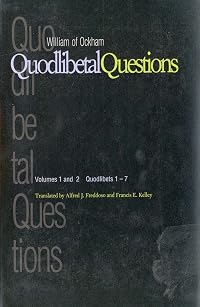
Quodlibetal Questions. Volumes 1 and 2, Quodlibets 1-7
by of Ockham William
On This Page
Description
This book offers the first English translation of the Quodlibetal Questions of William of Ockham (c. 1285-1347)--reflections on a variety of topics in logic, ontology, natural philosophy, philosophical psychology, moral theory, and theology by one of the preeminent thinkers of the Middle Ages. It is based on the recent critical edition of Ockham's theological and philosophical works.Tags
Recommendations







Members
- Recently Added By
Author Information

William of Ockham was a Franciscan at Oxford. He came just short of receiving his theology degree; he was never able to undertake the necessary year of teaching because of the long list of those waiting and the opposition of his enemy, John Lutterel. From 1320 to 1324, he taught and wrote at the London Studium, the private school of his order. He show more was summoned to Avignon in 1324 on charges of heresy and became involved there in the dispute over Franciscan poverty. In 1328 Ockham fled with Michael of Cesena, general of his order, was excommunicated, and took refuge in Munich with Duke Ludwig of Bavaria, who had also been excommunicated. From there he engaged in an extensive polemic against Pope John XXII and his successors, writing numerous political works. Ockham's metaphysics and his logic are closely connected because of his deployment of "Ockham's razor," the notion that we should not suppose that more things exist than are needed to explain the meaning of true sentences. Very often his arguments hang on the logical analysis of a sentence, revealing its logical structure and making it clear that some questionable entity, something other than a word or an individual thing, is not referred to in it. His philosophy is marked by nominalism. He rejected the notion that we somehow or other get the forms of things themselves into our intellect, attacking especially Scotist attempts to hold on to this view using the "formal distinction." Instead, he held that our concepts were like mental words, with a natural capacity to signify their objects but in no way to be identified with their objects. This led to a strong skeptical current among his followers. (Bowker Author Biography) show less
Some Editions
Series
Belongs to Publisher Series
Common Knowledge
- Canonical title
- Quodlibetal Questions. Volumes 1 and 2, Quodlibets 1-7
Classifications
- Genres
- Philosophy, Nonfiction, Religion & Spirituality, History
- DDC/MDS
- 189.4 — Philosophy & psychology Ancient, medieval & eastern philosophy Medieval western philosophy Scholastic: Scotus, Aquinas, Anselm, Abelard
- LCC
- BX890 .O3413 — Philosophy, Psychology and Religion Christian Denominations Christian Denominations Catholic Church General collected works
- BISAC
Statistics
- Members
- 30
- Popularity
- 929,612
- Languages
- English
- Media
- Paper
- ISBNs
- 2