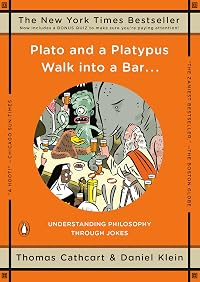
Plato and a Platypus Walk Into a Bar...: Understanding Philosopy Through Jokes
by Thomas Cathcart, Daniel Klein, Thomas Cathcart (Author)
On This Page
Description
Here's a lively, not-so-reverent crash course through the great philosophical traditions, schools, concepts, and thinkers. It's Philosophy 101 for everyone who knows not to take all this heavy stuff too seriously. Some of the Big Ideas are existentialism (what do Hegel and Bette Midler have in common?), philosophy of language (how to express what it's like being stranded on a desert island with Halle Berry), feminist philosophy (why, in the end, a man is always a man), and much more. show more Finally--it all makes sense!--From publisher description. show lessTags
Recommendations









Member Recommendations
Member Reviews
Six-word review: Wisdom is a fool in motley.
Extended review:
Do you think this is funny?
Two cows are standing in a field. One says to the other, "What do you think about this mad cow disease?"
"What do I care?" says the other. "I'm a helicopter."
There's humor in much of what I read, but it's usually of the cerebral variety, mild irony or absurdity, witty turns of phrase, that sort of thing; even Harry Dresden's wisecracks aren't usually laugh-out-loud funny. But this silly two-liner on page 120 just struck me as hilarious. If you're giggling too, then you and I have something in common.
If you think it's just dumb, well, never mind. People's senses of humor are pretty idiosyncratic, after all. There's a lot of supposed comedy that I just show more don't care for at all. But I loved this little book.
What that cow story has to do with existentialism may not be immediately apparent, but the authors will make it clear. It's their gift to be able to encapsulate the chief ideas of several branches of philosophy--metaphysics, logic, epistemology, ethics, and so on--and convey their essential qualities through jokes. Their approach is unabashedly entertaining, and I wish I'd had this light-hearted treatment on hand when I was a philosophy student; but it also rests on a very sound premise for which I've always had immense respect, namely, the efficacy of humor as a vehicle for truth: something cartoonists and satirists know very well.
Watch out, though: there are pop quizzes along the way and a three-point exam at the end. Resisting my native compulsions, I went on past it without completing the assignment. Instead I read the timeline of the history of philosophy, which set me off all over again.
I picked up this small orange-covered volume on a whim a few days ago, and it proved a nice break from far heavier stuff. My daytime sofa read is currently a very serious history of postwar Japan, and my bedtime novel is Adam Bede (1859), full of George Eliot's gently but deftly ironic observations on human nature, but nonetheless with a plot revolving around some deep and earnest characters who don't seem to see much humor in things. It was good for a change just to go ahead and laugh. By the time I got to the end and tried to read one of the stories aloud to my husband, I could hardly get the words out between gasps and tears. And it wasn't even that funny.
My father taught philosophy for 35 years. I know he would have loved this. He was fond of my all-time favorite quotation about philosophy (attributed to Feigl): "Philosophy is the disease for which it ought to be the cure." This book is a cure. show less
Extended review:
Do you think this is funny?
Two cows are standing in a field. One says to the other, "What do you think about this mad cow disease?"
"What do I care?" says the other. "I'm a helicopter."
There's humor in much of what I read, but it's usually of the cerebral variety, mild irony or absurdity, witty turns of phrase, that sort of thing; even Harry Dresden's wisecracks aren't usually laugh-out-loud funny. But this silly two-liner on page 120 just struck me as hilarious. If you're giggling too, then you and I have something in common.
If you think it's just dumb, well, never mind. People's senses of humor are pretty idiosyncratic, after all. There's a lot of supposed comedy that I just show more don't care for at all. But I loved this little book.
What that cow story has to do with existentialism may not be immediately apparent, but the authors will make it clear. It's their gift to be able to encapsulate the chief ideas of several branches of philosophy--metaphysics, logic, epistemology, ethics, and so on--and convey their essential qualities through jokes. Their approach is unabashedly entertaining, and I wish I'd had this light-hearted treatment on hand when I was a philosophy student; but it also rests on a very sound premise for which I've always had immense respect, namely, the efficacy of humor as a vehicle for truth: something cartoonists and satirists know very well.
Watch out, though: there are pop quizzes along the way and a three-point exam at the end. Resisting my native compulsions, I went on past it without completing the assignment. Instead I read the timeline of the history of philosophy, which set me off all over again.
I picked up this small orange-covered volume on a whim a few days ago, and it proved a nice break from far heavier stuff. My daytime sofa read is currently a very serious history of postwar Japan, and my bedtime novel is Adam Bede (1859), full of George Eliot's gently but deftly ironic observations on human nature, but nonetheless with a plot revolving around some deep and earnest characters who don't seem to see much humor in things. It was good for a change just to go ahead and laugh. By the time I got to the end and tried to read one of the stories aloud to my husband, I could hardly get the words out between gasps and tears. And it wasn't even that funny.
My father taught philosophy for 35 years. I know he would have loved this. He was fond of my all-time favorite quotation about philosophy (attributed to Feigl): "Philosophy is the disease for which it ought to be the cure." This book is a cure. show less
I picked up Plato and a Platypus... on a whim, an impulse buy as I was heading out of a Barnes & Noble one day. I think the orange cover caught my eye, and then a quick scan of the subject matter piqued my curiosity. Jokes? I like jokes. Philosophy? I don't know much about it, but it always seemed like something I *should* know more about, something I would like to know more about. So I brought it home and started flipping through it.
I'm amazed at how much enjoyment I got out of it. First of all, a couple of the jokes I had to bring around to the wife and tell her. A couple of gems in there. (Mostly not, but that wasn't the point of the book. Besides, pick up any book of jokes - and I've picked up my share - and you'll know that it's show more mostly a collection of banality surrounding a couple of great knee-slappers.)
But mostly I enjoyed how the humor taught me a little about each different school of philosophy discussed. I can't say I'm walking away an expert in any of them, but I'm certainly a little more enlightened now. show less
I'm amazed at how much enjoyment I got out of it. First of all, a couple of the jokes I had to bring around to the wife and tell her. A couple of gems in there. (Mostly not, but that wasn't the point of the book. Besides, pick up any book of jokes - and I've picked up my share - and you'll know that it's show more mostly a collection of banality surrounding a couple of great knee-slappers.)
But mostly I enjoyed how the humor taught me a little about each different school of philosophy discussed. I can't say I'm walking away an expert in any of them, but I'm certainly a little more enlightened now. show less
The philosophy in this book is only superficial, and seems mostly to be an excuse for a large collection of jokes, but I'm not complaining. I listened to it on cd, and must have appeared crazy to others as I often laughed out loud alone in the car. Even the jokes you already know are enhanced by the use of them to illustrate philosophical principles. I wouldn't say this is great literature, but it sure is fun.
(JAF)
(JAF)
Okay, this I picked up purely because there was a platypus in the title, but since I've always meant to brush up on my philosophy, it was like hitting two birds with one stone. I didn't expect much from this little book and was pleasantly surprised. The authors, both erstwhile students of philosophy at Harvard, take the reader through a whirlwind review of philosophy. So far, so typical. What's not so typical is their stated goal- to demonstrate the similarities between philosophy and jokes, and to use the latter to explain the former. The jokes they use are, by and large, "oldies but goodies"- ie likely to produce a chuckle at most. Nonetheless, the book is cleverly written and makes for a pleasant little read. High brow literature? show more No, but a heck of a lot more readable than Schopenhauer, last I checked. show less
For those of us who missed philosophy and logic the first time around this is a great way to humorously and succinctly hit the highlights. This is an easily digested read that will kick your thinking up a notch while you chase your best pals around trying to tell them jokes. Even jaded old philosophers should secretly snort in amusement.
An original approach to a traditional topic, this clever little book explores complicated philosophical concepts through jokes. It is structured by topic rather than by chronology which makes it easy to pick out the various disciplines of philosophy. Detractors would no doubt point out that this book is very superficial and in no way explores any of the concepts in any kind of depth and that the jokes most often distract from (some of them are really very funny) rather than enforce the notions being explained, but as an introduction, it is a delicious place to start. Personally, it has given me the interest to pursue some of these ideas more fully.
Explaining philosophy through jokes, and mostly terrible jokes at that, though there are a few chucklers mixed in. This would be a good gift for a philosophy major or professor, or that guy in the coffee shop who's always quoting Schopenhauer and should just shut up already. It's clever and informative though not too much of either. A fun, quick read.
Members
- Recently Added By
Lists

Llibres que he llegit el 2024
77 works; 1 member
Author Information

7 Works 4,725 Members
Thomas Cathcart is the author of coauthor of six books, including the New York Times best-seller Plato and a Platypus Walk into a Bar (2007). He has been a college instructor, a hospital administrator, a social worker with inner-city gangs, a hospice director for patients with HIV/AIDS, and a lay leader in many congregations. He lives in upstate show more New York. show less

21+ Works 5,397 Members
Some Editions
Awards and Honors
Awards
Distinctions
Common Knowledge
- Canonical title
- Plato and a Platypus Walk Into a Bar...: Understanding Philosopy Through Jokes
- Original publication date
- 2006
- People/Characters
- Dimitri; Torquato Tasso
- Dedication
- To the memory of our philosophical grandfather GROUCHO MARX, who summed up our basic ideology when he said, "These are my principles; if you don't like them, I have others."
- First words
- Dimitri: If Atlas holds up the world, what holds up Atlas?
- Last words
- (Click to show. Warning: May contain spoilers.)The man rounds the next curve, crashes into a huge pig in the middle of the road, and dies.
- Publisher's editor
- Triestman, Ann
- Blurbers
- Blount, Roy, Jr.
- Original language
- English
- Canonical DDC/MDS
- 102.07
Classifications
Statistics
- Members
- 3,370
- Popularity
- 4,999
- Reviews
- 119
- Rating
- (3.53)
- Languages
- 13 — Catalan, Dutch, English, Finnish, French, German, Greek, Italian, Polish, Portuguese, Romanian, Slovenian, Spanish
- Media
- Paper, Audiobook, Ebook
- ISBNs
- 40
- ASINs
- 18