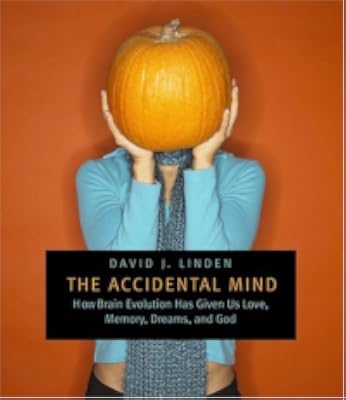
The Accidental Mind: How Brain Evolution Has Given Us Love, Memory, Dreams, and God
by David J. Linden
On This Page
Description
With forays into evolutionary biology, this analysis of mental function answers some of our most common questions about how we've come to be who we are.Tags
Recommendations












Member Reviews
Linden sets out to prove that our brains more closely resemble inefficient clunkers reflecting millions of years of evolutionary tinkering, rather than sophisticated, well-designed and amazing intelligent creations. He discusses the structure of our brain from the lower evolutionary parts of the brain stem and cerebellum through the more recent frontal lobes and cortex. When discussing the brain’s design, he uses a cool example of a supermodern racecar built on the Ford T plan, in which nothing of the original Ford T plan is to be dropped or replaced, and the new systems are to be built in addition and/or on top of the old ones. This is precisely how we ended up having two visual and two auditory systems in our brains- one ancient and show more one more modern. This is how congenitally blind people can in fact perceive movement and objects even though they don’t consciously realize that. It’s their ancient visual system at work. Linden also discusses the way our brain communicates within itself and how we come up with a picture of the world that is both physical and abstract. From what I understand, even though there are parts of the brain designated to perform specialized functions, the whole brain with all its parts creates the memories and images of what we perceive and know. Worldviews, dreams and religious views are an inherent feature of our brains creating narratives.
All in all, the book is a wonderfully balanced review of what we do and don’t know about the brain and the best debunking of intelligent design I have read in a while.
As a PS, there were some nice observations on sex in mammals and how humans compare to others. What caught my attention was the discussion of ovulation in females and the fact that the hidden ovulation of human females keeps males around since they never know when females are fertile. The joke is that females don’t know either, so they have to keep the males around as well (that wasn't in the book;), so the pair bonding is a must here because of that.
A note for audiobook fans. It's read in an outstandingly clear performance by Ray Porter. show less
All in all, the book is a wonderfully balanced review of what we do and don’t know about the brain and the best debunking of intelligent design I have read in a while.
As a PS, there were some nice observations on sex in mammals and how humans compare to others. What caught my attention was the discussion of ovulation in females and the fact that the hidden ovulation of human females keeps males around since they never know when females are fertile. The joke is that females don’t know either, so they have to keep the males around as well (that wasn't in the book;), so the pair bonding is a must here because of that.
A note for audiobook fans. It's read in an outstandingly clear performance by Ray Porter. show less
A fascinating, accessible review of current work on brain biology related to sexual orientation (separated monozygotic twins supporting a genetic basis for such behavior), sexual attraction, the mystery of dreams (dreams, even narrative ones occur outside of r.e.m.), and the cross-cultural believes in divine being and calling capsaicin sensation "hot". The brain is truly an engrossing mystery and during this age, the curtain is opening wider on those mysteries.
Surprisingly well-written book on the biology and evolution of the human brain, for the non-scientific reader. Linden gets just far enough into the actual science to give an idea of what's going on.
"The brain is not elegantly designed by any means: it is a cobbled-together mess, which, amazingly, and in spite of its shortcomings, manages to perform a number of very impressive functions."
"The brain is not elegantly designed by any means: it is a cobbled-together mess, which, amazingly, and in spite of its shortcomings, manages to perform a number of very impressive functions."
As with most science related books, dumbing down a topic as complex and advanced as neuroscience is not easy. Linden has tried to make it as simple as possible, though he has admittedly stated that certain places he would need to speak in scientific parlance.
The book is very insightful, at least the parts that one can grasp, which is most of the book (minus all the chemical names of molecules, enzymes and hormones and bilogical names of certain parts of the brain and the nervous system). But that is no fault of the book or the author.
I would definitely recommend this book to anyone who wishes to read more on the subject.
The book is very insightful, at least the parts that one can grasp, which is most of the book (minus all the chemical names of molecules, enzymes and hormones and bilogical names of certain parts of the brain and the nervous system). But that is no fault of the book or the author.
I would definitely recommend this book to anyone who wishes to read more on the subject.
Fascinating in general -- I like particularly the analogy of building a CD player around an 8-track machine. However, I had a difficult time following a lot of the neurology... this is not for the scientifically-uninclined!
I once asked David Linden what a thought is: not the dictionary definition but what, in material terms, is a thought. He impressed me by saying that some cognitive scientists will start talking about chemistry and electricity, but that he, himself, didn't know.
You've probably seen it before: a human brain dramatically lit from the side, the camera circling it like a helicopter shot of Stonehenge, and a modulated baritone voice exalting the brain's elegant design in reverent tones.
To which this book says: Pure nonsense. In a work at once deeply learned and wonderfully accessible, the neuroscientist David Linden counters the widespread assumption that the brain is a paragon of design--and in its place gives us a compelling explanation of how the brain's serendipitous evolution has resulted in nothing short of our humanity. A guide to the strange and often illogical world of neural function, The Accidental Mind shows how the brain is not an optimized, general-purpose problem-solving machine, but show more rather a weird agglomeration of ad-hoc solutions that have been piled on through millions of years of evolutionary history. Moreover, Linden tells us how the constraints of evolved brain design have ultimately led to almost every transcendent human foible: our long childhoods, our extensive memory capacity, our search for love and long-term relationships, our need to create compelling narrative, and, ultimately, the universal cultural impulse to create both religious and scientific explanations. With forays into evolutionary biology, this analysis of mental function answers some of our most common questions about how we've come to be who we are. show less
To which this book says: Pure nonsense. In a work at once deeply learned and wonderfully accessible, the neuroscientist David Linden counters the widespread assumption that the brain is a paragon of design--and in its place gives us a compelling explanation of how the brain's serendipitous evolution has resulted in nothing short of our humanity. A guide to the strange and often illogical world of neural function, The Accidental Mind shows how the brain is not an optimized, general-purpose problem-solving machine, but show more rather a weird agglomeration of ad-hoc solutions that have been piled on through millions of years of evolutionary history. Moreover, Linden tells us how the constraints of evolved brain design have ultimately led to almost every transcendent human foible: our long childhoods, our extensive memory capacity, our search for love and long-term relationships, our need to create compelling narrative, and, ultimately, the universal cultural impulse to create both religious and scientific explanations. With forays into evolutionary biology, this analysis of mental function answers some of our most common questions about how we've come to be who we are. show less
Members
- Recently Added By
Author Information

8 Works 857 Members
Some Editions
Classifications
Statistics
- Members
- 323
- Popularity
- 98,444
- Reviews
- 8
- Rating
- (3.75)
- Languages
- English, German, Italian, Spanish
- Media
- Paper, Audiobook, Ebook
- ISBNs
- 10
- ASINs
- 4