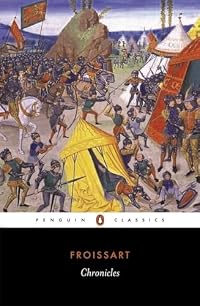
Chronicles [ed. Geoffrey Brereton]
by Jean Froissart, Geoffrey Brereton (Editor and Translator)
On This Page
Description
The Chronicles of Froissart (1337-1410) are one of the greatest contemporary records of fourteenth-century England and France. Depicting the great age of Anglo-French rivalry from the deposition of Edward II to the downfall of Richard II, Froissart powerfully portrays the deeds of knights in battle at Sluys, Crecy, Calais and Poitiers during the Hundred Years War. Yet they are only part of this vigorous portrait of medieval life, which also vividly describes the Peasants' Revolt, trading show more activities and diplomacy against a backdrop of degenerate nobility. Written with the same sense of curiosity about character and customs that underlies the works of Froissart's contemporary, Chaucer, the Chronicles are a magnificent evocation of the age of chivalry. show lessTags
Recommendations













Member Reviews
This penguin classic edition was translated by Geoffrey Brereton and contains selections from the four books of chronicles written in the 14th century by Jean Froissart, who was at various times attached to the courts of Edward III, Richard II, and the Count of Foix. The chronicles were contemporaneous documents that recorded some of the major events of 14th century France and England. Froissart was writing for the educated classes of his time and so his accounts of events had to be realistic. They are in fact more than that as he has his own inimitable style that makes his narratives flow and the events described come alive on the page. He has been described as a forerunner of modern day journalists and I can certainly see why people show more hold this view.
His narrative accounts of the battles of Poitiers, Crecy, the siege of Calais and the peasants revolt of 1381 have been used extensively by modern day historians. In Froissart's hands they give a real feel for the age in which he was writing. There is plenty of information about how people lived and how they reacted. When he writes more provincially when he was attached to the Count of Foix we get some marvellous medieval tales of haunting, shape changing and sorcery. There is much here for the modern reader, I was enthralled by the descriptions of tournaments, coronations and marriages. His descriptions of the battlefield are at times frighteningly realistic and shot through with medieval lore
I learned much about the period from this book, but at the same time it is very entertaining. Froissart says that the French had come to the battlefield of Poitiers "splendidly provided like men who felt certain in advance of victory. They were routed and there was gold, silver plate, precious jewels, ornamental chests, and splendid cloaks pilfered from the aftermath. At other times the reader is hurled back into the realms of the 14th century when in a narrative description of Edward II's attempted escape from his pursuers we get Froissart saying
"Their plan was to escape to Wales.... but their sins weighed so heavily against them that God would not permit it."
We are told this about one of the brigand leaders that roamed France when King John was a prisoner in England
"This Sir Eustace performed many fine feats of arms and no one could stand up to him, for he was young and deeply in love and full of enterprise."
The English doctor who nursed King Charles VI back from an attack of "madness" goes back to England with a substantial reward but Friossart says of him:
"His only pleasure in life had been to amass great piles of florins. There were days when he hardly spent a penny of his own, but went round getting free meals and drinks wherever he could. All doctors suffer from such weaknesses" show less
His narrative accounts of the battles of Poitiers, Crecy, the siege of Calais and the peasants revolt of 1381 have been used extensively by modern day historians. In Froissart's hands they give a real feel for the age in which he was writing. There is plenty of information about how people lived and how they reacted. When he writes more provincially when he was attached to the Count of Foix we get some marvellous medieval tales of haunting, shape changing and sorcery. There is much here for the modern reader, I was enthralled by the descriptions of tournaments, coronations and marriages. His descriptions of the battlefield are at times frighteningly realistic and shot through with medieval lore
I learned much about the period from this book, but at the same time it is very entertaining. Froissart says that the French had come to the battlefield of Poitiers "splendidly provided like men who felt certain in advance of victory. They were routed and there was gold, silver plate, precious jewels, ornamental chests, and splendid cloaks pilfered from the aftermath. At other times the reader is hurled back into the realms of the 14th century when in a narrative description of Edward II's attempted escape from his pursuers we get Froissart saying
"Their plan was to escape to Wales.... but their sins weighed so heavily against them that God would not permit it."
We are told this about one of the brigand leaders that roamed France when King John was a prisoner in England
"This Sir Eustace performed many fine feats of arms and no one could stand up to him, for he was young and deeply in love and full of enterprise."
The English doctor who nursed King Charles VI back from an attack of "madness" goes back to England with a substantial reward but Friossart says of him:
"His only pleasure in life had been to amass great piles of florins. There were days when he hardly spent a penny of his own, but went round getting free meals and drinks wherever he could. All doctors suffer from such weaknesses" show less
This is an absorbing commentary on the major political and military events in France, England, Scotland and briefly Spain during the Fourteenth Century. Jean Froissart transcribes description from court acquaintances and, as well, writes of his own participation in these historical tales.
He makes some major geographical blunders, but the historical sense and engaging style give these excerpts life and maintain interest.
The old knightly values permeate the lives of the aristocracy; bravery, mercy, Christian values, remain the standard of behaviour.
There is a lengthy section devoted to the coup d'etat that toppled Richard II. This was a set Shakespeare play for study at school when I was sixteen (probably because it is relatively short). show more I remained confused as to who was who until Froissart, and his chronicle on the affair, swept like a new comet into my ken and all became as clear to me as the blue Pacific. show less
He makes some major geographical blunders, but the historical sense and engaging style give these excerpts life and maintain interest.
The old knightly values permeate the lives of the aristocracy; bravery, mercy, Christian values, remain the standard of behaviour.
There is a lengthy section devoted to the coup d'etat that toppled Richard II. This was a set Shakespeare play for study at school when I was sixteen (probably because it is relatively short). show more I remained confused as to who was who until Froissart, and his chronicle on the affair, swept like a new comet into my ken and all became as clear to me as the blue Pacific. show less
This is the most modern of the selections of Froissart that I have read, and Mr. Brereton has made a serious effort to present at least one example of the vast range of topics covered by the work. I can read this as a historical novel, or as a serious source, though academic historians really prefer almost any other source for making serious points. It's a good read, but the Thomas Johnes translatin, though much longer gives a good flavour of the piece. I tried the Lord Berners translation from the 1530's but the writing is flatter than Malory, and the spelling has not been regularized as the Penguin Malory is. But for wandering in a medieval experience, muttering out the words one by one, the Berners is wonderful. This Penguin show more selection is the best way into Froissart, and if you go on to the longer translations you'll be grateful you stared with this one. show less
Froissart is prone to embellishment but, like Herodotus, he is often our only source for the material. Interesting insight into the difficulty of life during that period.
Jean Froissart är möjligen den störste av senmedeltida historieskrivare; utanför Island finns det i alla fall få som kan ta upp tävlan med hans Krönika, vilken berättar om den första delen av hundraårskrigen, liksom andra ändelser under samma period, från kung Edvard III till Rikard II:s död. Froissart reste över halva Västeuropa: han var flera år vid engelska hovet (och var tillsammans med Chaucer med på en ambassad till Milan, där de hamnade på samma fest som Petrarka – men ingen av dem verkar närmare ha noterat de andra), han besökte Skottland, Spanien, Sydfrankrike. Huvuddelen av sitt liv framlevde han dock i Nederländerna.
Hans krönika är av den farliga litterära kvalitet som gör att den ofta show more återberättas tämligen rättframt i senare historieböcker. Så gjorde förresten Froissart själv: första delen, som bland annat skildrar slagen vid Crécy och Poiters, är en omarbetning av en tidigare krönika skriven av Jean le Bel. Snart kastade han dock dessa bojor och lät sin krönika svälla till ett enormt omfång: den förkortade utgåva jag nu läst är på dryga 450 sidor, och motsvarar enligt förordet endast en ungefärlig sjättedel av hela texten.
Froissart intresserar sig i huvudsak för vapendåd och kungligheter; när lägre stånd någon gång skymtar förbi är det nästan alltid med förakt, såvida de inte är lydigt disciplinerade. Jacqueriet fyllde honom med enorm fasa: inte nog med att folk reste sig och slog ihjäl adeln, de var otvättade och saknade ledare. Senare resningar skildras visserligen i något mildare kulörer, men ändå klart missbelåtet.
Hellre då nobla riddare, eller åtminstone försigtagna friskaror, fast naturligtvis allra helst bildade herrar som greven av Foix, en hedersman vars tragiska öde (hans son skall enligt Froissart ha lurats att försöka förgifta honom, men påkommits och sedan svultit sig till döds i fångenskap) ges mer sympati än alla de som drabbats av krigstågen genom Frankrike.
Den som vill döma historiker efter allmän moral har alltså inte mycket att glädjas åt hos Froissart. Ej heller de kritiskt sinnade historikerna, då hans handlag med sanning (och geografi) är minsta sagt fritt. Vill man ha en läslig, opålitlig men roande krönika kan man dock knappast göra ett bättre val. show less
Hans krönika är av den farliga litterära kvalitet som gör att den ofta show more återberättas tämligen rättframt i senare historieböcker. Så gjorde förresten Froissart själv: första delen, som bland annat skildrar slagen vid Crécy och Poiters, är en omarbetning av en tidigare krönika skriven av Jean le Bel. Snart kastade han dock dessa bojor och lät sin krönika svälla till ett enormt omfång: den förkortade utgåva jag nu läst är på dryga 450 sidor, och motsvarar enligt förordet endast en ungefärlig sjättedel av hela texten.
Froissart intresserar sig i huvudsak för vapendåd och kungligheter; när lägre stånd någon gång skymtar förbi är det nästan alltid med förakt, såvida de inte är lydigt disciplinerade. Jacqueriet fyllde honom med enorm fasa: inte nog med att folk reste sig och slog ihjäl adeln, de var otvättade och saknade ledare. Senare resningar skildras visserligen i något mildare kulörer, men ändå klart missbelåtet.
Hellre då nobla riddare, eller åtminstone försigtagna friskaror, fast naturligtvis allra helst bildade herrar som greven av Foix, en hedersman vars tragiska öde (hans son skall enligt Froissart ha lurats att försöka förgifta honom, men påkommits och sedan svultit sig till döds i fångenskap) ges mer sympati än alla de som drabbats av krigstågen genom Frankrike.
Den som vill döma historiker efter allmän moral har alltså inte mycket att glädjas åt hos Froissart. Ej heller de kritiskt sinnade historikerna, då hans handlag med sanning (och geografi) är minsta sagt fritt. Vill man ha en läslig, opålitlig men roande krönika kan man dock knappast göra ett bättre val. show less
Feb 9, 2020Swedish
Ratings
Members
- Recently Added By
Lists

r/History Recommended Reading List
603 works; 12 members

In Our Time books
4,934 works; 2 members
Talk Discussions
Past Discussions
Froissart Chronicles – LIMITED EDITIONS CLUB 1959 in George Macy devotees (May 2023)
Author Information

75+ Works 1,508 Members
Common Knowledge
- Canonical title
- Chronicles [ed. Geoffrey Brereton]
- Disambiguation notice
- This is a selection of Froissart’s Chronicles translated and edited by Geoffrey Brereton. Do not combine with the entire work or other selections.
Classifications
Statistics
- Members
- 757
- Popularity
- 36,897
- Reviews
- 6
- Rating
- (3.80)
- Languages
- English, French
- Media
- Paper
- ISBNs
- 1
- ASINs
- 5