The Soul of the Indian: An Interpretation
by Charles Alexander Eastman
On This Page
Description
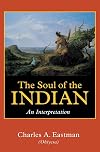
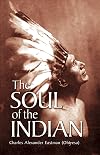
American history is rife with shameful episodes in which the tribes indigenous to the continent were subjected to horrible trials and tribulations. Historians have argued that this was partly because early European Americans failed to recognize the essential humanity of the Indians, of which their complex spiritual beliefs form a major component. This work from Charles A. Eastman represents an early effort to delve into this subject; although it is not completely free of stereotypes and show more generalizations that were common in the period, the book offers a fascinating glimpse into one man's earnest attempt to understand indigenous spirituality.. show less
Tags
Recommendations
























Member Reviews
I love firsthand accounts to begin with and I love a good book about history. This was a quick read. It's a small book. This is an honest account of Native practices, to the best of the author's remembrances, prior to the introduction of white and Christian influences, and the beliefs and/or motivations of those practices.
Whether you agree or disagree with the practices or the motivations, this is must read to try to understand another culture or to discover your own, if you happen to be native.
He describes in some detail the struggle of being a product of both worlds, what that encompasses and how his feelings evolved on the matter.
While this is an honest account, he was more than fair and gracious about the effects of white, show more Christian culture on the native population.
At times dry, and at other times very poetic, it's by far a good read and I intend to seek out more of his work. I would recommend this book to anyone, but you cannot have my copy. Good luck and good reading. show less
Whether you agree or disagree with the practices or the motivations, this is must read to try to understand another culture or to discover your own, if you happen to be native.
He describes in some detail the struggle of being a product of both worlds, what that encompasses and how his feelings evolved on the matter.
While this is an honest account, he was more than fair and gracious about the effects of white, show more Christian culture on the native population.
At times dry, and at other times very poetic, it's by far a good read and I intend to seek out more of his work. I would recommend this book to anyone, but you cannot have my copy. Good luck and good reading. show less
simply marvelous! Short book outlining not just one man's integration between his experience with Sioux spirituality and his Christian faith. The way Baptism and the Eucharist were reimaged into the Native American culture was truly refreshing. It reminded me of the Christianity's current struggle to integrate and imagine within our current culture.
Very quick read and an extremely simplified account of Sioux religious practices that the author a Sioux himself applied to all Native American cultures. All cultures are not a like and this painting with such a broad brush does not do justice to the other cultures who practiced religion different than the Sioux. It is still an enlightening book on the practice of having a very personal type of religion that does not rely on someone between you and your Lord
This is definitely an interesting book and an important accounting for traditions of the Sioux. Yet it is done from a perspective "after the white man's arrival." And this leads to my conclusion that Mr. Eastman's histrionics are putting an acceptable slant on this Native American's culture.
Essentially The Soul of the Indian is a comparison of Sioux religiosity to Christianity. Self-admittedly, the author explains the basis of Indian culture and religion is the antithesis of Biblical religion. Yet he then proceeds to find similarities of varying proportion. He extolls the virtue of Indian religion and expresses disdain for the materialism or monetarism of Christianity.
Mr. Eastman takes time to include a section on familiar hierarchy and show more societal culture. One aspect I found suspect was his play down of the warrior culture. Understanding this book was written after the segregation of Indians to reservations Mr. Eastman likely tempered this profile of his people, in an effort to "humanize" the Native Americans.
Hence, I sensed that while the author was conveying his culture to white man, he was simultaneously trying to raise the Sioux religion to the level he perceives Christianity. Struggling to veil his contempt for Christianity but fully cognizant that his target audience was Americans, he paints the Sioux as simply a different strain of Christianity.
Blaming some of the misconceptions and alterations of long-standing cultural modalities on arrival of the White, this book needs to be read with a grain of salt. Granted his interpretations may be truly a perspective free of my suspected distortion towards his audience, the same caution afforded to autobiographies applies to this first-person defense of culture and religion. show less
Essentially The Soul of the Indian is a comparison of Sioux religiosity to Christianity. Self-admittedly, the author explains the basis of Indian culture and religion is the antithesis of Biblical religion. Yet he then proceeds to find similarities of varying proportion. He extolls the virtue of Indian religion and expresses disdain for the materialism or monetarism of Christianity.
Mr. Eastman takes time to include a section on familiar hierarchy and show more societal culture. One aspect I found suspect was his play down of the warrior culture. Understanding this book was written after the segregation of Indians to reservations Mr. Eastman likely tempered this profile of his people, in an effort to "humanize" the Native Americans.
Hence, I sensed that while the author was conveying his culture to white man, he was simultaneously trying to raise the Sioux religion to the level he perceives Christianity. Struggling to veil his contempt for Christianity but fully cognizant that his target audience was Americans, he paints the Sioux as simply a different strain of Christianity.
Blaming some of the misconceptions and alterations of long-standing cultural modalities on arrival of the White, this book needs to be read with a grain of salt. Granted his interpretations may be truly a perspective free of my suspected distortion towards his audience, the same caution afforded to autobiographies applies to this first-person defense of culture and religion. show less
I wanted a book which did not have a Christian theme, and found this little book in the Religious section at Project Gutenburg: The Soul of the Indian by Charles Alexander Eastman. It was published in 1911, and is an overview of some of the religious customs of the 'Indians' written by a Sioux who was raised in his native traditions, but later educated at Dartmouth and Boston University. This was an interesting book, as the author tried to separate the later traditions of his people from those they held before the white man came and corrupted them. The author is able, in the beginning of the book, to portray the beauty and peace of his people's silent and solitary communion with "the great mystery".
Charles Eastman was a native American who was taught in white schools in the early part of the last century.
His purpose in life was to communicate just what the American Indian believed. In this book he showed the values of the Indian *before* he was essentially spiritually polluted by the white invasion of his world.
His purpose in life was to communicate just what the American Indian believed. In this book he showed the values of the Indian *before* he was essentially spiritually polluted by the white invasion of his world.
CCA-5
Sep 22, 2021Catalan
Members
- Recently Added By
Author Information

27+ Works 1,440 Members
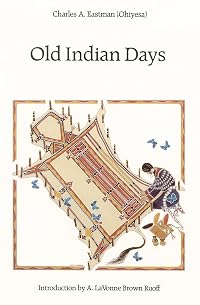
A Santee Sioux, born in Red Falls, Minnesota, Charles Eastman was raised by his grandmother and uncle in Manitoba, Canada, where he learned Native American traditions and lore. As a teenager he returned to his father's family and attended mission schools and Beloit College. He graduated from Dartmouth College in 1887 and from Boston University show more School of Medicine in 1890. Although his background made him unwelcome in some parts of white society and his education made him uneasy in Native American cultures, he worked for his people throughout his life as a doctor, as a representative in Washington, D.C., and as a founder of the Society of American Indians. His first published book, Indian Boyhood (1902), written for children, tells the stories and traditions of the Sioux nation. Red Hunters and the Animal People (1904), Old Indian Days (1907), and Wigwam Evenings (1909), written with the help of his wife, Elaine Goodale Eastman, continue in this vein, but his later work, including The Soul of the Indian (1911), The Indian Today (1915), and his autobiography, From the Deep Woods to Civilization (1916), attempts to interpret Native American culture for white society, describing the problems of assimilation. (Bowker Author Biography) show less
Some Editions
Awards and Honors
Awards
Series
Belongs to Publisher Series
Work Relationships
Common Knowledge
- Canonical title
- The Soul of the Indian: An Interpretation
- Original publication date
- 1911
- Dedication
- To my wife
Elaine Goodale Eastman
in grateful recognition of her
ever-inspiring companionship
in thought and work
and in love of her most
Indian-like virtues
I dedicate this book - First words
- The original attitude of the American Indian toward the Eternal, the "Great Mystery," that surrounds and embraces us, was as simple as it was exalted.
- Last words
- (Click to show. Warning: May contain spoilers.)This proved to the warriors beyond doubt or cavil the claims of their seer.
Classifications
Statistics
- Members
- 280
- Popularity
- 114,925
- Reviews
- 7
- Rating
- (3.87)
- Languages
- 6 — Catalan, English, German, Italian, Portuguese, Spanish
- Media
- Paper, Audiobook, Ebook
- ISBNs
- 52
- UPCs
- 1
- ASINs
- 6