On This Page
Description
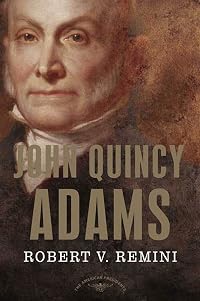
A portrait of the early nineteenth-century president documents his career with the House of Representatives, efforts to create a consolidated national government, role as a diplomat, contributions to foreign policy, and antislavery campaigns.Tags
Recommendations






Member Reviews
What especially interested me about this book was the way in which the author, a noted Jackson scholar, was able to take a fresh look at the way Adams came to the presidency in 1824. To Jackson, and therefore Jacksonians, this was a corrupt deal between Adams and Clay, who then was rewarded with the office of Secretary of State. Remini was able to look at the incident anew through the eyes of Adams and see that the appointment was fully in accord with JQA's principles; Clay was to him the best qualified candidate for the job. That it would look suspicious to his opponents was a further instance (neither the first nor the last) of his political naivete. Kudos to Remini for putting aside the Jacksonian view.
A small book, only 192 pages, but for whatever reason it took me far to long to finish it and I don't know why. I say that because every time that I picked it up I really enjoyed the writing and found President John Quincy Adams life so very interesting.
Born the son of Funding Father John Adams, JQA was raised in a very strict house by his mother Abigail (father John was away a lot). He reached adolescence at a convenient time for him, his family and the country as he joined his father on his diplomatic trip to France and Europe. He learned so much that he himself was made a US diplomat at a very young and and did quite well in that role. When his time in Europe was up he returned home, became a lawyer, got into National politics and as show more they say, the rest is history...
Remini does a great job of synthesizing and condensing JQA's life and the events and people that shaped it. His prose are so well written that it seemed to me at times I was having a conversation with him instead of reading the words he had chose to write about Adams.
The best thing I can say about this is that it makes me hungry for more about our 6th president. To learn more about his domineering mother, his somewhat loveless marriage, his duties, his wants and his hates...as he hates a few others like something out of the old testament.
Again, I have no idea as to why it took so long to get through this little powerhouse, but it was so well worth it.
Highly recommended for US history buffs, those who are interested in the fight for Civil Rights and American presidents. A four star for sure. show less
Born the son of Funding Father John Adams, JQA was raised in a very strict house by his mother Abigail (father John was away a lot). He reached adolescence at a convenient time for him, his family and the country as he joined his father on his diplomatic trip to France and Europe. He learned so much that he himself was made a US diplomat at a very young and and did quite well in that role. When his time in Europe was up he returned home, became a lawyer, got into National politics and as show more they say, the rest is history...
Remini does a great job of synthesizing and condensing JQA's life and the events and people that shaped it. His prose are so well written that it seemed to me at times I was having a conversation with him instead of reading the words he had chose to write about Adams.
The best thing I can say about this is that it makes me hungry for more about our 6th president. To learn more about his domineering mother, his somewhat loveless marriage, his duties, his wants and his hates...as he hates a few others like something out of the old testament.
Again, I have no idea as to why it took so long to get through this little powerhouse, but it was so well worth it.
Highly recommended for US history buffs, those who are interested in the fight for Civil Rights and American presidents. A four star for sure. show less
Early proof of the regenerative powers of the U.S. Senate, the post-Presidential career of JQA (as the book affectionately calls him) makes for some of the more interesting reading in this entry in the American Presidents series. This tome brings to life the highs and lows of this, one of the more interesting men to set foot in the White House. The details of his harsh relationship with his mother certainly paints a dark picture of Abigail Adams. The tragedy of JQA's eldest son is something that is chronicled but left me wanting for more. This book serves as an excellent concise biography of our 6th president.
Celebrated chronicler of the Jacksonian Age Remini undertakes to explain the paradox of one of America's greatest diplomats and legislators being one of its poorer presidents, and by and large succeeds, delving deeply into Adams' saturnine personality. Remini ascribes a great deal of blame for Adams' aloof and combative public manner to his parents from hell and his own difficult sons. Substantively, this is a fine book. The prose could use some work. Remini deploys sentence fragments quite liberally--perhaps too liberally, in my view--to emphasize and dramatize his points. He has a peculiar weakness for the wrong word; two men don't "all" agree on something, they "both" agree, and emperors don't "resign", they "abdicate". This book is show more never less than entertaining and informative, but grammarians may cringe at times. show less
I am familiar with the concept of the American Presidents Series, whereby each chief executive is given a relatively short and concise treatment. Perfect for the history buff that might not want to invest several weeks in reading a two volume discourse on the life and times of James K. Polk.
John Quincy Adams was an important American statesman during a turbulent period of American history. His heritage as a son of Founding Father John Adams, coupled with a virtual lifetime of public service is certainly deserving of study (granted, for a serious history buff, probably more than that provided in this work). I was therefore somewhat disappointed when upon receipt of the book, it was no larger than a mere pamphlet.
The Amazon synopsis show more lists it as being composed of 196 pages. I can't imagine how this number was arrived at. The text of the book comes in at 155 pages. Even including the "Editor's Note", endnotes, milestones, bibliography and index, only 173 are consumed. If you add the title page, all the blank pages at the beginning and end of the book AND the front and back cover, you still can't come up with 196 pages. Therefore, what you have is a very short biography that is actually over 20% shorter than advertised. Certainly understandable in the case of some of the "sketchier" Presidents, but John Quincy Adams?
Adams, born into the illustrious family of John and Abigail Adams, was raised to lead a life in politics. It is an unusual set of circumstances that resulted in Adams's presidency actually being viewed as the least successful period of his life, rather than its pinnacle. Adams was an accomplished diplomat from an early age, spending productive time in all the European capitals throughout the early American administrations. He finally served as Secretary of State under James Monroe, a recognized stepping stone to the presidency.
His election in 1824, by a bitterly divided House of Representatives, ushered in a period of political bitterness and infighting astonishing in its ferocity. His personal feuds with Andrew Jackson and his supporters are possibly the most vicious in political history. Adams's presidency is generally viewed as quite ineffective. His refusal to take advantage of political patronage and his naivety in matters of political strategy doomed him to serve a single term.
Following his presidency, Adams was elected to represent the state of Massachusetts in the House of Representatives, where he continued to be a thorn in the side of his opponents, from all aspects of the political spectrum. The single personality trait of Adams highlighted throughout this work is independence. His refusal to abide by party lines and forge long lasting alliances resulted in his failure to govern firm majorities throuhgout his career.
He was a henpecked son and, according to the author, a failure as a father and husband. He comes across many times as a sanctimonious Puritan and devolved later in life into an unpleasant, irascible, back bencher. Nevertheless, he was a seminal figure in early 19th century American history and deserving of more than 155 pages of treatment.
Finally, a note on the author's style. Given the brevity of the work and the scope of Adams's life, it is not surprising that the writing sometimes feels clipped and brusque, moving quickly from topic to topic. On several ocassions, the author begins paragraphs with short, declarative statements such as, "What a disaster!", "What an opening!", "That did it!" (twice), "Superior management!", "What idiocy!", that lent a jarring almost inappropriately informal tone to the writing.
All in all a relatively unsatisfactory work. Had the author in fact taken 196 pages to present the subject, perhaps it would have been better received. Nevertheless, if you want an ultra quick and dirty synopsis on the life and political career of John Quincy Adams and only have 5-6 hours to invest, this may be the best you could do. show less
John Quincy Adams was an important American statesman during a turbulent period of American history. His heritage as a son of Founding Father John Adams, coupled with a virtual lifetime of public service is certainly deserving of study (granted, for a serious history buff, probably more than that provided in this work). I was therefore somewhat disappointed when upon receipt of the book, it was no larger than a mere pamphlet.
The Amazon synopsis show more lists it as being composed of 196 pages. I can't imagine how this number was arrived at. The text of the book comes in at 155 pages. Even including the "Editor's Note", endnotes, milestones, bibliography and index, only 173 are consumed. If you add the title page, all the blank pages at the beginning and end of the book AND the front and back cover, you still can't come up with 196 pages. Therefore, what you have is a very short biography that is actually over 20% shorter than advertised. Certainly understandable in the case of some of the "sketchier" Presidents, but John Quincy Adams?
Adams, born into the illustrious family of John and Abigail Adams, was raised to lead a life in politics. It is an unusual set of circumstances that resulted in Adams's presidency actually being viewed as the least successful period of his life, rather than its pinnacle. Adams was an accomplished diplomat from an early age, spending productive time in all the European capitals throughout the early American administrations. He finally served as Secretary of State under James Monroe, a recognized stepping stone to the presidency.
His election in 1824, by a bitterly divided House of Representatives, ushered in a period of political bitterness and infighting astonishing in its ferocity. His personal feuds with Andrew Jackson and his supporters are possibly the most vicious in political history. Adams's presidency is generally viewed as quite ineffective. His refusal to take advantage of political patronage and his naivety in matters of political strategy doomed him to serve a single term.
Following his presidency, Adams was elected to represent the state of Massachusetts in the House of Representatives, where he continued to be a thorn in the side of his opponents, from all aspects of the political spectrum. The single personality trait of Adams highlighted throughout this work is independence. His refusal to abide by party lines and forge long lasting alliances resulted in his failure to govern firm majorities throuhgout his career.
He was a henpecked son and, according to the author, a failure as a father and husband. He comes across many times as a sanctimonious Puritan and devolved later in life into an unpleasant, irascible, back bencher. Nevertheless, he was a seminal figure in early 19th century American history and deserving of more than 155 pages of treatment.
Finally, a note on the author's style. Given the brevity of the work and the scope of Adams's life, it is not surprising that the writing sometimes feels clipped and brusque, moving quickly from topic to topic. On several ocassions, the author begins paragraphs with short, declarative statements such as, "What a disaster!", "What an opening!", "That did it!" (twice), "Superior management!", "What idiocy!", that lent a jarring almost inappropriately informal tone to the writing.
All in all a relatively unsatisfactory work. Had the author in fact taken 196 pages to present the subject, perhaps it would have been better received. Nevertheless, if you want an ultra quick and dirty synopsis on the life and political career of John Quincy Adams and only have 5-6 hours to invest, this may be the best you could do. show less
Excellent brief account of the brilliant, highly accomplished and far-seeing statesman who, because he lacked the common touch, failed at much of what he set out to do as President of the United States. But would that many more of today's politicians shared his abhorrence of demagoguery as well as his sterling integrity!
A very nice and brief version of JQA's life and career. I felt I learned quite a bit reading it. I was very interested in the part about the Amistad and his role in that. But I just didn't like him and I felt the author was a little too fixated on his mom. Would love to read about his sons!
Members
- Recently Added By
Author Information

35+ Works 4,414 Members
Robert V. Remini, professor emeritus of history & the humanities at the University of Illinois at Chicago, won the National Book Award for his three-volume biography of Andrew Jackson. He is the author of numerous books on American history, including "The Battle of New Orleans" & biographies of Henry Clay & Daniel Webster. (Bowker Author Biography)
Series

Common Knowledge
- Canonical title
- John Quincy Adams
- Original publication date
- 2002 (1st edition) (1st edition)
- People/Characters
- John Quincy Adams; John Adams; Abigail Adams; Louisa Catherine Johnson Adams; Andrew Jackson; Martin van Buren (show all 10); Henry Clay; John C. Calhoun; James Monroe; Daniel Webster
- Important places
- Quincy, Massachusetts, USA; Massachusetts, USA; Boston, Massachusetts, USA; Harvard University, Cambridge, Massachusetts, USA; Cambridge, Massachusetts, USA; Massachusetts, USA (show all 11); Pennsylvania, USA; Philadelphia, Pennsylvania, USA; London, England, UK; St. Petersburg, Russia; Washington, D.C., USA
- Important events
- Amistad rebellion; War of 1812
- First words
- Toward the end of the presidential campaign of 1824, John Quincy Adams, one of the four candidates for the office, left his duties as secretary of state in Washington and returned to his home in Quincy, Massachusetts, there ... (show all)to roam around the cemetery and look at tombstones of his ancesters and meditate on the past and future.
- Last words
- (Click to show. Warning: May contain spoilers.)Surely he now feels completely vindicated.
- Publisher's editor
- Schlesinger, Arthur M. Jr.
- Disambiguation notice
- 1st edition (2002): John Quincy Adams / Robert V. Remini
Classifications
- Genres
- Nonfiction, History, Biography & Memoir, General Nonfiction
- DDC/MDS
- 973.52092 — History & geography History of North America United States Jacksonian Era (1809-1837) War pf 1812, Burning of Washington D.C., Battle of New Orleans
- LCC
- E377 .R46 — History of the United States United States Revolution to the Civil War, 1775/1783-1861 By period Early nineteenth century, 1801/1809-1845 John Quincy Adams' administration, 1825-1829
- BISAC
Statistics
- Members
- 287
- Popularity
- 112,694
- Reviews
- 11
- Rating
- (3.64)
- Languages
- English
- Media
- Paper, Audiobook, Ebook
- ISBNs
- 5
- ASINs
- 1