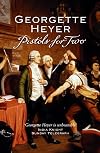
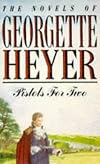
Pistols for Two
by Georgette Heyer
On This Page
Description
Intrigue, elegance, and glittering romance... In eleven charming short stories, the Queen of Regency romance presents an exquisite romp through affairs of honor and affairs of the heart. Featuring rakes and rascals, orphans and heirs, beauties and their beaus, the legendary Georgette Heyer's signature wit and inimitable style bring the Regency world dazzlingly alive.Tags
Recommendations
















Member Reviews
Georgette Heyer's only collection of short stories, Pistols for Two offers eleven charming tales, each a little bon-bon that both satisfies and tantalizes. Compact and self-contained, each of these stories will involve and entertain the reader, before bringing matters to a satisfactory conclusion. The delights contains herein include:
Pistols for Two, in which lifelong friends Tom and Jack find themselves confronting one another across a dueling field, fighting for the right to court a woman whom neither of them really loves. Heyer's delicate but pointed sense of humor is in full force here...
A Clandestine Affair, in which Lord Iver and Miss Elinor Tresilian, two bitterly estranged lovers, find themselves reconciled while trying to show more prevent the elopement of their respective wards. This was a very satisfying tale of love lost and found...
Bath Miss, in which Sir Charles Wainfleet finds himself in charge of the mischievous Miss Massingham, when he agrees to do a favor for his mother's friend. The chance meeting with Wainfleet's fiancée may have felt somewhat improbable, but the heroine of the piece was delightful!
Pink Domino, in which Mr Wrexham of Lyonshall finds the woman of his dreams at a masquerade ball, while trying to protect his younger sister from a fortune-hunter. I was surprised that Heyer used the "love at first sight" trope, as she usually avoids it, but its inclusion here did not seem inappropriate.
A Husband For Fanny, in which the widowed Mrs Wingham mistakes the intentions of the Marquis of Harleston, and almost loses her only chance at love. One of Heyer's rare romances involving an "older" woman...
To Have The Honor, in which Lord Allerton comes home from war to discover that his estates are badly mortgaged, and that he is expected to marry his wealthy cousin. A tale of two young people who love one another, but won't tell each other...
Night At The Inn, in which two young people find themselves staying at the same sinister inn one foggy night. Far more gruesome than the other stories in the collection, this was more of a mystery-thriller than a romance...
The Duel, in which the impetuous Miss Dorothea Saltford finds her way to the home of Lord Rothersfield late one night, in order to beg him to spare her brother's life in an upcoming duel. Sheer improbable fun!
Hazard, in which Miss Helen Morland is won in a game of cards by the Marquis of Carlington. I have never been fond of this plot device, and this was the sole story in the collection that I didn't love...
Snow Drift, in which Miss Sophy Trent enlists the aid of that bored man of fashion, Sir Julian Arden, in reaching Bath in time to "win" a fortune. Another road-trip adventure par excellence!
And finally, Full Moon, in which Lord Stavely unexpectedly finds himself assuring Miss Annabella Abingdon that she does not have to elope with her best friend in order to escape him... show less
Pistols for Two, in which lifelong friends Tom and Jack find themselves confronting one another across a dueling field, fighting for the right to court a woman whom neither of them really loves. Heyer's delicate but pointed sense of humor is in full force here...
A Clandestine Affair, in which Lord Iver and Miss Elinor Tresilian, two bitterly estranged lovers, find themselves reconciled while trying to show more prevent the elopement of their respective wards. This was a very satisfying tale of love lost and found...
Bath Miss, in which Sir Charles Wainfleet finds himself in charge of the mischievous Miss Massingham, when he agrees to do a favor for his mother's friend. The chance meeting with Wainfleet's fiancée may have felt somewhat improbable, but the heroine of the piece was delightful!
Pink Domino, in which Mr Wrexham of Lyonshall finds the woman of his dreams at a masquerade ball, while trying to protect his younger sister from a fortune-hunter. I was surprised that Heyer used the "love at first sight" trope, as she usually avoids it, but its inclusion here did not seem inappropriate.
A Husband For Fanny, in which the widowed Mrs Wingham mistakes the intentions of the Marquis of Harleston, and almost loses her only chance at love. One of Heyer's rare romances involving an "older" woman...
To Have The Honor, in which Lord Allerton comes home from war to discover that his estates are badly mortgaged, and that he is expected to marry his wealthy cousin. A tale of two young people who love one another, but won't tell each other...
Night At The Inn, in which two young people find themselves staying at the same sinister inn one foggy night. Far more gruesome than the other stories in the collection, this was more of a mystery-thriller than a romance...
The Duel, in which the impetuous Miss Dorothea Saltford finds her way to the home of Lord Rothersfield late one night, in order to beg him to spare her brother's life in an upcoming duel. Sheer improbable fun!
Hazard, in which Miss Helen Morland is won in a game of cards by the Marquis of Carlington. I have never been fond of this plot device, and this was the sole story in the collection that I didn't love...
Snow Drift, in which Miss Sophy Trent enlists the aid of that bored man of fashion, Sir Julian Arden, in reaching Bath in time to "win" a fortune. Another road-trip adventure par excellence!
And finally, Full Moon, in which Lord Stavely unexpectedly finds himself assuring Miss Annabella Abingdon that she does not have to elope with her best friend in order to escape him... show less
This collection of short stories is typical Heyer – it’s funny, sweet, romantic, and full of Regency goodness. Since the stories aren’t connected to each other, there’s no easy way to summarize the book as a whole – so I’ll just summarize some of my favorites! In “A Clandestine Affair,” an old maid (in her early 30s) worries about her niece’s romantic entanglement with an unsuitable man, but is completely unprepared to encounter her own long-lost love. In “To Have the Honour,” a young soldier returns from the Napoleonic Wars to find his estate grossly in debt, and his family urges him to marry his childhood friend, who is now a beautiful heiress. And in my personal favorite, “Hazard,” a brooding marquis wins show more the sister of one of his drinking buddies in a card game. The only story I didn’t particularly enjoy was “Night at the Inn,” which was actually rather creepy and gruesome – not something one looks for in Heyer! One of these things is not like the others…. Other than that, though, romance fans will enjoy Pistols for Two – I only wish Heyer had expanded all these stories, which were far too short, into novels! show less
Pistols for Two by Georgette Heyer is a collection of 11 short stories with the addition of excerpts from her novels Sylvester and Venetia to flesh it out. With this author I knew what to expect and was not disappointed with these light and entertaining tales.
Of course I was more engaged with some of the stories than others but overall this is a good sampling of Heyer’s writing techniques and themes. There were a couple of stories that I wished she had extended into full length novels, “Hazard” being chief among them. While I am fond of romance, I did find that I had to suspend my belief at how quickly romance bloomed between many of these couples. Often they met, fell in love and were making plans for the rest of their lives show more within a couple of pages. The most surprising of the stories was the melodramatic entry entitled “Night at the Inn” as it had quite a different feel and tone from the author’s usual fare.
The words charming and delightful are often used to describe Georgette Heyer’s writing and, once again, could very well be used to describe this collection. I would suggest however that this compilation not be used as an introduction to this author as her longer works show her style to their best advantage. show less
Of course I was more engaged with some of the stories than others but overall this is a good sampling of Heyer’s writing techniques and themes. There were a couple of stories that I wished she had extended into full length novels, “Hazard” being chief among them. While I am fond of romance, I did find that I had to suspend my belief at how quickly romance bloomed between many of these couples. Often they met, fell in love and were making plans for the rest of their lives show more within a couple of pages. The most surprising of the stories was the melodramatic entry entitled “Night at the Inn” as it had quite a different feel and tone from the author’s usual fare.
The words charming and delightful are often used to describe Georgette Heyer’s writing and, once again, could very well be used to describe this collection. I would suggest however that this compilation not be used as an introduction to this author as her longer works show her style to their best advantage. show less
Heyer’s only collection, until a recent one was cobbled together from this and some uncollected pieces, which is not much of a surprise as her only published stories were contemporary, and the contents of Pistols for Two appeared nowhere else. They are… condensed versions of Heyer’s Regency novels. Mostly.
Pretty much every story is a young woman, either nineteen or twenty, who finds herself in a situation with a man - of the Quality, of course - a dozen or so years older, and so comes to love him or realise she has always loved him, and they agree to marry. In some cases, Heyer holds back on the history of the characters in order to male the romance more, well, cute. The two guardians who refuse to allow their wards to marry show more because they were once engaged and it all went wrong but they’ve carried a torch for each other ever since. The young woman who prevails on an unknown lord to prevent the duel between her brother and a known rake, only to discover the unknown lord is the rake and he’s fallen for her.
The only one that breaks the mould is the young cit gentleman who puts up at a country inn on his way home from working in Portugal, and finds himself the intended victim of murderous thieves. Fortunately, one of his fellow guests is a Bow Street Runner on the hunt for the thieves.
Short stories by definition allow less room for character development, and Heyer did tend to rely on a series of stock characters. So it’s hardly a surprise the stories in Pistols for Two feature those self-same stock characters, and the plots read mostly like incidents from a novel-length work.
On the other hand, it’s Heyer and these stories are typical of her work. If you like Heyer, you’ll like these. If you like these, you’ll like Heyer’s other works. show less
Pretty much every story is a young woman, either nineteen or twenty, who finds herself in a situation with a man - of the Quality, of course - a dozen or so years older, and so comes to love him or realise she has always loved him, and they agree to marry. In some cases, Heyer holds back on the history of the characters in order to male the romance more, well, cute. The two guardians who refuse to allow their wards to marry show more because they were once engaged and it all went wrong but they’ve carried a torch for each other ever since. The young woman who prevails on an unknown lord to prevent the duel between her brother and a known rake, only to discover the unknown lord is the rake and he’s fallen for her.
The only one that breaks the mould is the young cit gentleman who puts up at a country inn on his way home from working in Portugal, and finds himself the intended victim of murderous thieves. Fortunately, one of his fellow guests is a Bow Street Runner on the hunt for the thieves.
Short stories by definition allow less room for character development, and Heyer did tend to rely on a series of stock characters. So it’s hardly a surprise the stories in Pistols for Two feature those self-same stock characters, and the plots read mostly like incidents from a novel-length work.
On the other hand, it’s Heyer and these stories are typical of her work. If you like Heyer, you’ll like these. If you like these, you’ll like Heyer’s other works. show less
This is a fun set of short stories. You get the essence of a Heyer story in a bit sized chunk. These usually play out through just a few scenes and you can see the way that they for the key element of the novels. The downside is that they are fairly much of a muchness and reading them in this format brings that home.
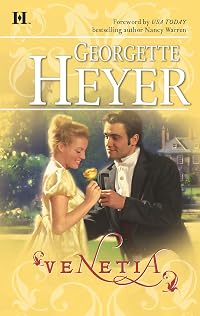
Fun - a set of short stories which are...pretty much Heyer novels condensed. At least one actually turned into a novel - I remember the miser, though I don't remember which book it was (and the circumstances certainly changed, in the novel). I think I enjoyed them even more than her novels - no long scenes of banter, but also no extended misunderstandings. Much the same characters - the sardonic hero, the sensible heroine, the naive heroine, the sensible hero driven out of his sensible ways...at least one "adorable brat", though she was more sheltered and therefore silly rather than the intentionally obnoxious ones Heyer seems to like. Two extracts from other books, both of which I've read - Venetia and Sylvester. Oddly enough, although show more I loved Venetia, the extract didn't make me want to reread - but I do want to reread Sylvester. Fun, worth reading, possibly worth rereading. show less
Short stories were definitely not Heyer's forte—their length doesn't allow her the scope to bring in the secondary characters and humorous set-pieces which are the major part of her charm, and reading so many separate works of hers so close together does nothing but enforce the repetitive nature of her plots and her stock characters. The only story which I thought at all out of the ordinary for her was the one in which two middle-aged characters fall in love. Readable I think only if you're a ...more Short stories were definitely not Heyer's forte—their length doesn't allow her the scope to bring in the secondary characters and humorous set-pieces which are the major part of her charm, and reading so many separate works of hers so show more close together does nothing but enforce the repetitive nature of her plots and her stock characters. The only story which I thought at all out of the ordinary for her was the one in which two middle-aged characters fall in love. Readable I think only if you're a big fan of Regencies, or a Heyer completist, or both show less
Members
- Recently Added By
Lists

Short Story Collections and Anthologies
261 works; 42 members
Author Information

125+ Works 78,085 Members
Georgette Heyer was born on August 16, 1902 at Wimbledon, London. She wrote The Black Moth as a story for her brother Boris. Her father, impressed with his daughter's imagination, suggested that she prepare it to be published, which it was by Constable in 1921. Having scored an instant success with The Black Moth at the age of nineteen under her show more own name, Georgette Heyer, she experimented with a pseudonym, Stella Martin, for her third book, published by Mills & Boon. She continued writing and in 1925 she married Ronald Rougier, a mining engineer. After reasonable but not spectacular sales from her first few books the instant success of These Old Shades in 1926 brought her a solid source of income which was very necessary at the time since the family relied to a large extent on the income from Georgette Heyer's writing. She wrote over fifty books during her lifetime and created the Regency England genre of romance novels. She died on July 4, 1974 at the age of 71. (Bowker Author Biography) show less
Series
Belongs to Publisher Series
Work Relationships
Is contained in
Contains
Common Knowledge
- Original publication date
- 1960
- First words
- In the end, the quarrel, smouldering for so many weeks, flared up over such a trifle that anyone, Tom reflected, would have laughed to have known the cause. (Pistols for Two)
- Last words
- (Click to show. Warning: May contain spoilers.)"Moon madness!" laughed Miss Abingdon. "Just like Lord Stavely! POOR Papa!" (Full Moon)
- Original language
- English
Classifications
Statistics
- Members
- 858
- Popularity
- 31,814
- Reviews
- 33
- Rating
- (3.61)
- Languages
- English, German
- Media
- Paper, Ebook
- ISBNs
- 22
- UPCs
- 1
- ASINs
- 20