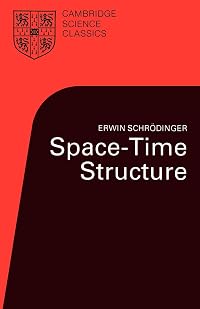
Space-Time Structure (Cambridge Science Classics)
by Erwin Schrödinger
On This Page
Description
In response to repeated requests this classic book on space-time structure by Professor Erwin Schro?dinger is now available in the Cambridge Science Classics series. First published in 1950, and reprinted in 1954 and 1960, this lucid and profound exposition of Einstein's 1915 theory of gravitation still provides valuable reading for students and research workers in the field.Tags
Recommendations








Member Reviews
This book defines Einstein's Theories on Gravitation in a mathematical manner, using partial differentiation and multiple integrals and matrices and other advanced things. It describes scalar densities and tensor densities, defining what they are and showing the symbols used to show it.
I didn't really understand this book, since I can't explain it well, but I did like it. I need to find a book or something that will teach me partial derivatives and stuff. Maybe then I can follow it.
I didn't really understand this book, since I can't explain it well, but I did like it. I need to find a book or something that will teach me partial derivatives and stuff. Maybe then I can follow it.
Ratings
Members
- Recently Added By
Author Information

68+ Works 2,331 Members
Born and educated in Vienna, Erwin Schrodinger received his Ph.D. in 1910 from the University of Vienna. He developed the theory of wave mechanics (1925--26). For this theory, which furnished a solid mathematical explanation of quantum theory, Schrodinger shared the Nobel Prize in 1933 with Paul Dirac. Schrodinger was dissatisfied with Niels show more Bohr's early quantum theory of the atom, objecting to the many arbitrary quantum rules imposed. Building on Louis-Victor De Broglie's idea that a moving atomic particle has a wave character, Schrodinger developed a famous wave equation that describes the behavior of an electron orbiting the nucleus of an atom. When applied to the hydrogen atom, the equation yielded all the results of Bohr and De Broglie, and was also used as a tool to solve a wide range of new problems in which quantization occurs. In 1927 Schrodinger succeeded Max Planck at the University of Berlin but resigned in 1933 when the Nazis came to power. He left then for England, becoming a guest professor at Oxford University. In 1936 he returned to Austria, but then fled in 1938 under the threat of Nazi arrest and was invited to Dublin's newly established Institute for Advanced Studies. He remained there from 1940 until his retirement in 1956, when he returned to his native Austria and to the University of Vienna, where he held his last chair in theoretical physics. In 1944 Schrodinger published What Is Life? The Physical Aspects of a Living Cell, a book that had a tremendous impact on a new generation of scientists. The book directed young physicists who were disillusioned by the Hiroshima bombing to an unexplored discipline free of military applications---molecular biology. Schrodinger proposed the existence of a molecular code as the genetic basis of life, inspiring an entire generation to explore this idea. (Bowker Author Biography) show less
Classifications
Statistics
- Members
- 56
- Popularity
- 549,025
- Reviews
- 1
- Rating
- (4.00)
- Languages
- English, Spanish
- Media
- Paper, Ebook
- ISBNs
- 6
- ASINs
- 4