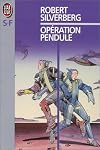
Project Pendulum
by Robert Silverberg
On This Page
Description
Twins become involved in an experiment in time travel.Tags
Recommendations

















Member Reviews
Ol' Silverberg has finally disappointed me, but I suppose we all have our off days. Project Pendulum came much later in his career after his hiatus and subsequent return, though at the time he was mostly writing fantasy novels. I can't even really call this a novel though, because as it is Project Pendulum is a simple one-dimensional skeleton of what could've been something much better.
The novum is a time travel device that takes two perfectly equal humans (twins in this case) and swings them both forward and back in time on "logarithmically increasing intervals, each one ten times as wide as the one before". One twin will exist 5 minutes in the future, the other 5 minutes in the past, followed by them switching places and now 50 show more minutes distant from the starting time. This goes on and on until one twin is in the cretaceous period, and the other in an incomprehensible future.
As far as time travel devices goes I really enjoyed this one. I can can see the implications of this being explored in an exciting way, despite the glaring logical issues that Silverberg ignores here. The problem is... this is all we get. The twins go off on their shared but separate adventure, popping in to different settings for mere moments, only to be whisked on unceremoniously. There are, quite literally, no stakes, no character depth, no plot, no texture at all. It's one of those books that comes off unintentionally like YA, which is always a bad place to end up.
Honestly, I have no idea why Silverberg thought this one idea was enough to publish on its own. I didn't hate this like I do most works I rate so lowly, but I just can't give what is essentially a crude initial sketch any more praise than I am. An inferior and minor work from one of the greats. Super skippable. show less
The novum is a time travel device that takes two perfectly equal humans (twins in this case) and swings them both forward and back in time on "logarithmically increasing intervals, each one ten times as wide as the one before". One twin will exist 5 minutes in the future, the other 5 minutes in the past, followed by them switching places and now 50 show more minutes distant from the starting time. This goes on and on until one twin is in the cretaceous period, and the other in an incomprehensible future.
As far as time travel devices goes I really enjoyed this one. I can can see the implications of this being explored in an exciting way, despite the glaring logical issues that Silverberg ignores here. The problem is... this is all we get. The twins go off on their shared but separate adventure, popping in to different settings for mere moments, only to be whisked on unceremoniously. There are, quite literally, no stakes, no character depth, no plot, no texture at all. It's one of those books that comes off unintentionally like YA, which is always a bad place to end up.
Honestly, I have no idea why Silverberg thought this one idea was enough to publish on its own. I didn't hate this like I do most works I rate so lowly, but I just can't give what is essentially a crude initial sketch any more praise than I am. An inferior and minor work from one of the greats. Super skippable. show less
For mankind's very first time travel experiment, the identical twins Eric (a paleontologist) and Sean (a physicist) are sent on a sort of oscillating path through time, spending short periods in eras that are each exponentially farther into the future or past than the last; thus, when Eric is at a point 5 x 10⁷ minutes into the future, Sean is at a point 5 x 10⁷ minutes into the past; next, Sean will be 5 x 10⁸ minutes into the past and Eric 5 x 10⁸ minutes into the future; and so on. Why this bananas need for temporal symmetry? It's never properly explained, but there's a stab at it:
Sean had brought home a pile of theoretical papers about it. Explaining how the phase-linkage coupling of a minute black hole, identical to those that show more are found all over interstellar space, and its mathematical opposite, a "white hole," created an incredibly powerful force that ripped right through the fabric of space-time -- and how that force could be contained and controlled, like a bomb in a basket, so that it could be used as a transit tube for making two-way movements in time. (p136)
Children, do not use phrases like "phase-linkage coupling of a minute black hole" when the teacher's around. It will only cause misunderstanding and get you into trouble.
But there are other dumbnesses in what it pains me to say is a pretty dumb book. The reason identical twins have been chosen for the experiment is that the two "packages" involved must be of exactly the same mass, right down to the milligram, to maintain the symmetry; otherwise everything will go bang. The very obvious fact seems to have occurred to Silverberg, after setting this up, that it's just as difficult to get the weights of adult identical twins exactly the same as it would be for any other two adults, and there's a certain amount of panicky fudging over the issue. It's lucky one of them didn't have to take a pee during their temporal adventure -- very lucky indeed, as arch-boffin experimenter Dr Ludwig explains in that typically dispassionate way scientists have:
He looked ready to explode. "The past is fluid! The future is yet unborn! Anything can be changed! Anything! Who knows what will befall the entire history of the world, if anything happens to you? Who knows?" (p159)
So don't so much as sneeze, d'you hear, or you'll change your body mass and screw up the symmetry and everything will go kerfluie and then you'll be sorry. Even a fart could be risky.
Another thing that irritated me was that, as the twins go on bigger and bigger hops through time, their arrival points move laterally across the face of the planet, yet they always emerge standing on solid ground -- even if that solid ground is at the bottom of a mesa or in a subterranean maze of tunnels. What stops them from emerging into a new epoch in midair? Or in the middle of the ocean? It's obviously a logical dilemma faced by many other time travel novels, and most of the time we don't think about it; but here, because of the unexplained (and in plot terms surely unnecessary) geographical slippage in the twins' arrival sites, it becomes particularly glaring.
And Eric meets aliens. They are a particularly daring imaginative creation:
They were cone-shaped beings eight or nine feet high, with brilliant orange eyes the size of platters and rubbery blue bodies. Clusters of scarlet tentacles dangled like nests of snakes from their shoulders. They walked in an odd gliding, lurching way on suction pads that make a peculiar slurping sound as they clamped down and pulled free again. (pp195-6)
It's difficult not to find oneself musing that, if the employment situation becomes grim in the aliens biz, this lot could always get jobs with The Muppet Show.
Silverberg has always been one of science fiction's more intelligent practitioners. It's difficult to conceive why he should be writing such stuff. Maybe it was a flat-fee commission and his heart wasn't in it. Or something. show less
I've enjoyed many of Silverberg's works, but this short book is more of a single idea than a finished story. In a CalTech time travel experiment, twin brothers are recruited for a time-travel experiment. Equally 'weighted' by their identicality, the time-travel gadget will send them swinging through time like pendulums, in an ever-increasing arc throughout history, each stopping briefly but separately at the same spots.
OK, it's not even much of an idea (the logical holes are obvious, as with most time-travel fiction.)
But there's no story. They do the experiment, it happens.
That's it. No plot, no tension, not even much character generation. No disasters occur, no revelations about the past or future are gleaned. So why read this book?
OK, it's not even much of an idea (the logical holes are obvious, as with most time-travel fiction.)
But there's no story. They do the experiment, it happens.
That's it. No plot, no tension, not even much character generation. No disasters occur, no revelations about the past or future are gleaned. So why read this book?
An example of science fiction that has not aged well. Set in 2016 2 brothers are sent on a time travel experiment that involves them oscillating back and forth through times. For the most part they do not stay long enough to do more than a quick look around and even when they do there is not any development if the story. They look and they leave. Boring.
Ratings
Members
- Recently Added By
Author Information

987+ Works 62,533 Members
Work Relationships
Is contained in
Common Knowledge
- Original publication date
- 1987
- Important places
- Pasadena, California, USA
- Dedication
- For Jim and Greg Benford
- First words
- Displacement hit him like a punch in the gut.
- Last words
- (Click to show. Warning: May contain spoilers.)Enough to last them for the rest of their lives.
- Publisher's editor
- Harris, David M.
Classifications
- Genres
- Science Fiction, Fiction and Literature
- DDC/MDS
- 973.917 — History & geography History of North America United States 1901- World Wars and Depression Era (1901-1953) Franklin Delano Roosevelt (1933-1937) New Deal, Social Security Act
- LCC
- PZ7 .S5858 .P — Language and Literature Fiction and juvenile belles lettres Fiction and juvenile belles lettres Juvenile belles lettres
Statistics
- Members
- 218
- Popularity
- 150,124
- Reviews
- 4
- Rating
- (2.85)
- Languages
- English, French, Polish
- Media
- Paper, Ebook
- ISBNs
- 7
- UPCs
- 1
- ASINs
- 2