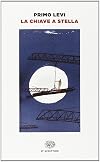
The Monkey's Wrench
by Primo Levi
On This Page
Description
This is not a book for journalists. Civil servants, too, will feel uneasy while reading it, and as for lawyers, they will never sleep again. For it is about a man in his capacity as homo faber, a maker of things with his hands, and what has any of us ever made but words. I say it is 'about' the man who makes; truly, it is more a hymn of praise than a description, and not only because the toiler who is the hero of the book is a hero indeed - a figure, in his humanity, simplicity, worthy of show more inclusion in the catalogue of mythical giants alongside Hercules, Atlas, Gargantua and Orion. He is Faussone, a rigger' Bernard Levin, THE TIMES show lessTags
Recommendations












Member Reviews
I bought this after hearing potter Edmund de Waal talk about how The Wrench had inspired and validated his choice of a career where he makes things with his hands (http://www.bbc.co.uk/programmes/b00zdh3v). It's structured simply, as a series of stories told by a rigger to a chemist as share 'dead time' on their respective assignments in 1970s Russia. The stories are about work building cranes, derricks, bridges and similar structures in various corners of the world. The trials of working with inhospitable clients, climates and co-workers, plus the conflicts of taking pride in work without copping the blame when things go wrong. Without being able to put my finger on the attractions of these stories, I devoured them (I was supposed to show more be reading and reviewing another book at the time). That they made me think of my father's early career as a civil engineer may have had something to do with it. show less
"I really believe that to live happily you have to have something to do, but it shouldn't be too easy, or else something to wish for, but not just any old wish: something there's hope of achieving."
Primo Levi's The Monkey's Wrench is a bundle of words, concise and passionate, light-hearted enough to arouse an emotional disconnect from its characters. It tells a series of conversations between two people who acquaint each other, in a number of encounters, through sharing of stories about their job; one a rigger, the other a chemist. In these conversations about accidents, experiences, and arguments that happened in their job Levi reminds the importance of loving your bread and butter at the end of the day amidst the hiccups and loose show more definition the hard work; hard work does not necessarily results to a job well done. Each but not most has a lesson to give.
The Monkey's Wrench is a silently profound tribute to work, an ode perhaps — the joy it brings as part of a life ordinarily yet satisfyingly lived. show less
Primo Levi's The Monkey's Wrench is a bundle of words, concise and passionate, light-hearted enough to arouse an emotional disconnect from its characters. It tells a series of conversations between two people who acquaint each other, in a number of encounters, through sharing of stories about their job; one a rigger, the other a chemist. In these conversations about accidents, experiences, and arguments that happened in their job Levi reminds the importance of loving your bread and butter at the end of the day amidst the hiccups and loose show more definition the hard work; hard work does not necessarily results to a job well done. Each but not most has a lesson to give.
The Monkey's Wrench is a silently profound tribute to work, an ode perhaps — the joy it brings as part of a life ordinarily yet satisfyingly lived. show less
Short, work-place vignettes that read together could form an homage to labor, work, if one chooses to read them that way. Levi, the chemist, and a fellow Italian rigger swap tales. Mostly we hear the rigger, working abroad on one massive project after the other.
Sur un chantier isolé de basse Volga, deux hommes se rencontrent, se lient d'amitié et parlent. L'un est constructeur de charpentes métalliques, c'est Faussone, un bourlingueur un peu foutraque, l'autre est chimiste, c'est Primo Levi, qui se fait le narrateur de ce tête-à-tête inattendu. Tout y passe : le métier, la famille, les amis, les femmes. C'est drôle et désabusé tout à la fois, et, sur un mode moins tragique que celui qui caractérise Si c'est un homme, Maintenant ou jamais et Les Naufragés et les Rescapés. Une grande leçon de vie par l'un des témoins capitaux de l'horreur au XXe siècle.
Stories told to an unnamed narrator by a rigger while they are both stuck working in the Soviet Union. They didn't really grip me. The narrator's story of how he found out what was wrong with the anchovy can enamel (the last story in the book) was actually the most interesting. Machinery just doesn't interest me all that much, but then nor does chemistry yet the chemist's story had a puzzle I could empathise with and feel good when the solution came. Most of the rigger's stories I just felt 'so what?' at the end.
These are stories of the life of work, whether as an itinerant rigger or as a synthetic chemist; they are tales of the consuming force of construction, told by and to a pair of men, and the stories are sometimes set against a hypothetical counter-force of (often destructive) women, as if women's conundrums of building related only to relationships, to the web of knitting they are often seen doing rather than to the towers and bridges constructed by men.
Così così. Struttura rigida e ripetitiva (ogni capitolo un racconto), caratterizzazione del personaggio Faussone un po' troppo piatta ed eccessiva, mancanza di vere riflessioni sul cambiamento del lavoro in quegli anni. Nell'insieme, piuttosto freddo.
Members
- Recently Added By
Lists

Italian Literature
556 works; 41 members

Book Riot's 100 must-read works of Jewish Fiction
100 works; 8 members

el
1,139 works; 1 member
Author Information

167+ Works 25,338 Members
Primo Levi was born on July 31, 1919 in Turin, Italy. He pursued a career in chemistry, and spent the early years World War II as a research chemist in Milan. Upon the German invasion of northern Italy, Levi, an Italian Jew, joined an anti-fascist group and was captured and sent to the Auschwitz concentration camp in Poland. He was able to survive show more the camp, due in part to his value to the Nazis as a chemist. After the war ended, Levi did chemistry work in a Turin paint factory while beginning his writing career. His first book, If This Is a Man (title later was changed to Survival in Auschwitz) was published in 1947 and its sequel, The Truce (later retitled The Reawakening) came out in 1958. These two books recount Levi's story of surviving concentration camp life. Levi also published poetry, short stories, and novels, some under the pen name Damianos Malabaila. His 1985, largely autobiographical work, The Periodic Table, cemented his world fame. Awards in tribute to his writing included the Kenneth B. Smilen fiction award, presented by the Jewish Museum in New York. Ironically, despite his surviving Auschwitz, Primo Levi appears to have died by suicide, in Turin on April 11, 1987. (Bowker Author Biography) show less
Some Editions
Awards and Honors
Awards
Series
Belongs to Publisher Series
Work Relationships
Is contained in
Common Knowledge
- Canonical title
- The Monkey's Wrench
- Original title
- La chiave a stella
- Alternate titles
- The Monkey's Wrench
- Original publication date
- 1978
- People/Characters*
- Libertino Faussone
- Important places
- Piedmont, Italy
- First words*
- Eh no: tutto non le posso dire. O che le dico il paese, o che le racconto il fatto: io però, se fossi in lei, sceglierei il fatto, perché è un bel fatto.
- Last words*
- (Click to show. Warning: May contain spoilers.)«Così lei vuole proprio chiudere bottega? Io, scusi sa, ma al suo posto ci penserei bene. Guardi che fare delle cose che si toccano con le mani è un vantaggio; uno fa i confronti e capisce quanto vale. Sbaglia, si corregge, e la volta dopo non sbaglia più. Ma lei è più anziano di me, e forse nella vita ne ha già viste abbastanza».
- Original language*
- Italiano
- Disambiguation notice
- Original title: La chiave a stella (The Wrench). Published in the US as The Monkey's Wrench.
*Some information comes from Common Knowledge in other languages. Click "Edit" for more information.
Classifications
- Genres
- General Fiction, Fiction and Literature
- DDC/MDS
- 853.914 — Literature & rhetoric Italian, Romanian & related literatures Italian fiction 1900- 20th Century 1945-1999
- LCC
- PQ4872 .E8 .C4813 — Language and Literature French, Italian, Spanish and Portuguese literatures Italian literature Individual authors, 1961-2000
- BISAC
Statistics
- Members
- 994
- Popularity
- 26,264
- Reviews
- 14
- Rating
- (4.08)
- Languages
- 7 — Dutch, English, French, German, Italian, Portuguese, Spanish
- Media
- Paper, Ebook
- ISBNs
- 34
- ASINs
- 9